. 2020 Feb 20:148:70-82.
doi: 10.1016/j.freeradbiomed.2019.12.037. Epub 2019 Dec 26.

Fumarate and oxidative stress synergize to promote stability of C/EBP homologous protein in the adipocyte

Affiliations

Fumarate and oxidative stress synergize to promote stability of C/EBP homologous protein in the adipocyte

Allison M Manuel et al. Free Radic Biol Med. .

Abstract

C/EBP homologous protein (CHOP) is a transcription factor that is elevated in adipose tissue across many models of diabetes and metabolic stress. Although increased CHOP levels are associated with the terminal response to endoplasmic reticulum stress and apoptosis, there is no evidence for CHOP mediated apoptosis in the adipose tissue during diabetes. CHOP protein levels increase in parallel with protein succination, a fumarate derived cysteine modification, in the adipocyte during metabolic stress. We investigated the factors contributing to sustained CHOP proteins levels in the adipocyte, with an emphasis on the regulation of CHOP protein turnover by metabolite-driven modification of Keap1 cysteines. CHOP protein stability was investigated in conditions of nutrient stress due to high glucose or elevated fumarate (fumarase knockdown model); where cysteine succination is specifically elevated. CHOP protein turnover is significantly reduced in models of elevated glucose and fumarate with a ~30% increase in CHOP stability (p > 0.01), in part due to decreased CHOP phosphorylation. Sustained CHOP levels occur in parallel with elevated heme-oxygenase-1, a production of increased Nrf2 transcriptional activity and Keap1 modification. While Keap1 is directly succinated in the presence of excess fumarate derived from genetic knockdown of fumarase (fumarate levels are elevated >20-fold), it is the oxidative modification of Keap1 that predominates in adipocytes matured in high glucose (fumarate increases 4-5 fold). Elevated fumarate indirectly regulates CHOP stability through the induction of oxidative stress. The antioxidant N-acetylcysteine (NAC) reduces fumarate levels, protein succination and CHOP levels in adipocytes matured in high glucose. Elevated CHOP does not contribute elevated apoptosis in adipocytes, but plays a redox-dependent role in decreasing the adipocyte secretion of interleukin-13, an anti-inflammatory chemokine. NAC treatment restores adipocyte IL-13 secretion, confirming the redox-dependent regulation of a potent anti-inflammatory eotaxin. This study demonstrates that physiological increases in the metabolite fumarate during high glucose exposure contributes to the presence of oxidative stress and sustained CHOP levels in the adipocyte during diabetes. The results reveal a novel metabolic link between mitochondrial metabolic stress and reduced anti-inflammatory adipocyte signaling as a consequence of reduced CHOP protein turnover.

Keywords: Adipocytes; Adipose; ER stress; Glucotoxicity; Metabolism; Oxidative stress; Protein modification.


Figures

Figure 1:
Figure 1:. CHOP turnover decreases during metabolic stress in the adipocyte
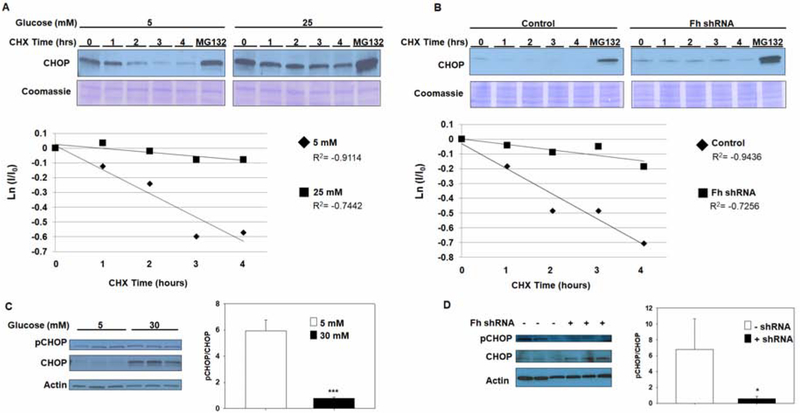
(A) 3T3-L1 adipocytes were matured in 5 mM or 25 mM glucose or (B) transduced with either scrambled control or fumarase (Fh) knockdown shRNA (FHKD), and matured in 5 mM glucose for 8 days. Protein synthesis was inhibited with 3.5 μg/mL cycloheximide (CHX) and the adipocytes in each group were harvested at the indicated times (hrs) after addition of CHX. CHOP protein levels over time are shown by immunoblotting with anti-CHOP antibody and Coomassie blue staining represents equal protein loading. The graphs display the natural logarithm of the relative levels of CHOP as a function of CHX chase time. n=3/group for all treatments, p<0.01 at 4 hours. (C) The levels of phosphorylated CHOP (pSer30) were compared to total levels of CHOP in adipocytes during normal and high glucose exposure, or (D) upon shRNA knockdown of Fh. pCHOP levels were normalized to total CHOP protein levels. Despite the pronounced increase in CHOP levels, the level of CHOP phosphorylation is not increased when glucose or fumarate are elevated. Representative experiments are shown with n=3 per group for immunoblots.
Figure 2:
Figure 2:. Keap1 cysteine modification increases CHOP stability and HOX1 protein levels
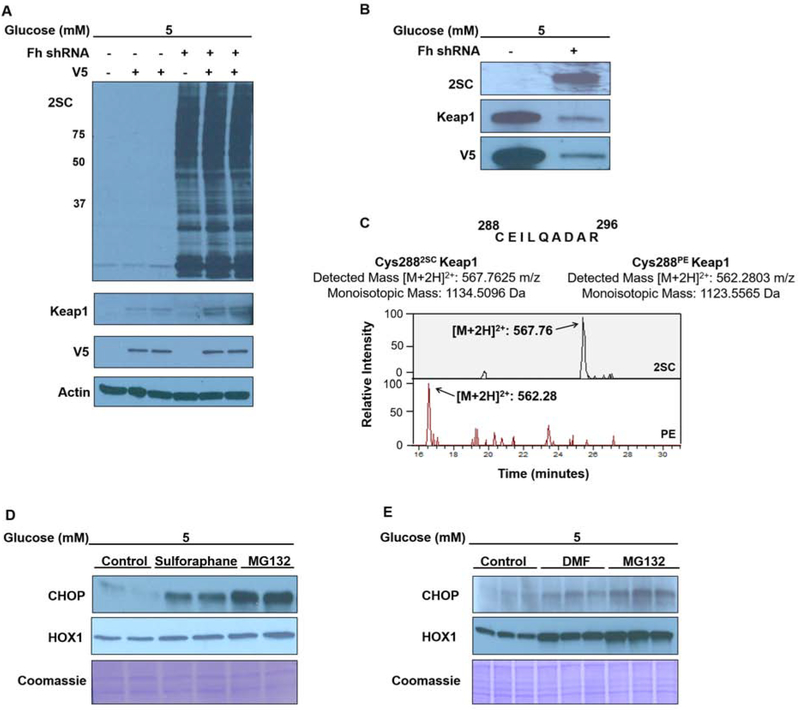
(A) Control and fumarase knockdown (FHKD) adipocytes were transduced with the Keap1-V5 tagged or empty control lentivirus. Immunoblotting with anti-2SC confirms increased protein succination in adipocytes following shRNA knockdown of Fh (FHKD) versus the scrambled control. The overexpression of Keap1 protein was confirmed Keap1 and V5 antibodies. (B) Keap1 was immunoprecipitated with anti-V5 agarose beads from up to 800 μg of protein from control or FHKD adipocytes, respectively. Immunoblotting for 2SC confirms intense Keap1 succination, despite less total Keap1 immunoprecipitated from the FHKD lysates (Keap1/V5 panels). (C) Mass spectrum showing the regulatory Cys288 of Keap1 is modified by fumarate in the FHKD adipocytes (upper spectrum). The pyridyethylated form of this peptide was also detected (lower spectrum). (D-E) Immunoblotting was performed to detect ChOp and heme oxygenase 1 (HOX1) levels in 30 μg protein lysates from adipocytes matured in normal glucose and treated with 40 μM sulforaphane, 300 μM dimethylfumarate (DMF) or 10 μM MG132. Representative immunoblot from samples prepared with a minimum of n=3 per group. Coomassie blue staining indicates equal protein loading.
Figure 3:
Figure 3:. Fumarate augments oxidative stress to modify Keap1 and stabilize CHOP
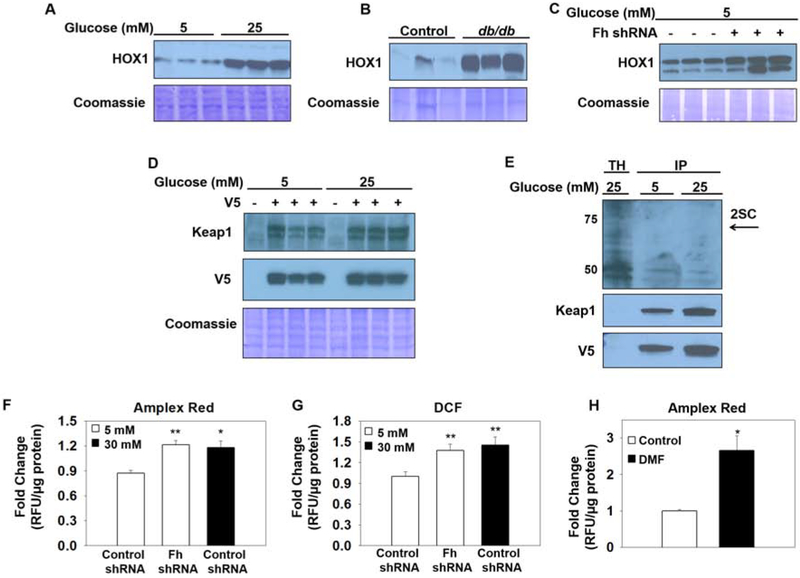
(A-C) Protein from mature 3T3-L1 adipocytes, control or db/db epididymal adipose tissue and control or FHKD adipocytes was immunoblotted and probed to detect heme oxygenase 1 (HOX1) protein levels. (D) Immunoblotting with anti-Keap1 and -V5 antibodies validates the successful transduction of the scrambled control or Keap1-V5 tagged lentivirus in adipocytes matured in 5 mM or 25 mM glucose. (E) Protein (600 μg) from adipocytes matured in 5 mM or 25 mM glucose was immunoprecipitated with anti-V5 agarose beads. The eluted protein was immunoblotted to detect succination (2SC) in the the total homogenate (TH) and immunoprecipitate (IP), followed by re-probing with anti-Keap1 and -V5 antibodies. Arrow indicates anticipated position of succinated Keap1 (F-G) Measurement of reactive oxygen species was performed using both Amplex Red and DCF detection methods. Control or FHKD adipocytes were cultured in 5 or 30 mM glucose, or (H) 5 mM glucose and treated with 200 pM DMF (representative experiments shown with minimum n=3/group, mean +/− SEM, *p< 0.05, **p<0.001).
Figure 4:
Figure 4:. N-acetylcysteine reduces fumarate, protein succination and ROS
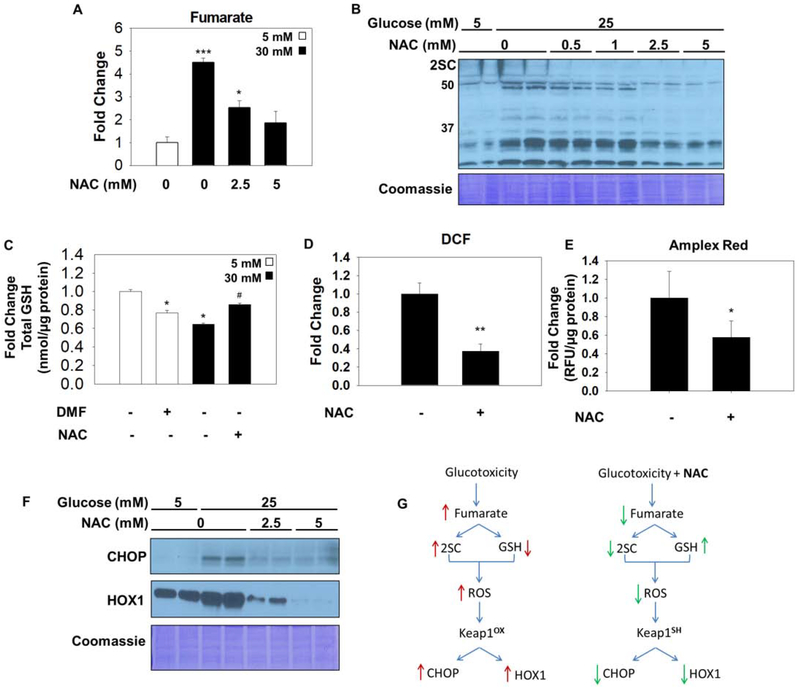
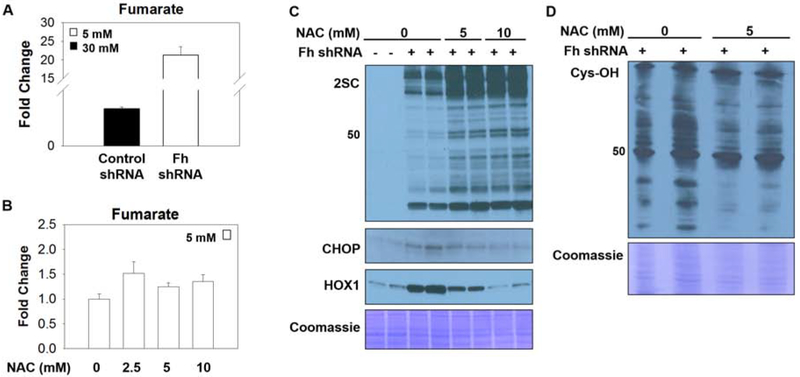
(A) Metabolites were extracted from adipocytes matured in 5 or 25 mM glucose, or 25 mM glucose treated with 5 mM NAC for 3 days. Fumarate levels are significantly increased with glucotoxicity and return to normal with NAC treatment. Data is normalized to total protein content (μg) (n=3/group, mean +/− SEM, *p< 0.05, ***p<0.001 vs. 5 mM glucose, ##p<0.01 vs. 30 mM glucose). (B) 30 μg of protein from adipocytes cultured in 5 or 25 mM glucose and treated with 0, 0.5, 1, 2.5 or 5 mM N-acetylcysteine (NAC) for 8 days was immunoblotted to detect 2SC levels. (C) (D) Adipocytes were treated with 100 μM dimethyl fumarate (DMF) for 24 hours, or 5 mM NAC for 8 days. Total glutathione levels were quantified (n=3/group, mean +/− SEM, *p< 0.05 vs. 5 mM glucose, #p<0.05 vs. 30 mM glucose). Reactive oxygen species was measured using dichlorofluorescein in adipocytes matured in 30 mM glucose with or without 1 mM NAC for 8 hours (n=4/group, mean +/− SEM, **p<0.01). (E) CHOP and HOX1 levels were measured in adipocytes treated with 2.5 or 5 mM NAC for 8 days. Coomassie staining represents equal protein loading. (F) Schematic summarizing beneficial effect of N-acetylcysteine during glucotoxicity. Elevated glucose increases fumarate levels resulting in protein succination, reduced glutathione (GSH) concentrations, and exacerbates the levels of reactive oxygen species (ROS) that react with redox-sensitive cysteines on Keap1. Oxidized Keap1 is unable unable to form the CSN supercomplex or to sequester Nrf2, resulting in the accumulation of CHOP and increased production HOX1. During high glucose stress N-acetylcysteine (NAC) decreases fumarate concentrations and protein succination and rescues the concentration of GSH in the adipocyte resulting in decreased ROS levels. In the absence of oxidative stress Keap1 is able to promote CHOP degradation and down regulate HOX1 production by sequestering Nrf2 in the cytosol.
Figure 5:
Figure 5:. Protein oxidation regulates CHOP stability
(A) Fumarate levels were measured by GC-MS/MS following metabolite extraction from adipocytes matured 30 mM glucose or FHKD adipocytes in 5 mM glucose or (B) FHKD adipocytes cultured in 5 mM glucose and treated with 0, 2.5, 5 or 10 mM NAC for 3 days. Fumarate levels are normalized to total protein content of the samples. (C) Levels of 2SC, CHOP and HOX-1 were measured in control of FHKD adipocytes treated with 5 or 10 mM N-acetylcysteine (NAC) (D) Dimedone based detection of cysteine sulfenic acids was performed in lysates from FHKD adipocytes following treatment with NAC. Representative immunoblots shown, Coomassie indicates protein loading.
Figure 6:
Figure 6:. 2SC and CHOP accumulate in the absence of apoptosis
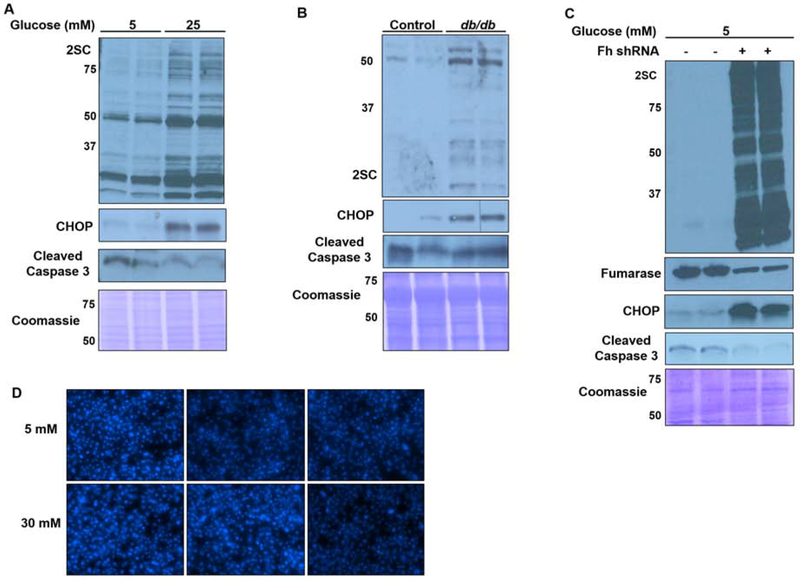
2SC and CHOP increase in parallel in (A) 3T3-L1 adipocytes, (B) 15 week old heterozygote control or db/db epididymal adipose tissue or (C) control or FHKD adipocytes, without an increase in the levels of cleaved caspase 3. Equal protein loading was confirmed by Coomassie. (D) Triplicate DAPI staining of nuclear content 5 mM or 30 mM glucose adipocytes matured for 8 days confirms no significant cell loss or evidence of apoptosis.
Figure 7:
Figure 7:. Accumulation of nuclear CHOP is associated with impaired IL-13 secretion by adipocytes
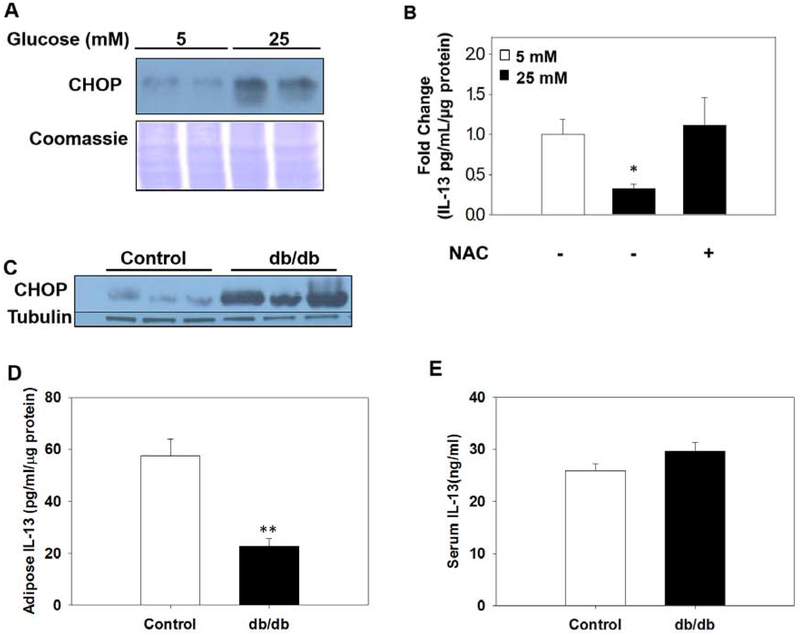
(A) The nuclear fraction from adipocytes cultured in 5 or 25 mM glucose demonstrates elevated nuclear CHOP levels during glucotoxicity. (B) Serum free conditioned medium was collected from adipocytes matured in normal or high glucose +/− 5 mM NAC and IL-13 levels were quantified (n=3/group, mean +/− SEM, *p< 0.05). (C) Confirmation of elevated CHOP protein levels in adipose tissue of 15 week old db/db (n=3 representative), in which IL-13 was quantified in (D) adipose tissue, p=0.004** and (E) serum, n=5 controls, n=6 db/db mice per group for the IL-13 quantification, normalized to protein levels.

References

    1. Ubeda M, Wang XZ, Zinszner H, Wu I, Habener JF, Ron D. Stress-induced binding of the transcriptional factor CHOP to a novel DNA control element. Molecular and Cellular Biology. 1996;16(4):1479–1489. - PMC - PubMed
    1. Batchvarova N, Wang XZ, Ron D. Inhibition of adipogenesis by the stress-induced protein CHOP (Gadd153). EMBO Journal. 1995;14(19):4654–4661. - PMC - PubMed
    1. Han J, Murthy R, Wood B, Song B, Wang S, Sun B, Malhi H, Kaufman RJ. ER stress signalling through eIF2 and CHOP, but not IRE1, attenuates adipogenesis in mice. Diabetologia. 2013;56():911–924. - PMC - PubMed
    1. Carrière A, Carmona MC, Fernandez Y, Rigoulet M, Wenger RH, Pénicaud L, Casteilla L. Mitochondrial reactive oxygen species control the transcription factor CHOP-10/GADD153 and adipocyte differentiation: a mechanism for hypoxia-dependent effect. Journal of Biological Chemisty;279(39) 40462–40469. - PubMed
    1. Luethy JD, Holbrook NJ. Activation of the gadd153 promoter by genotoxic agents: a rapid and specific response to DNA damage. Cancer Research. 1992;52(1):5–10. - PubMed

Publication types

MeSH terms