Review
. 2019 Dec 29;12(1):141.
doi: 10.1186/s13045-019-0801-y.

Targeting T cell malignancies using CAR-based immunotherapy: challenges and potential solutions

Affiliations
Review

Targeting T cell malignancies using CAR-based immunotherapy: challenges and potential solutions

Lauren C Fleischer et al. J Hematol Oncol. .

Abstract

Chimeric antigen receptor (CAR) T cell therapy has been successful in treating B cell malignancies in clinical trials; however, fewer studies have evaluated CAR T cell therapy for the treatment of T cell malignancies. There are many challenges in translating this therapy for T cell disease, including fratricide, T cell aplasia, and product contamination. To the best of our knowledge, no tumor-specific antigen has been identified with universal expression on cancerous T cells, hindering CAR T cell therapy for these malignancies. Numerous approaches have been assessed to address each of these challenges, such as (i) disrupting target antigen expression on CAR-modified T cells, (ii) targeting antigens with limited expression on T cells, and (iii) using third party donor cells that are either non-alloreactive or have been genome edited at the T cell receptor α constant (TRAC) locus. In this review, we discuss CAR approaches that have been explored both in preclinical and clinical studies targeting T cell antigens, as well as examine other potential strategies that can be used to successfully translate this therapy for T cell disease.

Keywords: CAR; Immunotherapy; T cell lymphoma; T-ALL.


Conflict of interest statement

The authors declare that they have no competing interests.

Figures
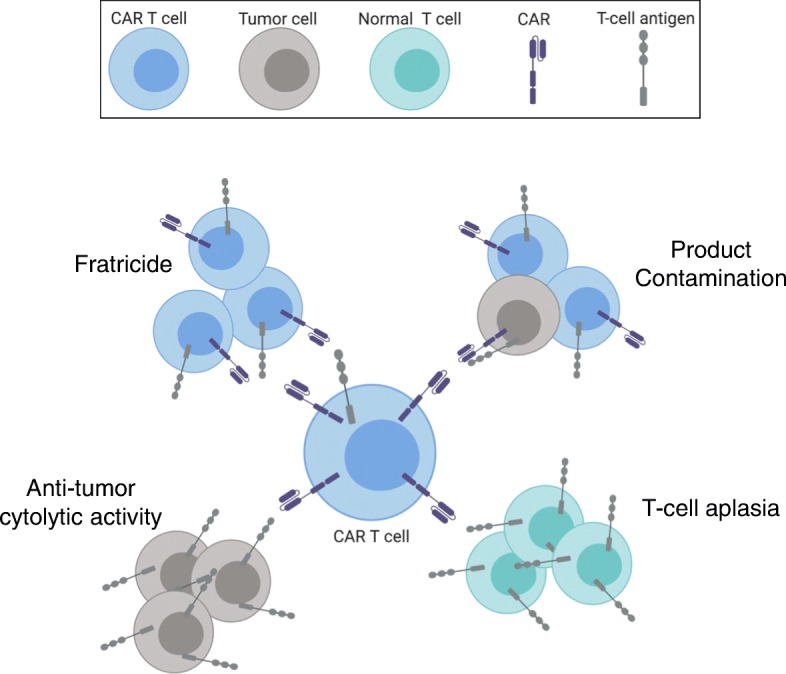
Fig. 1
Fig. 1
Potential outcomes of CAR T cell therapy in a patient with T cell disease. Upon re-infusion into a patient, CAR T cells recognize their cognate antigen, expanding upon this recognition, and initiating an attack. However, due to shared antigen expression on CAR T cells, normal T cells, and tumor cells, numerous outcomes can be observed. CAR T cells target tumor cells as intended, reducing tumor burden. However, without further engineering, the CAR-modified T cells are likely to express the targeted antigen as well, resulting in fratricide. CAR T cells would also target healthy T cells, resulting in unintended T cell aplasia. Lastly, CAR T cell therapy involves isolating normal T cells from malignant T cells for CAR-modification. A single malignant cell contaminating this population can result in masking of the antigen, leading to antigen-positive relapse. *Figure was created using BioRender
Fig. 2
Fig. 2
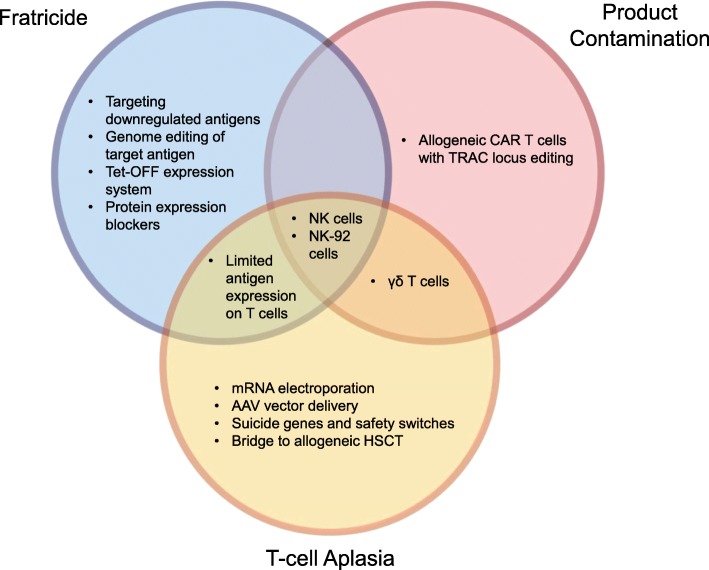
Venn diagram representing challenges and solutions in targeting T cell antigens with CAR therapy. Each circle represents a hurdle associated with translation of CAR therapy to T cell disease—fratricide, T cell aplasia, and product contamination. As seen in the figure, only the use of NK cells or NK-92 cells as the CAR-effector cell can potentially address all three issues concurrently. However, using NK cells or NK-92 cells comes with its own limitations as previously described. All other approaches require multiple modifications to generate a translatable CAR product to target T cell disease. Potential alternative solutions such as use of γδ T cells as the CAR-effector cell, transient CAR expression with mRNA electroporation or AAV viral delivery, as well as incorporating suicide genes and safety switches, remain largely unexplored. A greater focus on implementing such strategies is required to enable successful translation of this therapy for T cell malignancies

References

    1. Belver L, Ferrando A. The genetics and mechanisms of T cell acute lymphoblastic leukaemia. Nat Rev Cancer. 2016;16(8):494–507. doi: 10.1038/nrc.2016.63. - DOI - PubMed
    1. Hunger SP, Mullighan CG. Acute Lymphoblastic leukemia in children. N Engl J Med. 2015;373(16):1541–1552. doi: 10.1056/NEJMra1400972. - DOI - PubMed
    1. Phillips AA, Harewood JCK. Adult T cell leukemia-lymphoma (ATL): State of the Art. Curr Hematol Malig Rep. 2018;13(4):300–307. doi: 10.1007/s11899-018-0458-6. - DOI - PubMed
    1. Utsunomiya A, Choi I, Chihara D, Seto M. Recent advances in the treatment of adult T-cell leukemia-lymphomas. Cancer Sci. 2015;106(4):344–351. doi: 10.1111/cas.12617. - DOI - PMC - PubMed
    1. Matutes E. Adult T-cell leukaemia/lymphoma. J Clin Pathol. 2007;60(12):1373–1377. doi: 10.1136/jcp.2007.052456. - DOI - PMC - PubMed

Publication types

MeSH terms

Substances

LinkOut - more resources