Case Reports
. 2019 Dec 7:2019:7394619.
doi: 10.1155/2019/7394619. eCollection 2019.

Immunotherapy- (Blinatumomab-) Related Lineage Switch of KMT2A/AFF1 Rearranged B-Lymphoblastic Leukemia into Acute Myeloid Leukemia/Myeloid Sarcoma and Subsequently into B/Myeloid Mixed Phenotype Acute Leukemia

Affiliations
Case Reports

Immunotherapy- (Blinatumomab-) Related Lineage Switch of KMT2A/AFF1 Rearranged B-Lymphoblastic Leukemia into Acute Myeloid Leukemia/Myeloid Sarcoma and Subsequently into B/Myeloid Mixed Phenotype Acute Leukemia

Rui R He et al. Case Rep Hematol. .

Abstract

The presence of KMT2A/AFF1 rearrangement in B-lymphoblastic leukemia (B-ALL) is an independent poor prognostic factor and has been associated with higher rate of treatment failure and higher risk of linage switch under therapy. Blinatumomab has shown promising therapeutic results in refractory or relapsed B-ALL; however, it has potential risk of inducing lineage switch, especially in KMT2A/AFF1 rearranged B-ALL into acute myeloid leukemia and/or myeloid sarcoma. We report a 40-year-old female with KMT2A/AFF1-rearranged B-ALL that was refractory to conventional chemotherapy. Following administration of blinatumomab, she developed a breast mass proven to be myeloid sarcoma, in addition to bone marrow involvement by AML. Approximately six weeks after cessation of blinatumomab, a repeat bone marrow examination revealed B/myeloid MPAL.


Conflict of interest statement

The authors declare that they have no conflicts of interest.

Figures
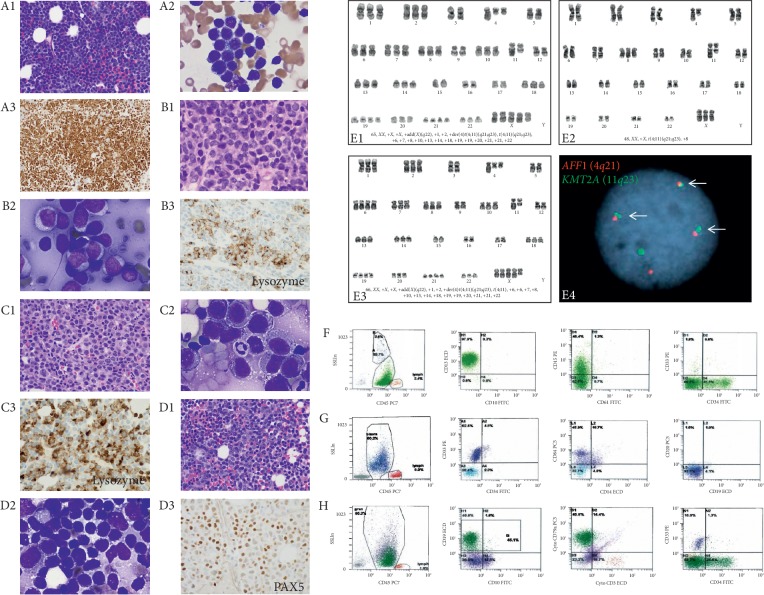
Figure 1
Figure 1
Morphologic, immunohistochemical, flow cytometric, and cytogenetic characteristics of the patient's leukemia. A1–A3 represent bone marrow evaluation at initial diagnosis. Bone marrow biopsy (A1, H&E, 400x) and aspirate (A2, Wright stain 100x, oil) showing numerous small-sized B-lymphoblasts which are strongly positive for PAX5 (A3). B1–B3 represent biopsy of the breast mass (B1, H&E, 400x) and touch imprint (B2, Wright stain, 100x, oil) showing numerous large-sized blasts with monocytic differentiation, which are patchy positive for lysozyme (B3). C1–C3 represent bone marrow biopsy (C1, H&E, 400x) and aspirate (C2, Wright stain, 100x, oil) showing sheets of myeloblasts which are patchy positive for lysozyme (C3). D1–D3 represent bone marrow evaluation six weeks after cessation of blinatumomab. Core biopsy (D1, H&E, 400x) and aspirate (D2, Wright stain, 100x, Oil) show a dimorphic population of blasts: small-sized B-lymphoblasts which are positive for PAX5 (D3) and large-sized myeloblasts which are positive for lysozyme (data not shown here). E1 represents the karyogram of bone marrow specimen at myeloblastic transformation. E2–E4 represent karyograms and AFF1/KMT2A fusion of bone marrow specimen with B/myeloid mixed phenotype acute leukemia. F–H represent flow cytometric features of the leukemic blasts. F represents flow cytometry performed on the bone marrow aspirate at the initial diagnosis showing a large population of B-lymphoblasts (green) in dim CD45 region expressing CD19, CD34 (partial), and CD15 (dim), G represents flow cytometry of the bone marrow aspirate while administration of blinatumomab showing a population of myeloblasts (blue) expressing CD33 and CD64 (dim) and was negative for CD19 and CD34. H represents flow cytometry of the bone marrow aspirate six weeks after cessation of blinatumomab showing two populations: B-lymphoblasts (green) expressing CD19, CD34 (dim), and cytoCD79a, and myeloblasts (blue) expressing CD33, CD64 (dim), and MPO (data not shown here).

References

    1. Gardner R., Wu D., Cherian S., et al. Acquisition of a CD19-negative myeloid phenotype allows immune escape of MLL-rearranged B-ALL from CD19 CAR-T-cell therapy. Blood. 2016;127(20):2406–2410. doi: 10.1182/blood-2015-08-665547. - DOI - PMC - PubMed
    1. Brower V. Phase 1/2 study of blinatumomab in relapsed paediatric ALL. The Lancet Oncology. 2016;17(12):p. e525. doi: 10.1016/s1470-2045(16)30580-0. - DOI - PubMed
    1. Wölfl M., Rasche M., Eyrich M., Schmid R., Reinhardt D., Schlegel P. G. Spontaneous reversion of a lineage switch following an initial blinatumomab-induced ALL-to-AML switch in MLL-rearranged infant ALL. Blood Advances. 2018;2(12):1382–1385. doi: 10.1182/bloodadvances.2018018093. - DOI - PMC - PubMed
    1. Fournier E., Inchiappa L., Delattre C., et al. Increased risk of adverse acute myeloid leukemia after anti-CD19-targeted immunotherapies in KMT2A-rearranged acute lymphoblastic leukemia: a case report and review of the literature. Leukemia and Lymphoma. 2019;60(7):1827–1830. doi: 10.1080/10428194.2018.1562185. - DOI - PubMed
    1. Haddox C. L., Mangaonkar A. A., Chen D., et al. Blinatumomab-induced lineage switch of B-ALL with t(4:11)(q21;q23) KMT2A/AFF1 into an aggressive AML: pre- and post-switch phenotypic, cytogenetic and molecular analysis. Blood Cancer Journal. 2017;7(9):p. e607. doi: 10.1038/bcj.2017.89. - DOI - PMC - PubMed

Publication types

LinkOut - more resources
