


Sarcopenia, long-term conditions, and multimorbidity: findings from UK Biobank participants
- PMID: 31886632
- PMCID: PMC7015236
- DOI: 10.1002/jcsm.12503
Sarcopenia, long-term conditions, and multimorbidity: findings from UK Biobank participants
Abstract
Background: Sarcopenia, the loss of muscle strength and mass, predicts adverse outcomes and becomes common with age. There is recognition that sarcopenia may occur at younger ages in those with long-term conditions (LTCs) as well as those with multimorbidity (the presence of two or more LTCs), but their relationships have been little explored. Our aims were to describe the prevalence of sarcopenia in UK Biobank, a large sample of men and women aged 40-70 years, and to explore relationships with different categories of LTCs and multimorbidity.
Methods: We used data from 499 046 participants in the baseline of UK Biobank. Our main outcome was probable sarcopenia based on maximum grip strength below sex-specific cut-points. Participants' LTCs were recorded during an interview and categorized against a hierarchy. We used logistic regression to examine the independent associations between each category of LTCs and probable sarcopenia, including adjustment for age, sex, and body mass index. We also examined the association with multimorbidity.
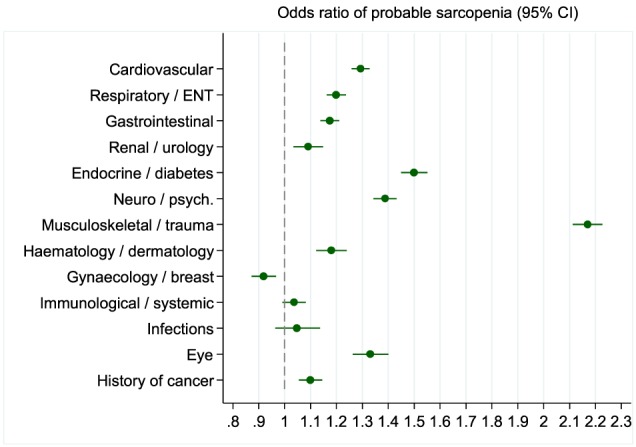
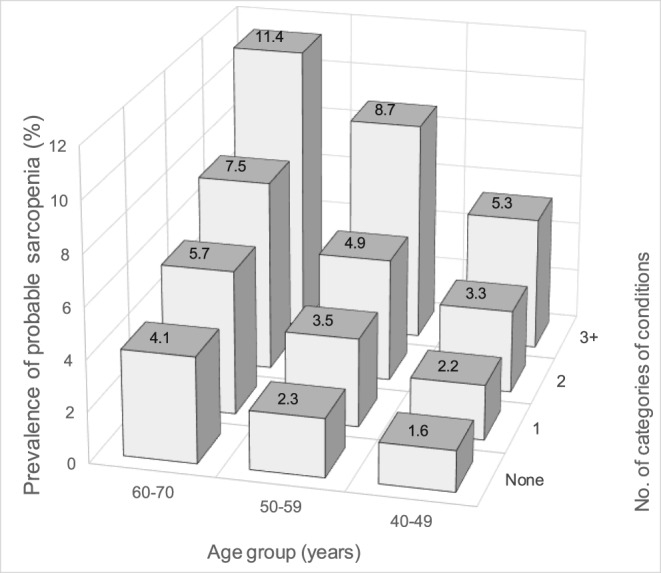
Results: Probable sarcopenia had an overall prevalence of 5.3% and increased with age. The categories with the strongest associations with probable sarcopenia were musculoskeletal/trauma [OR 2.17 (95% CI: 2.11, 2.23)], endocrine/diabetes [OR 1.49 (95% CI: 1.45, 1.55)], and neurological/psychiatric [OR 1.39 (95% CI: 1.34, 1.43)] LTCs. Almost half of the sample (44.5%) had multimorbidity, and they were at nearly twice the odds of probable sarcopenia [OR 1.96 (95% CI: 1.91, 2.02)] compared with those without.
Conclusions: We have shown an overall prevalence of 5.3% of probable sarcopenia at ages 40-70 in UK Biobank. The risk of probable sarcopenia was higher in those with some categories of LTCs, suggesting that these groups may stand to benefit from assessment of sarcopenia, during mid-life as well as old age.
Keywords: Grip strength; Later life; Long-term conditions; Mid-life; Multimorbidity; Sarcopenia.
© 2019 The Authors. Journal of Cachexia, Sarcopenia and Muscle published by John Wiley & Sons Ltd on behalf of Society on Sarcopenia, Cachexia and Wasting Disorders.
Conflict of interest statement
None declared.
Figures
References
Publication types
MeSH terms
Grants and funding
LinkOut - more resources
Full Text Sources
