. 2019 Dec 30;20(1):1028.
doi: 10.1186/s12864-019-6390-x.

High-level integration of murine intestinal transcriptomics data highlights the importance of the complement system in mucosal homeostasis

Affiliations

High-level integration of murine intestinal transcriptomics data highlights the importance of the complement system in mucosal homeostasis

Nirupama Benis et al. BMC Genomics. .

Abstract

Background: The mammalian intestine is a complex biological system that exhibits functional plasticity in its response to diverse stimuli to maintain homeostasis. To improve our understanding of this plasticity, we performed a high-level data integration of 14 whole-genome transcriptomics datasets from samples of intestinal mouse mucosa. We used the tool Centrality based Pathway Analysis (CePa), along with information from the Reactome database.

Results: The results show an integrated response of the mouse intestinal mucosa to challenges with agents introduced orally that were expected to perturb homeostasis. We observed that a common set of pathways respond to different stimuli, of which the most reactive was the Regulation of Complement Cascade pathway. Altered expression of the Regulation of Complement Cascade pathway was verified in mouse organoids challenged with different stimuli in vitro.

Conclusions: Results of the integrated transcriptomics analysis and data driven experiment suggest an important role of epithelial production of complement and host complement defence factors in the maintenance of homeostasis.

Keywords: Complement pathway; Data integration; Homeostasis; Intestine; Pathway analysis; Transcriptomics.


Conflict of interest statement

The authors declare that they have no competing interests.

Figures
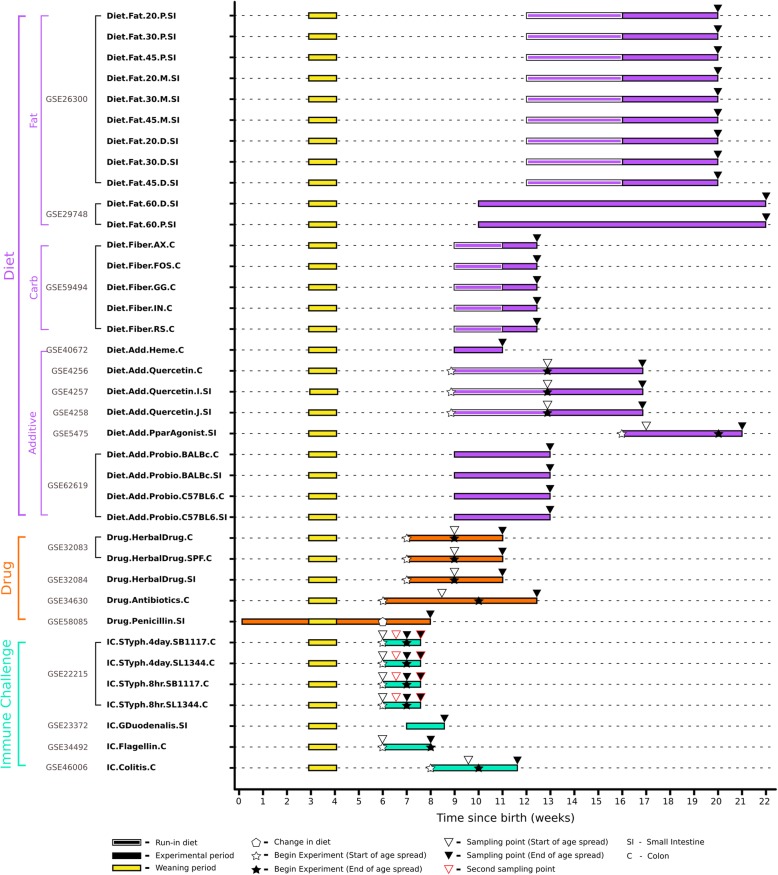
Fig. 1
Fig. 1
Experimental datasets: The 37 conditions from 14 experiments (with 17 GEO accession numbers) used in this study are detailed in a timeline based on the age of the mice. Mice are selected to be part of an experiment based on weight, hence their age can vary within a range. The stars denote the start of the intervention, an empty star indicates the range of age when the intervention starts, when the age is not the same for all the animals in the group. Triangles denote the end of the interventions, an empty triangle indicates the start of the range of age of the animals. Challenges have been divided in three categories (colour coded): Diet, Drug and Immune Challenge. The names given for each dataset are abbreviated to show the challenge category in the first part of the name, the tissue sampled at the end (SI: small intestine; C: colon) and the text in the middle indicates the nature of challenge. Additional detailed explanations for the abbreviated condition names and the control conditions are given in Additional file 1: Table S1
Fig. 2
Fig. 2
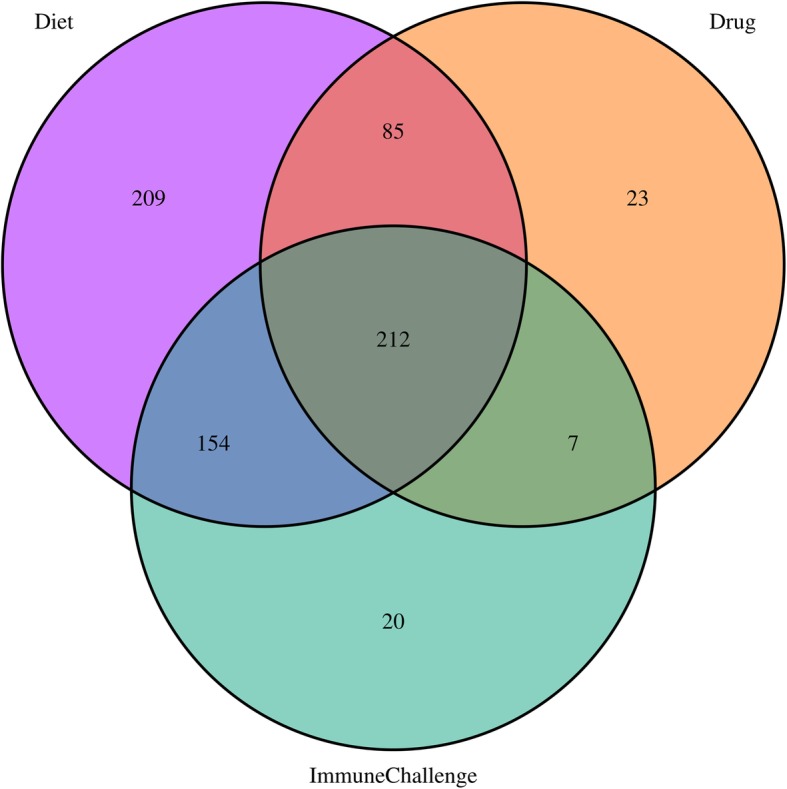
Number of leaf pathways enriched in differentially expressed genes in the three challenge categories. The three circles are indicative of the significant leaf pathways in the datasets belonging to one of the three challenge categories Diet, Drug, or Immune Challenge. The 212 common pathways of all the three classes are indicated in the centre
Fig. 3
Fig. 3
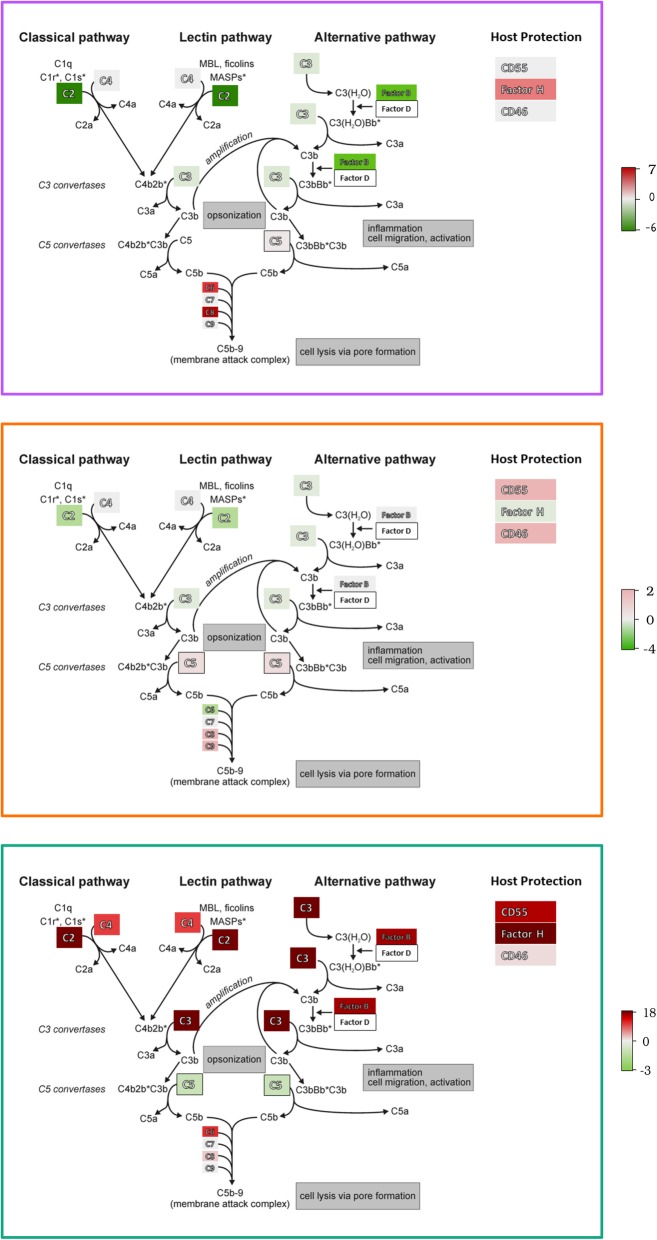
The three complement pathways leading to enhanced phagocytosis of microorganisms. The binding of C3b to a receptor expressed on the surface of phagocytes and formation of the C5 convertase which generates chemotactic factors C5a and C3a, and the membrane attack complex for lysis of microbial membranes are depicted in the figure. Names of enzymatic products or complexes are shown. Common gene names are shown in boxes and are shaded in red when positively regulated in the datasets included in this study and green when negatively regulated. Each panel shows the complement pathway; however, it is superimposed with the pathway gene expression measurements for three different experimental conditions, one from each challenge category. Panel a represents the expression of the genes in the condition Diet.Fat.45.P.SI, panel b, Drug.Penicillin.SI and panel c, IC.STyph.4 day.SL1344.C. The legend shows the range of differential regulation. Complement-mediated defence mechanisms are shown in grey boxes. Modified from Microbes Online by Srijana Khanal [33]
Fig. 4
Fig. 4
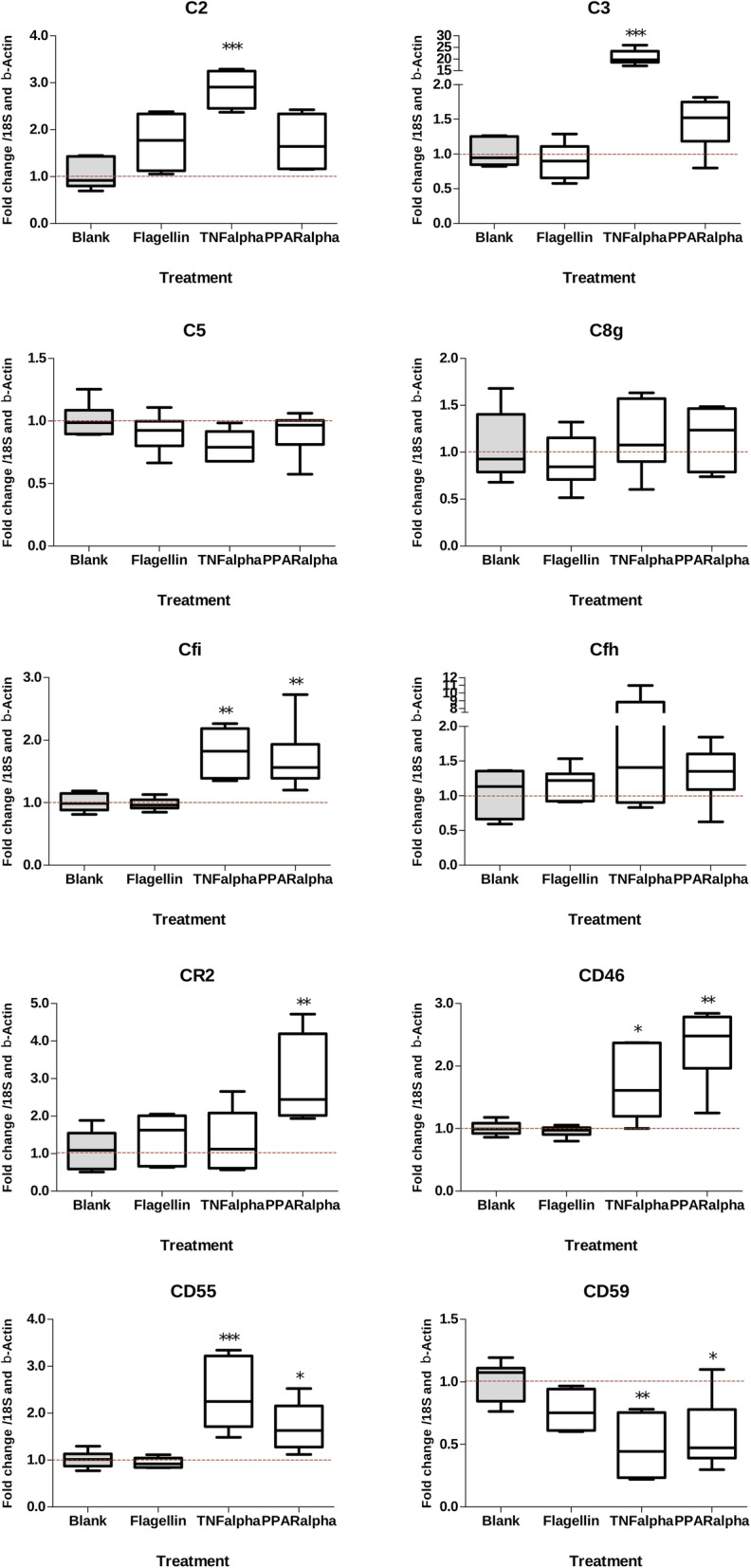
Expression of 10 chosen genes from the ‘Regulation of Complement Cascade’ pathways with significance calculated with ANOVA. Each graph contains information on different genes, the x-axis contains information on the treatment of the organoids and the y-axis has the fold change of the control genes. Data were analysed using Prism statistical software (v5.0, Graphpad, San Diego, US), measured for normality using the Kolmogorov-Smirnov test, and represented as Box and Whisker plots. A t-statistic test was performed on the RT-qPCR results of the 10 genes using the same methods as on the nodes in the gene set pathway analysis of CePa. All data were considered significantly different from the Blank (indicated in grey) when P < alpha (0.05) and indicated with * (P < 0.05 = *, P < 0.01 = **, P < 0.001 = ***)

References

    1. Hooper LV, Littman DR, Macpherson AJ. Interactions between the microbiota and the immune system. Science. 2012;336:1268–1273. doi: 10.1126/science.1223490. - DOI - PMC - PubMed
    1. Wells J. M., Rossi O., Meijerink M., van Baarlen P. Epithelial crosstalk at the microbiota-mucosal interface. Proceedings of the National Academy of Sciences. 2010;108(Supplement_1):4607–4614. doi: 10.1073/pnas.1000092107. - DOI - PMC - PubMed
    1. Van den Abbeele P, Gérard P, Rabot S, Bruneau A, El Aidy S, Derrien M, et al. Arabinoxylans and inulin differentially modulate the mucosal and luminal gut microbiota and mucin-degradation in humanized rats. Environ Microbiol. 2011;13:2667–2680. doi: 10.1111/j.1462-2920.2011.02533.x. - DOI - PubMed
    1. Kelly CJ, Zheng L, Campbell EL, Saeedi B, Scholz CC, Bayless AJ, et al. Crosstalk between microbiota-derived short-chain fatty acids and intestinal epithelial HIF augments tissue barrier function. Cell Host Microbe. 2015;17:662–671. doi: 10.1016/j.chom.2015.03.005. - DOI - PMC - PubMed
    1. Schokker D, Zhang J, Vastenhouw SA, Heilig HG, Smidt H, Rebel JM, et al. Long-lasting effects of early-life antibiotic treatment and routine animal handling on gut microbiota composition and immune system in pigs. PLoS One. 2015;10:e0116523. doi: 10.1371/journal.pone.0116523. - DOI - PMC - PubMed

Substances

LinkOut - more resources