


Intestinal parasite infections and associated factors among inmates of Arba Minch prison, southern Ethiopia: cross sectional study
- PMID: 31888496
- PMCID: PMC6937967
- DOI: 10.1186/s12879-019-4703-y
Intestinal parasite infections and associated factors among inmates of Arba Minch prison, southern Ethiopia: cross sectional study
Abstract
Background: Intestinal parasitic infection is one of the parasitic infections affecting people living in prison. Helminths and intestinal protozoan infections are the most common parasitic infection that may cause serious life-threatening diseases in inmates living in developing countries. This study was aimed to investigate the prevalence and associated factors of intestinal parasitic infections (IPIs) among inmates living in Arba Minch prison, southern Ethiopia.
Methods: Institutional based cross sectional study was conducted on Arba Minch inmates, southern Ethiopian. Pre-tested semi-structured questionnaire was used to gather the data of socio-demographic characteristics, hygiene status of the prisoners, sanitation condition of the prison, and associated factors for IPIs by face to face interview. Direct wet-mount examination and formol-ether sedimentation techniques were used to examine intestinal parasitic infection from stool specimens. Binary logistic regression analysis was used to see the association between different variables and the IPI. Odds ratio with 95% CI was computed to determine the presence association and strength of the associated factors.
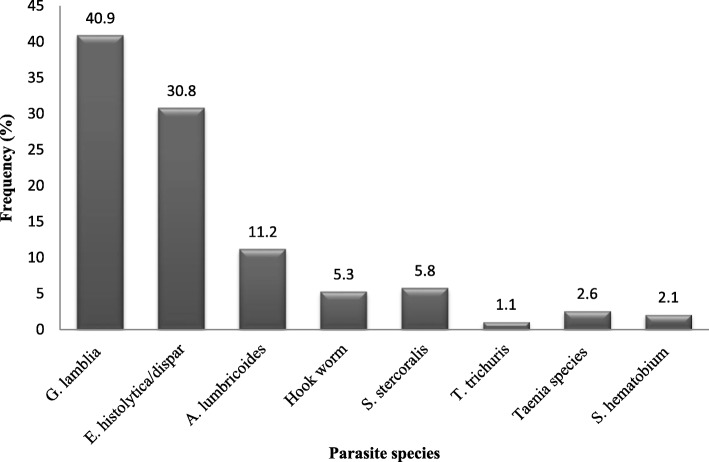
Result: A total of 320 prisoners were participated in this study. Of these, 154(48.1%) of them were infected with one or more intestinal parasites. Eight different intestinal parasites species were identified and Giardia lamblia was the predominant parasite. Among infected inmates, nearly one out of four of them had multiple parasitic infections dominated by Giardia lamblia and E. histolytica/dispar co-infection. Sleeping in group [AOR = 1.9; 95% CI: (1.0-3.8)], married prisoners [AOR = 1.8; 95% CI: (1.1-2.9)], and hand washing habits after handling soil [AOR = 2.4; 95% CI: (1.0-5.6)] were independently associated with IPI.
Conclusion: High prevalence of intestinal parasitic infection was detected in Arba Minch inmates, southern Ethiopian. Absence of hand washing, marital status, and way of sleeping were the factors associated with the IPI. Implementation of mass drug administration, education on water, sanitation and hygiene (WASH) and periodic screening of intestinal parasitic infection is very important to reduce the high prevalence IPIs in prison.
Keywords: Intestinal parasite; Multiple parasitic infection; Prisoners; Protozoa; Soil transmitted helminths.
Conflict of interest statement
The authors declare that they have no competing interests.
Figures
References
-
- World Health Organization. Intestinal worms. Accessed 1 Oct 2018. Available on: http://www.who.int/intestinal_worms/more/en/.
-
- World Health Organization Research priorities for helminth infections. World Health Organ Tech Rep Ser. 2012;972(972):1–174. - PubMed
-
- Mandal FB. Human parasitology, second edition. India: PHI Learning Pvt Ltd. Publishers; 2015. p. 69.
-
- World Health Organization . Prevention and control of schistosomiasis and soil transmitted helminthiasis. 2002. p. 1657. - PubMed
-
- Heelan JS. Cases in human parasitology. Washington DC: ASM Press; 2004. pp. 12–31.
MeSH terms
Substances
LinkOut - more resources
Full Text Sources
