Association between ambient fine particulate pollution and hospital admissions for cause specific cardiovascular disease: time series study in 184 major Chinese cities
- PMID: 31888884
- PMCID: PMC7190041
- DOI: 10.1136/bmj.l6572
Association between ambient fine particulate pollution and hospital admissions for cause specific cardiovascular disease: time series study in 184 major Chinese cities
Abstract
Objective: To estimate the risks of daily hospital admissions for cause specific major cardiovascular diseases associated with short term exposure to ambient fine particulate matter (aerodynamic diameter ≤2.5 μm; PM2.5) pollution in China.
Design: National time series study.
Setting: 184 major cities in China.
Population: 8 834 533 hospital admissions for cardiovascular causes in 184 Chinese cities recorded by the national database of Urban Employee Basic Medical Insurance from 1 January 2014 to 31 December 2017.
Main outcome measures: Daily counts of city specific hospital admissions for primary diagnoses of ischaemic heart disease, heart failure, heart rhythm disturbances, ischaemic stroke, and haemorrhagic stroke among different demographic groups were used to estimate the associations between PM2.5 and morbidity. An overdispersed generalised additive model was used to estimate city specific associations between PM2.5 and cardiovascular admissions, and random effects meta-analysis used to combine the city specific estimates.
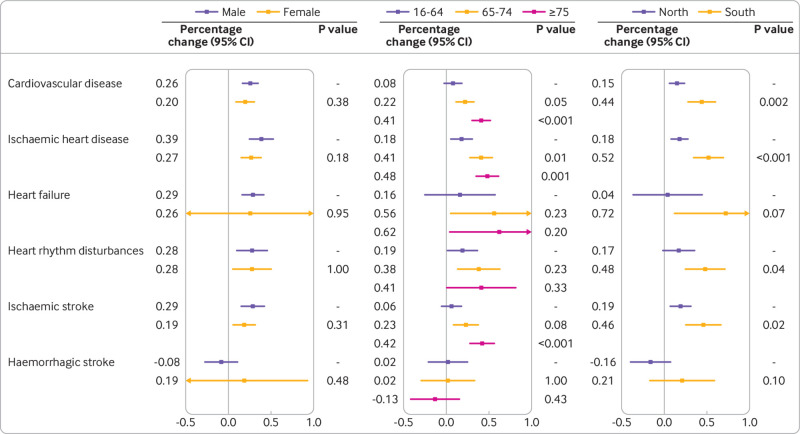
Results: Over the study period, a mean of 47 hospital admissions per day (standard deviation 74) occurred for cardiovascular disease, 26 (53) for ischaemic heart disease, one (five) for heart failure, two (four) for heart rhythm disturbances, 14 (28) for ischaemic stroke, and two (four) for haemorrhagic stroke. At the national average level, an increase of 10 μg/m3 in PM2.5 was associated with a 0.26% (95% confidence interval 0.17% to 0.35%) increase in hospital admissions on the same day for cardiovascular disease, 0.31% (0.22% to 0.40%) for ischaemic heart disease, 0.27% (0.04% to 0.51%) for heart failure, 0.29% (0.12% to 0.46%) for heart rhythm disturbances, and 0.29% (0.18% to 0.40%) for ischaemic stroke, but not with haemorrhagic stroke (-0.02% (-0.23% to 0.19%)). The national average association of PM2.5 with cardiovascular disease was slightly non-linear, with a sharp slope at PM2.5 levels below 50 μg/m3, a moderate slope at 50-250 μg/m3, and a plateau at concentrations higher than 250 μg/m3. Compared with days with PM2.5 up to 15 μg/m3, days with PM2.5 of 15-25, 25-35, 35-75, and 75 μg/m3 or more were significantly associated with increases in cardiovascular admissions of 1.1% (0 to 2.2%), 1.9% (0.6% to 3.2%), 2.6% (1.3% to 3.9%), and 3.8% (2.1% to 5.5%), respectively.According to projections, achieving the Chinese grade 2 (35 μg/m3), Chinese grade 1 (15 μg/m3), and World Health Organization (10 μg/m3) regulatory limits for annual mean PM2.5 concentrations would reduce the annual number of admissions for cardiovascular disease in China. Assuming causality, which should be done with caution, this reduction would translate into an estimated 36 448 (95% confidence interval 24 441 to 48 471), 85 270 (57 129 to 113 494), and 97 516 (65 320 to 129 820), respectively.
Conclusions: These data suggest that in China, short term exposure to PM2.5 is associated with increased hospital admissions for all major cardiovascular diseases except for haemorrhagic stroke, even for exposure levels not exceeding the current regulatory limits.
Published by the BMJ Publishing Group Limited. For permission to use (where not already granted under a licence) please go to http://group.bmj.com/group/rights-licensing/permissions.
Conflict of interest statement
Competing interests: All authors have completed the ICMJE uniform disclosure form at www.icmje.org/coi_disclosure.pdf and declare: supported from the National Natural Science Foundation of China and the National Thousand Talents Programme for Distinguished Young Scholars of China; no financial relationships with any organisations that might have an interest in the submitted work; no other relationships or activities that could appear to have influenced the submitted work.
Figures


References
-
- GBD 2016 DALYs and HALE Collaborators Global, regional, and national disability-adjusted life-years (DALYs) for 333 diseases and injuries and healthy life expectancy (HALE) for 195 countries and territories, 1990-2016: a systematic analysis for the Global Burden of Disease Study 2016. Lancet 2017;390:1260-344. 10.1016/S0140-6736(17)32130-X - DOI - PMC - PubMed
-
- Brook RD, Rajagopalan S, Pope CA, 3rd, et al. American Heart Association Council on Epidemiology and Prevention, Council on the Kidney in Cardiovascular Disease, and Council on Nutrition, Physical Activity and Metabolism Particulate matter air pollution and cardiovascular disease: An update to the scientific statement from the American Heart Association. Circulation 2010;121:2331-78. 10.1161/CIR.0b013e3181dbece1 - DOI - PubMed
Publication types
MeSH terms
Substances
LinkOut - more resources
Full Text Sources