. 2019 Dec 30;9(1):20335.
doi: 10.1038/s41598-019-56785-1.

A novel phytocannabinoid isolated from Cannabis sativa L. with an in vivo cannabimimetic activity higher than Δ9-tetrahydrocannabinol: Δ9-Tetrahydrocannabiphorol

Affiliations

A novel phytocannabinoid isolated from Cannabis sativa L. with an in vivo cannabimimetic activity higher than Δ9-tetrahydrocannabinol: Δ9-Tetrahydrocannabiphorol

Cinzia Citti et al. Sci Rep. .

Abstract

(-)-Trans-Δ9-tetrahydrocannabinol (Δ9-THC) is the main compound responsible for the intoxicant activity of Cannabis sativa L. The length of the side alkyl chain influences the biological activity of this cannabinoid. In particular, synthetic analogues of Δ9-THC with a longer side chain have shown cannabimimetic properties far higher than Δ9-THC itself. In the attempt to define the phytocannabinoids profile that characterizes a medicinal cannabis variety, a new phytocannabinoid with the same structure of Δ9-THC but with a seven-term alkyl side chain was identified. The natural compound was isolated and fully characterized and its stereochemical configuration was assigned by match with the same compound obtained by a stereoselective synthesis. This new phytocannabinoid has been called (-)-trans-Δ9-tetrahydrocannabiphorol (Δ9-THCP). Along with Δ9-THCP, the corresponding cannabidiol (CBD) homolog with seven-term side alkyl chain (CBDP) was also isolated and unambiguously identified by match with its synthetic counterpart. The binding activity of Δ9-THCP against human CB1 receptor in vitro (Ki = 1.2 nM) resulted similar to that of CP55940 (Ki = 0.9 nM), a potent full CB1 agonist. In the cannabinoid tetrad pharmacological test, Δ9-THCP induced hypomotility, analgesia, catalepsy and decreased rectal temperature indicating a THC-like cannabimimetic activity. The presence of this new phytocannabinoid could account for the pharmacological properties of some cannabis varieties difficult to explain by the presence of the sole Δ9-THC.


Conflict of interest statement

The authors declare no competing interests.

Figures
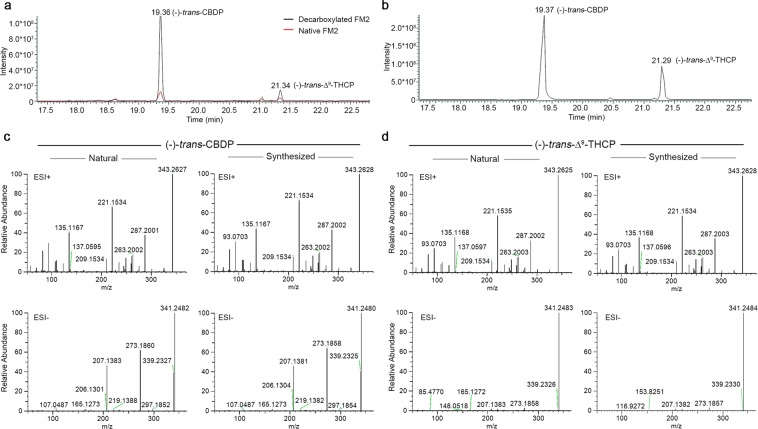
Figure 1
Figure 1
UHPLC-HRMS identification of (-)-trans-CBDP and (-)-trans9-THCP. Extracted ion chromatograms (EIC) of CBDP and Δ9-THCP from a standard mixture at 25 and 10 ng/mL respectively (a) and from the native (red plot) and decarboxylated (black plot) FM2 (b). (c,d) Comparison of the high-resolution fragmentation spectra of synthetic and natural CBDP and Δ9-THCP in both positive (ESI+) and negative (ESI−) mode.
Figure 2
Figure 2
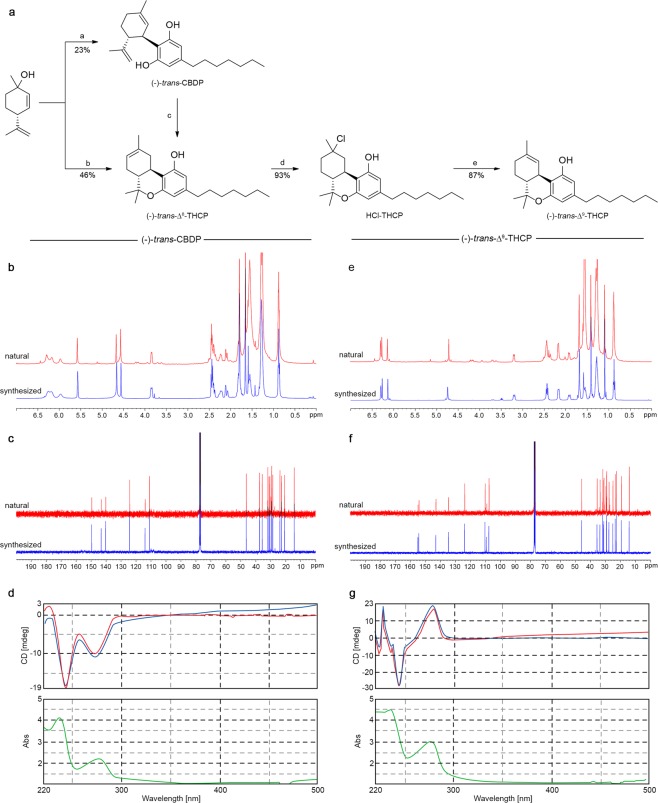
Synthesis and spectroscopic characterization of (-)-trans-CBDP and (-)-trans9-THCP. (a) Reagents and conditions: (a) 5-heptylbenzene-1,3-diol (1.1 eq.), pTSA (0.1 eq.), CH2Cl2, r.t., 90 min.; (b) 5-heptylbenzene-1,3-diol (1.1 eq.), pTSA (0.1 eq.), DCM, r.t., 48 h; (c) pTSA (0.1 eq.), DCM, r.t., 48 h; (d) ZnCl2 (0.5 eq.), 4 N HCl in dioxane (1 mL per 100 mg of Δ8-THCP), dry DCM, argon, 0 °C to r.t., 2 h. (e) 1.75 M potassium t-amylate in toluene (2.5 eq.), dry toluene, argon, −15 °C, 1 h. (b–g) Superimposition of 1H, 13C NMR and CD spectra for natural (red line) and synthesized (blue line) (-)-trans-CBDP (b–d) and (-)-trans9-THCP (e–g).
Figure 3
Figure 3
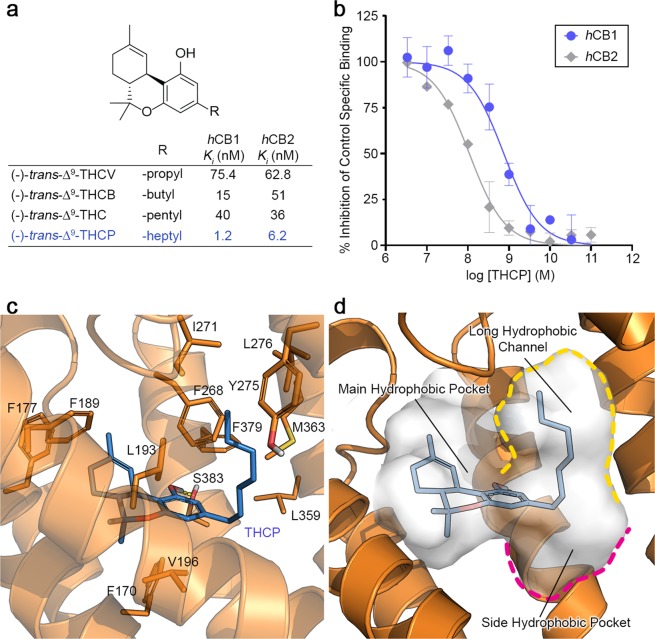
In vitro activity and docking calculation of Δ9-THCP. (a) Binding affinity (Ki) of the four homologues of Δ9-THC against human CB1 and CB2 receptors. (b) Dose-response studies of Δ9-THCP against hCB1 (in blue) and hCB2 (in grey). All experiments were performed in duplicate and error bars denote s.e.m. of measurements. (c) Docking pose of (-)-trans9-THCP (blue sticks), in complex with hCB1 receptor (PDB ID: 5XRA, orange cartoon). Key amino acidic residues are reported in orange sticks. H-bonds are reported in yellow dotted lines. Heteroatoms are color-coded: oxygen in red, nitrogen in blue and sulphur in yellow. (d) Binding pocket of hCB1 receptor, highlighting the positioning of the heptyl chain within the long hydrophobic channel of the receptor (yellow dashed line). The side hydrophobic pocket is bordered in magenta. Panels c and d were built using Maestro 10.3 of the Schrödinger Suite.
Figure 4
Figure 4
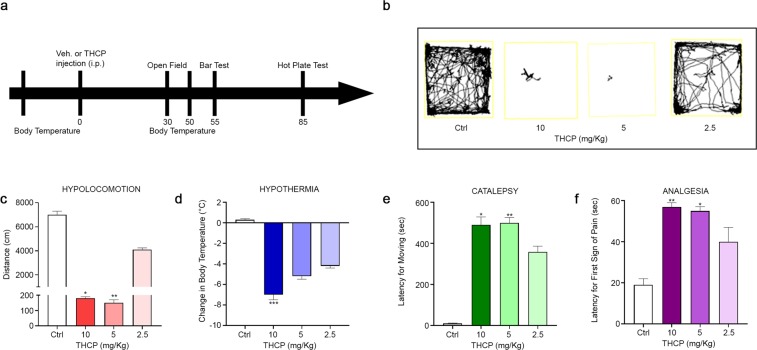
Dose-dependent effects of Δ9-THCP administration (2.5, 5, or 10 mg/kg, i.p.) on the tetrad phenotypes in mice in comparison to vehicle. (a) Time schedule of the tetrad tests in minutes from Δ9-THCP or vehicle administration. (b,c) Locomotion decrease induced by Δ9-THCP administration in the open field test. (d) Decrease of body temperature after Δ9-THCP administration; the values are expressed as the difference between the basal temperature (i.e., taken before Δ9-THCP or vehicle administration) and the temperature measured after Δ9-THCP or vehicle administration. (e) Increase in the latency for moving from the catalepsy bar after Δ9-THCP administration. (f) Increase in the latency after the first sign of pain shown by the mouse in the hot plate test following Δ9-THCP administration. Data are represented as mean ± SEM of 5 mice per group. * indicate significant differences compared to 0 (vehicle injection), respectively. *p < 0.05, **p < 0.01, ***p < 0.001 versus Δ9-THCP 0 mg/kg (vehicle). The Kruskall-Wallis test followed by Dunn’s post hoc tests were performed for statistical analysis.

References

    1. Novack GD. Cannabinoids for treatment of glaucoma. Curr. Opin. Ophthalmol. 2016;27:146–150. doi: 10.1097/ICU.0000000000000242. - DOI - PubMed
    1. Russo EB. Cannabis and epilepsy: an ancient treatment returns to the fore. Epilepsy Behav. 2017;70:292–297. doi: 10.1016/j.yebeh.2016.09.040. - DOI - PubMed
    1. Zeremski, T., Kiprovski, B., Sikora, V., Miladinović, J. & Tubić, S. In III International Congress,” Food Technology, Quality and Safety”, 25–27 October 2016, Novi Sad, Serbia. Proceedings 10–15 (University of Novi Sad, Institute of Food Technology).
    1. Mutje P, Lopez A, Vallejos M, Lopez J, Vilaseca F. Full exploitation of Cannabis sativa as reinforcement/filler of thermoplastic composite materials. Composites Part A: Applied Science and Manufacturing. 2007;38:369–377. doi: 10.1016/j.compositesa.2006.03.009. - DOI
    1. Westerhuis, W. Hemp for textiles: plant size matters, Wageningen University, (2016).

Publication types

MeSH terms