


Development of a framework with tools to support the selection and implementation of patient-reported outcome measures
- PMID: 31889232
- PMCID: PMC6937349
- DOI: 10.1186/s41687-019-0171-9
Development of a framework with tools to support the selection and implementation of patient-reported outcome measures
Abstract
Background: Patient reported outcomes (PROs) provide information on a patient's health status coming directly from the patient. Measuring PROs with patient reported outcome measures (PROMs) has gained wide interest in clinical practice for individual patient care, as well as in quality improvement, and for providing transparency of outcomes to stakeholders through public reporting. However, current knowledge of selecting and implementing PROMs for these purposes is scattered, and not readily available for clinicians and quality managers in healthcare organizations. The objective of this study is to develop a framework with tools to support the systematic selection, implementation and evaluation of PROs and PROMs in individual patient care, for quality improvement and public reporting.
Methods: We developed the framework in a national project in the Netherlands following a user-centered design. The development process of the framework contained five iterative components: (a) identification of existing tools, (b) identification of user requirements and designing steps for selection and implementation of PROs and PROMs, (c) discussing a prototype of the framework during a national workshop, (d) developing a web version, (e) pre-testing of the framework. A total of 40 users with different perspectives (clinicians, patient representatives, quality managers, purchasers, researchers) have been consulted.
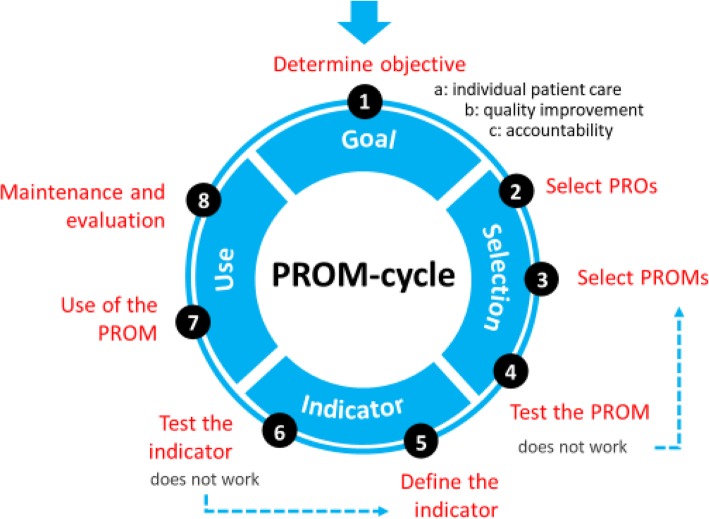
Results: The final framework is presented as the PROM-cycle that consists of eight steps in four phases: (1) goal setting, (2) selecting PROs and PROMs, (3) developing and testing of quality indicator(s), (4) implementing and evaluating the PROM(s) and indicator(s). Users emphasized that the first step is the key element in which the why, for whom and setting of the PROM has to be defined. This information is decisive for the following steps. For each step the PROM-cycle provides guidance and tools, with instruments, checklists, methods, handbooks, and standards supporting the process.
Conclusion: We developed a framework to support the selection and implementation of PROs and PROMs. Each step provides guidance and tools to support the process. The PROM-cycle and its tools are publicly available and can be used by clinicians, quality managers, patient representatives and other experts involved in using PROMS. Through periodic evaluation and updates, tools will be added for national and international use of the PROM-cycle.
Keywords: Patient reported outcome measures (PROMs); Patient reported outcomes (PROs); Public reporting; Quality improvement; Quality of care; Shared decision-making; Transparency.
Conflict of interest statement
MZ is employed by the National Health Care Institute (Zorginstituut Nederland). At the time of conducting the study CB and JB were employed by the Netherlands Federation of University medical Centers (NFU). All other authors declare no support from any organization for the submitted work; no financial relationships with any organizations that might have an interest in the submitted work in the previous 3 years, no other relationships or activities that could appear to have influenced the submitted.
References
-
- Van Der Wees PJ. Nijhuis-Van Der Sanden MW, Ayanian JZ, Black N, Westert GP, Schneider EC. Integrating the use of patient-reported outcomes for both clinical practice and performance measurement: Views of experts from 3 countries. The Milbank Quarterly. 2014;92(4):754–775. doi: 10.1111/1468-0009.12091. - DOI - PMC - PubMed
Grants and funding
LinkOut - more resources
Full Text Sources
Miscellaneous
