


Effect of fermentation and dry roasting on the nutritional quality and sensory attributes of quinoa
- PMID: 31890168
- PMCID: PMC6924334
- DOI: 10.1002/fsn3.1247
Effect of fermentation and dry roasting on the nutritional quality and sensory attributes of quinoa
Abstract
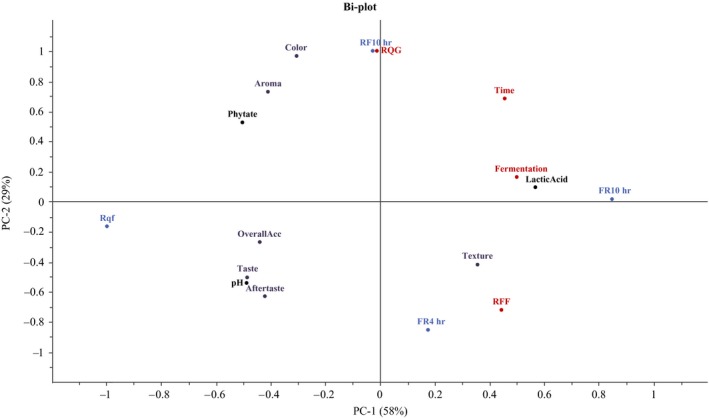
Background: Quinoa is a pseudocereal with relatively high content of proteins and minerals that also contains mineral inhibitors such as phytate. The aim of the present study was to evaluate lactic acid fermentation and dry roasting on the nutritional quality and sensory attributes of quinoa. Various processes were evaluated, and quinoa grains were dry-roasted, milled, and fermented, either with or without the addition of wheat phytase or activated quinoa phytase (added as back-slop starter), for 10 hr. In other processes, raw quinoa flour was fermented for 10 hr or 4 hr and dry-roasted. Hedonic sensory evaluation was then performed to evaluate the acceptability of the fermented flours prepared as porridges.
Results: The combined dry roasting and fermentation processes significantly (p < .05) degraded phytate between 30% and 73% from initial content. The most effective process was fermentation of raw quinoa flour followed by dry roasting, which improved the estimated zinc and iron bioavailability. Particularly, estimated zinc bioavailability improved from low (Phy:Zn 25.4, Phy·Zn:Ca 295) to moderate (Phy:Zn 7.14, Phy·Zn:Ca 81.5). Phytate degradation was mainly attributed to the activation of endogenous phytase during fermentation. Dry roasting was effective in improving the sensory attributes of the fermented quinoa flour. Porridge made with raw quinoa flour fermented for 4 hr and dry-roasted was more favorable to overall acceptability than that which was fermented for 10 hr and dry-roasted.
Conclusion: Fermentation of quinoa flour for 4 hr followed by dry roasting was successful in improving both nutritional and sensory attributes of the final product.
Keywords: dry roasting; fermentation; minerals; phytate degradation; quinoa; sensory attributes.
© 2019 The Authors. Food Science & Nutrition published by Wiley Periodicals, Inc.
Conflict of interest statement
The authors declare no conflict of interest.
Figures


References
-
- AOAC (2000). Official methods of analysis of AOAC International. Gaithersburg, MD: AOAC International.
-
- Bamforth, C. W. (2007). The science underpinning food fermentations In Bamforth C. W. (Ed.), Food, fermentation and micro‐organisms (pp. 1–39). Oxford, UK: Blackwell Publishing Ltd.
-
- Békés, F. , Schoenlechner, R. , & Tömösközi, S. (2017). Chapter 14 ‐ ancient wheats and pseudocereals for possible use in cereal‐grain dietary intolerances In Wrigley C., Batey I. & Miskelly D. (Eds.), Cereal grains, 2nd ed. (pp. 353–389). Cambridge, UK: Woodhead Publishing.
-
- Brady, K. , Ho, C.‐T. , Rosen, R. T. , Sang, S. , & Karwe, M. V. (2007). Effects of processing on the nutraceutical profile of quinoa. Food Chemistry, 100, 1209–1216. 10.1016/j.foodchem.2005.12.001 - DOI
-
- Brejnholt, S. M. , Dionisio, G. , Glitsoe, V. , Skov, L. K. , & Brinch‐Pedersen, H. (2011). The degradation of phytate by microbial and wheat phytases is dependent on the phytate matrix and the phytase origin. Journal of the Science of Food and Agriculture, 91, 1398–1405. 10.1002/jsfa.4324 - DOI - PubMed
LinkOut - more resources
Full Text Sources
