


Functional exploration of free and encapsulated probiotic bacteria in yogurt and simulated gastrointestinal conditions
- PMID: 31890171
- PMCID: PMC6924303
- DOI: 10.1002/fsn3.1254
Functional exploration of free and encapsulated probiotic bacteria in yogurt and simulated gastrointestinal conditions
Abstract
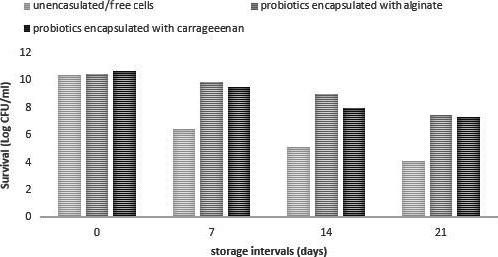
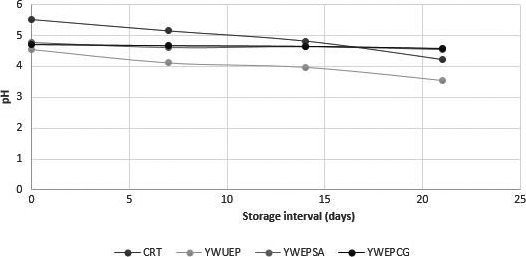
The core objective of the current study was to evaluate the effect of microencapsulation on the viability and stability of probiotic bacteria in yogurt and simulated gastrointestinal conditions. For this purpose, probiotic bacteria were encapsulated with sodium alginate and carrageenan by encapsulator. Yogurt was prepared with the incorporation of free and encapsulated probiotic bacteria and was analyzed for physicochemical, microbiological, and sensorial attributes. Encapsulation and storage exhibited a significant (p < .05) effect on different parameters of yogurt. An increasing trend in syneresis and acidity while a decreasing trend in viscosity, pH, viability, and stability were observed. The value of syneresis increased from 2.27 ± 0.17 to 2.9 ± 0.14 and acidity from 0.48 ± 0.04 to 0.64 ± 0.01 during 4 weeks of storage. The value of viscosity decreased from 3.68 ± 0.21 to 2.42 ± 0.09 and pH from 4.88 ± 0.31to 4.43 ± 0.36 during 28 days of storage. Unencapsulated (free) cells exhibited poor survival. The viable cell count of probiotic bacteria in the free-state in yogurt was 9.97 logs CFU/ml at zero-day that decreased to 6.12 log CFU/ml after 28 days. However, encapsulation improved the viability of the probiotics in the prepared yogurt and GIT. The cell count of probiotics encapsulated with sodium alginate and carrageenan was 9.91 logs CFU/ml and 9.89 logs CFU/ml, respectively, at zero-day that decreased to 8.74 logs CFU/ml and 8.39 log CFU/ml, respectively. Free cells (unencapsulated) showed very poor survival. Similarly, during in vitro gastrointestinal assay, the survival rate of encapsulated probiotic bacteria in simulated gastric solution and intestinal solutions was higher than that of free cells. In the case of encapsulated bacteria, only 3 logs while for free cells, 7 log reduction was recorded. Sodium alginate microcapsules exhibited better release profile than carrageenan. Conclusively, microencapsulation improved the survival of probiotic bacteria in carrier food as well as in simulated gastrointestinal condition.
Keywords: encapsulation; gastrointestinal conditions; probiotics viability; yogurt.
© 2019 The Authors. Food Science & Nutrition published by Wiley Periodicals, Inc.
Conflict of interest statement
Authors declare that they have no conflict of interest.
Figures
References
-
- Abghari, A. ,Sheikh‐Zeinoddin M., & Soleimanian‐Zad, S. (2011). Nonfermented ice cream as a carrier for Lactobacillus acidophilus and Lactobacillus rhamnosus . International Journal of Food Science & Technology, 46(1), 84–92.
-
- Agrawal, R. (2005). Probiotics: An emerging food supplement with health benefits. Food Biotechnology, 19(3), 227–246. 10.1080/08905430500316474 - DOI
-
- AOAC (2006). Official Methods of Analysis of Association of Official Analytical Chemists International. In: Horwitz, W. (Ed.), 18th ed. AOAC Press, Washington, DC. USA. Karimi, R., Mortazavian, A.M. and Amiri‐Rigi, A., 2012. Selective enumeration of probiotic microorganisms in cheese. Food microbiology, 29(1), pp.1‐9 - PubMed
-
- Ayar, A. , & Gurlin, E. (2014). Production and sensory, textural, physico‐chemical properties of flavored spreadable yogurt. Life Science Journal, 11(4), 58–65.
LinkOut - more resources
Full Text Sources
