. 2019 Nov 28;8(12):e1579-e1582.
doi: 10.1016/j.eats.2019.08.017. eCollection 2019 Dec.

Anterior Cruciate Ligament Reconstruction With Suture Tape Augmentation: A Surgical Technique

Affiliations

Anterior Cruciate Ligament Reconstruction With Suture Tape Augmentation: A Surgical Technique

Scott Richard Anderson et al. Arthrosc Tech. .

Abstract

The anterior cruciate ligament (ACL) is the most common ligamentous knee injury and often is encountered in those participating in multidirectional sports. ACL reconstruction is the most commonly performed knee ligament reconstruction and employs a variety of surgical techniques but still is challenged by residual laxity and graft rupture. To help address and prevent future ACL failures, new repair and reconstruction techniques have been employed that incorporate suture augmentation (InternalBrace; Arthrex, Naples, FL), which protects the graft during healing and ligamentization. Our goal of this article is to provide a surgical technique of suture augmentation with ACL reconstruction.


Figures

Fig 1
Fig 1
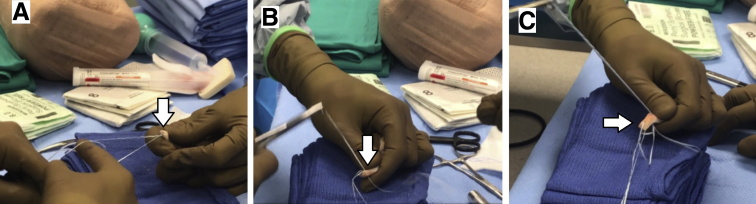
Patient in supine position, right knee, viewing from the anterior lateral portal. (A) Suture tape is passed through the predrilled, 2-mm hole on the planned femoral aspect of the bone block and tied around the planned proximal posterior end of the bone block. (B) A separate passing suture is passed through the same 2-mm planned femoral bone block hole. (C) The tails of the suture tape from (A) are passed back through the graft, as seen in the image. These tails will be fixed in the tibial tunnel, whereby they will span the graft and function as the suture augmentation.
Fig 2
Fig 2
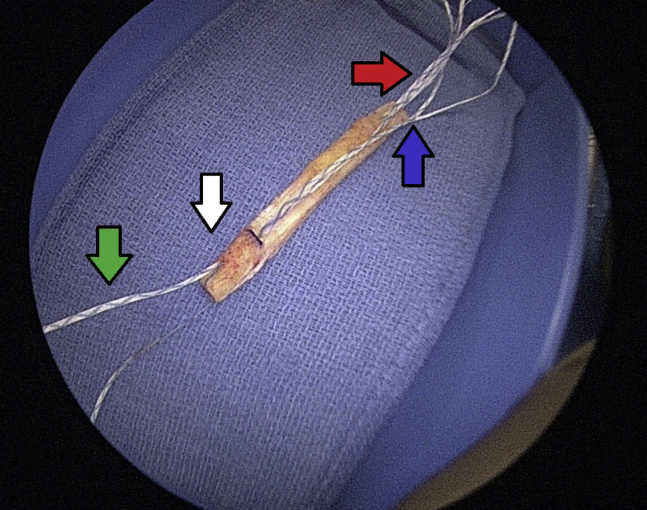
The final ACL graft with suture augmentation construct. White arrow: The planned femoral aspect of the graft. Green arrow: Passing sutures of the planned femoral aspect of the graft. Red arrow: Passing suture of the planned tibial aspect of the graft. Blue arrow: Tails of the suture augmentation. (ACL, anterior cruciate ligament.)
Fig 3
Fig 3
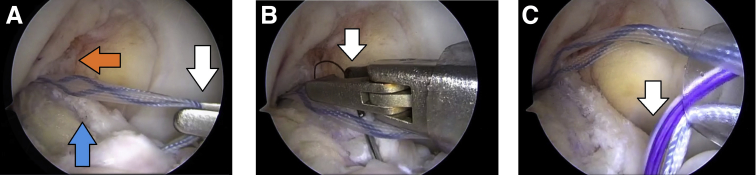
These images are taken from the anterior lateral portal with the patient's right knee in 90° of flexion, patient in supine position. (A) The orange arrow points to the femoral tunnel where the ACL graft has been fixed using an interference screw. The blue arrow points to the ACL graft. The tibial tunnel is in the inferior portion of the image. The suture tape is retrieved through an anterior medial portal (white arrow). (B) A suture wire is passed through the tibial interference screw and is retrieved via the anteromedial portal. (C) The suture tape is pulled through the tibial interference screw using the suture wire. (ACL, anterior cruciate ligament.)
Fig 4
Fig 4
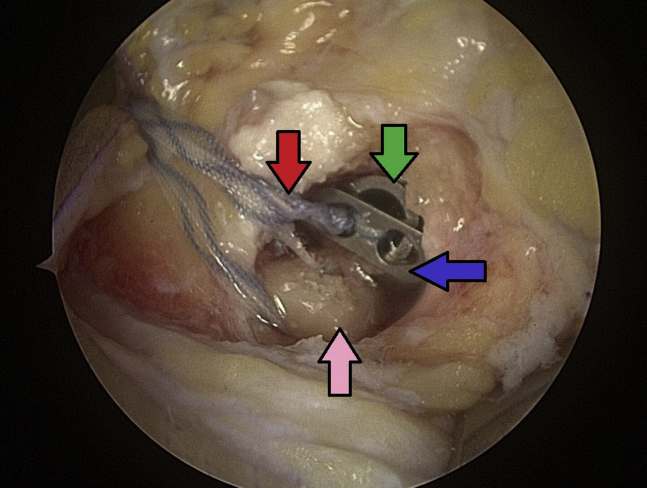
Patient in supine position, right knee, viewing from the anterior lateral portal. An extra-articular image of the tibial aspect of the final construct. Pink arrow: the bone block, which has been fixed in the tibial tunnel. Green arrow: The tibial interference screw, which has fixed the bone block in place. Blue arrow: a metallic button, which rests on top of the tibial interference screw. Red arrow: The tails of the suture tape, which have been tied down over the button, and are now fixed in place.

References

    1. Gianotti S.M., Marshall S.W., Hume P.A., Bunt L. Incidence of anterior cruciate ligament injury and other knee ligament injuries: A national population-based study. J Sci Med Sport. 2009;12:622–627. - PubMed
    1. Magnussen R.A., Granan L.P., Dunn W.R. Cross-cultural comparison of patients undergoing ACL reconstruction in the United States and Norway. Knee Surg Sports Traumatol Arthrosc. 2010;18:98–105. - PMC - PubMed
    1. Sanders T.L., Pareek A., Kremers H.M. Long-term follow-up of isolated ACL tears treated without ligament reconstruction. Knee Surg Sports Traumatol Arthrosc. 2017;25:493–500. - PubMed
    1. Lyman S., Koulouvaris P., Sherman S., Do H., Mandl L.A., Marx R.G. Epidemiology of anterior cruciate ligament reconstruction: Trends, readmissions, and subsequent knee surgery. J Bone Joint Surg Am. 2009;91:2321–2328. - PubMed
    1. Schlumberger M., Schuste P., Schulz M. Traumatic graft rupture after primary and revision anterior cruciate ligament reconstruction: Retrospective analysis of incidence and risk factors in 2915 cases. Knee Surg Sports Traumatol Arthrosc. 2017;25:1535–1541. - PubMed

LinkOut - more resources