


Steroid-Associated Side Effects in Patients With Primary Proteinuric Kidney Disease
- PMID: 31891002
- PMCID: PMC6933464
- DOI: 10.1016/j.ekir.2019.08.019
Steroid-Associated Side Effects in Patients With Primary Proteinuric Kidney Disease
Abstract
Introduction: The goal of this study was to assess the occurrence of steroid-associated adverse events (SAAE) in patients with primary proteinuric kidney disease.
Methods: The Kidney Research Network Registry consists of children and adults with primary proteinuric kidney disease. SAAEs of interest were hypertension, hyperglycemia and diabetes, overweight and obesity, short stature, ophthalmologic complications, bone disorders, infections, and psychosis. Events were identified using International Classification of Diseases, Ninth Revision/Tenth Revision codes, blood pressures, growth parameters, laboratory values, and medications. Poisson generalized estimating equations tested the association between steroid onset and dose on SAAE risk.
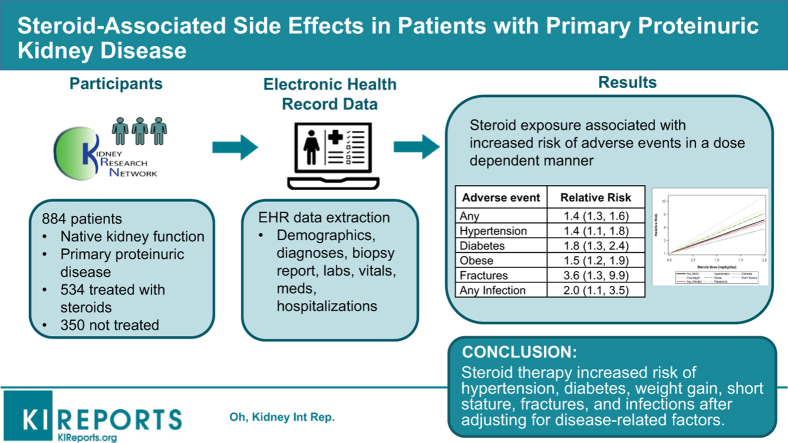
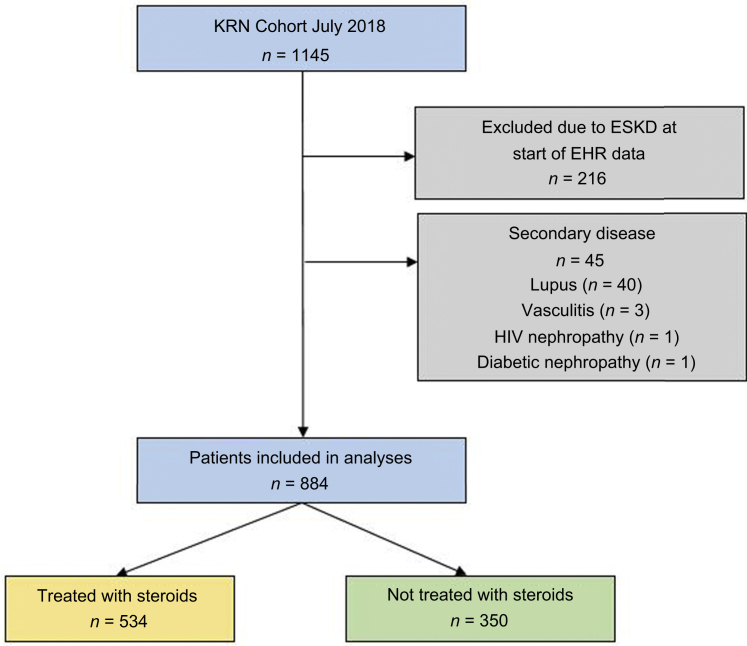
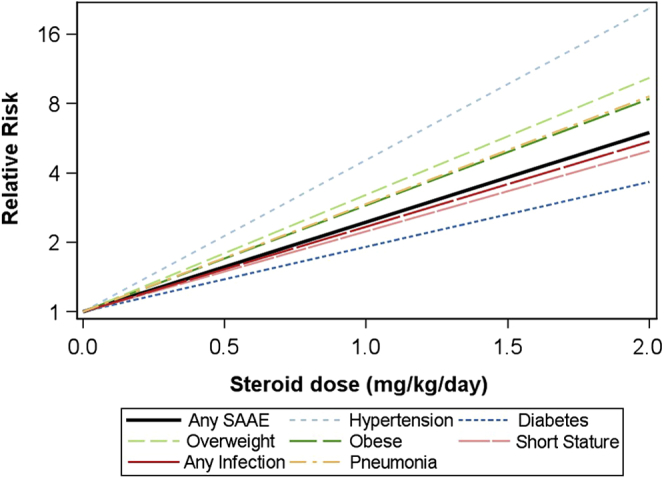
Results: A total of 884 participants were included in the analysis; 534 (60%) were treated with steroids. Of these, 62% had at least one SAAE. The frequency of any SAAE after initiation of steroids was 293 per 1000 person-years. The most common SAAEs were hypertension (173.7 per 1000 person-years), diabetes (78.7 per 1000 person-years), obesity (66.8 per 1000 person-years), and infections (46.1 per 1000 person-years). After adjustment for demographics, duration of kidney disease, estimated glomerular filtration rate (eGFR), proteinuria, and other therapies, steroid exposure was associated with a 40% increase in risk of any SAAE (Relative risk [RR]: 1.4; 95% confidence interval [CI]: 1.3-1.6). A 1-mg/kg per day increase in steroid dose was associated with a 2.5-fold increase in risk of any SAAE.
Conclusion: Most patients with primary proteinuric kidney disease treated with steroids experienced at least one SAAE. Steroid therapy increased risk of hypertension, diabetes, weight gain, short stature, fractures, and infections after adjusting for disease-related factors. This study highlights the importance of surveillance and management of SAAE and provides rationale for the development of steroid minimization protocols.
Keywords: adverse events; electronic medical record data; glomerular disease; nephrotic syndrome; side effects; steroids.
© 2019 International Society of Nephrology. Published by Elsevier Inc.
Figures
References
-
- Ruiz-Arruza I., Ugarte A., Cabezas-Rodriguez I. Glucocorticoids and irreversible damage in patients with systemic lupus erythematosus. Rheumatology. 2014;53:1470–1476. - PubMed
-
- Conn H.O., Poynard T. Corticosteroids and peptic ulcer:meta-analysis of adverse events during steroid therapy. J Intern Med. 1994;236:619–632. - PubMed
-
- Fardet L., Feve B. Systemic glucocorticoid therapy:a review of its metabolic and cardiovascular adverse events. Drugs. 2014;74:1731–1745. - PubMed
LinkOut - more resources
Full Text Sources
Research Materials
Miscellaneous
