


Ethnicity recording in health and social care data collections in Ireland: where and how is it measured and what is it used for?
- PMID: 31892328
- PMCID: PMC6938635
- DOI: 10.1186/s12939-019-1107-y
Ethnicity recording in health and social care data collections in Ireland: where and how is it measured and what is it used for?
Abstract
Background: In the European Union (EU), discrimination based on racial and ethnic origin is prohibited under the Racial Equality Directive. Ireland is one of only three EU countries where a legal duty of equality data collection is placed on public bodies. It provides an important context in which to study ethnic equality monitoring; however no systematic mapping of where it occurs in health information systems has been carried out. The aim of this study is to identify all existing national health and social care data collections with information on ethnicity and to explore how this data has been collected and used.
Methods: An electronic search of a national catalogue of health and social care data collections (N = 97) was carried out to identify any collections which contained information on ethnicity. Data dictionaries were searched and key informants contacted. For each of the data collections that collected information on ethnicity, data was extracted on the ethnic categories used and how this data is collected; the completeness of ethnicity recording; and other measures related to ethnicity in the data collection. Relevant outputs for these data collections, related to ethnicity, were identified through key informants and electronic searches.
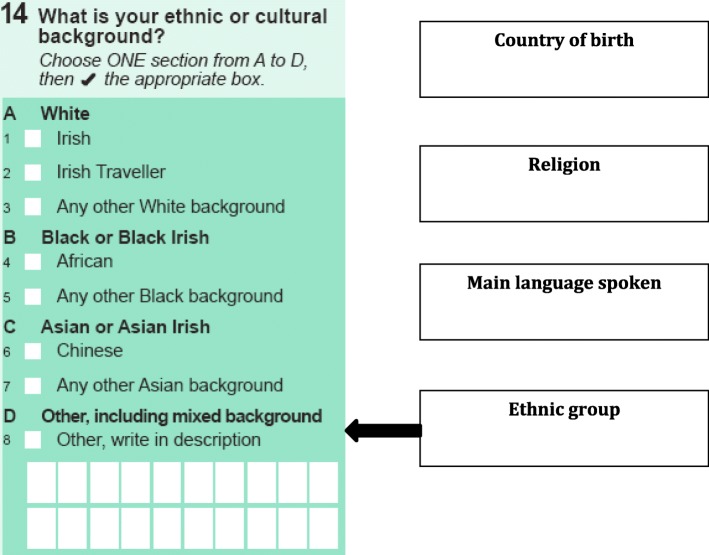
Results: Of the 97 data collections, 14 (14%) collected information on ethnic or cultural background. Country of birth was collected by 10 of these 14 data collections. Most used the ethnic categories in the Census and recommended that ethnicity should be self-identified and not assigned. Reported rates of identification were generally high (≥90%). Data collections which recorded ethnicity tended to be focused on potentially high-risk populations with no routine recording in primary care. There were some examples of where ethnic equality monitoring had informed targeted interventions e.g. vaccination awareness initiatives or cultural training for healthcare staff.
Conclusions: Despite strong policy and legal imperatives, there is limited data collection of ethnicity in health and social care data collections in Ireland. While there are some examples of where differences by ethnicity have been identified and acted upon, a more coordinated and comprehensive approach to the collection, quality and utilization of ethnicity data is needed to promote health equity.
Keywords: Equality monitoring; Ethnicity; Health information systems.
Conflict of interest statement
The authors declare they have no competing interests.
Figures
References
-
- Makkonen T. European handbook on equality data–2016 revision. Brussels: EU Commission DG Justice and Consumers; 2017.
-
- European Union Agency for Fundamental Rights. The Racial Equality Directive: application and challenges. Luxembourg: Publications Office of the European Union, 2012.
-
- Farkas L. Data collection in the field of ethnicity. Luxembourg: Publications Office of the European Union; 2017. Analysis and comparative review of equality data collection practices in the European Union.
-
- Simon P. Collecting ethnic statistics in Europe: a review. Ethn Racial Stud. 2012;35(8):1366–1391. doi: 10.1080/01419870.2011.607507. - DOI
-
- Roth WD. Methodological pitfalls of measuring race: international comparisons and repurposing of statistical categories. Ethn Racial Stud. 2017;40(13):2347–2353. doi: 10.1080/01419870.2017.1344276. - DOI
Publication types
MeSH terms
LinkOut - more resources
Full Text Sources
