


Intermittent theta burst stimulation applied during early rehabilitation after stroke: study protocol for a randomised controlled trial
- PMID: 31892668
- PMCID: PMC6955550
- DOI: 10.1136/bmjopen-2019-034088
Intermittent theta burst stimulation applied during early rehabilitation after stroke: study protocol for a randomised controlled trial
Abstract
Introduction: Intermittent theta burst stimulation (iTBS) applied to primary motor cortex (M1) has been shown to modulate both the excitability and connectivity of the motor system. A recent proof-of-principle study, based on a small group of hospitalised patients with acute ischemic stroke, suggested that iTBS applied to the ipsilesional M1 combined with physical therapy early after stroke can amplify motor recovery with lasting after effects. A randomised controlled clinical trial using a double-blind design is warranted to justify the implementation of iTBS-assisted motor rehabilitation in neurorehabilitation from an acute ischaemic stroke.
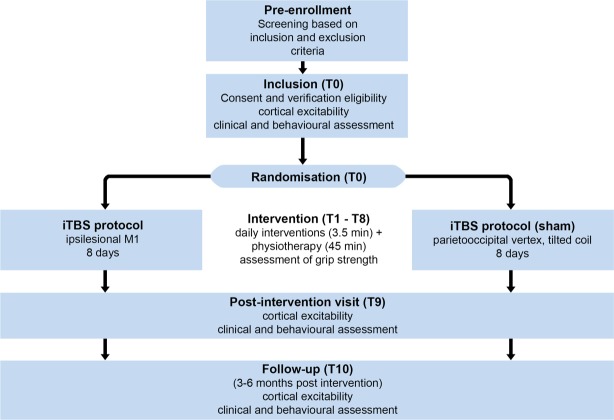
Methods/design: We investigate the effects of daily iTBS on early motor rehabilitation after stroke in an investigator-initiated, longitudinal randomised controlled trial. Patients (n=150) with hemiparesis receive either iTBS (600 pulses) applied to the ipsilesional motor cortex (M1) or a control stimulation (ie, coil placement over the parieto-occipital vertex in parallel to the interhemispheric fissure and with a tilt of 45°). On 8 consecutive workdays, a 45 min arm-centred motor training follows the intervention . The relative grip strength, defined as the grip force ratios of the affected and unaffected hands, serves as the primary outcome parameter. Secondary outcome parameters are measures of arm function (Action Research Arm Test, Fugl-Meyer Motor Scale), stroke severity (National Institutes of Health Stroke Scale), stroke-induced disability (modified Rankin Scale, Barthel Index), duration of inpatient rehabilitation, quality of life (EuroQol 5D), motor evoked potentials and the resting motor threshold of the ipsilesional M1.
Ethics and dissemination: The study was approved by the Ethics Commission of the Medical Faculty, University of Cologne, Germany (reference number 15-343). Data will be disseminated through peer-reviewed publications and presentations at conferences. Study title: Theta-Burst Stimulation in Early Rehabilitation after Stroke (acronym: TheSiReS). Study registration at German Registry for Clinical Trials (DRKS00008963) and at ClinicalTrials.gov (NCT02910024).
Keywords: TMS; hemiparesis; iTBS; motor recovery; rehabilitation.
© Author(s) (or their employer(s)) 2019. Re-use permitted under CC BY-NC. No commercial re-use. See rights and permissions. Published by BMJ.
Conflict of interest statement
Competing interests: None declared.
Figures
References
-
- Carod-Artal J, Egido JA, González JL, et al. Quality of life among stroke survivors evaluated 1 year after stroke: experience of a stroke unit. Stroke 2000;31:2995–3000. - PubMed
Publication types
MeSH terms
Associated data
LinkOut - more resources
Full Text Sources
Medical
