


Bacterial pathogens and resistance causing community acquired paediatric bloodstream infections in low- and middle-income countries: a systematic review and meta-analysis
- PMID: 31893041
- PMCID: PMC6937962
- DOI: 10.1186/s13756-019-0673-5
Bacterial pathogens and resistance causing community acquired paediatric bloodstream infections in low- and middle-income countries: a systematic review and meta-analysis
Abstract
Background: Despite a high mortality rate in childhood, there is limited evidence on the causes and outcomes of paediatric bloodstream infections from low- and middle-income countries (LMICs). We conducted a systematic review and meta-analysis to characterize the bacterial causes of paediatric bloodstream infections in LMICs and their resistance profile.
Methods: We searched Pubmed and Embase databases between January 1st 1990 and October 30th 2019, combining MeSH and free-text terms for "sepsis" and "low-middle-income countries" in children. Two reviewers screened articles and performed data extraction to identify studies investigating children (1 month-18 years), with at least one blood culture. The main outcomes of interests were the rate of positive blood cultures, the distribution of bacterial pathogens, the resistance patterns and the case-fatality rate. The proportions obtained from each study were pooled using the Freeman-Tukey double arcsine transformation, and a random-effect meta-analysis model was used.
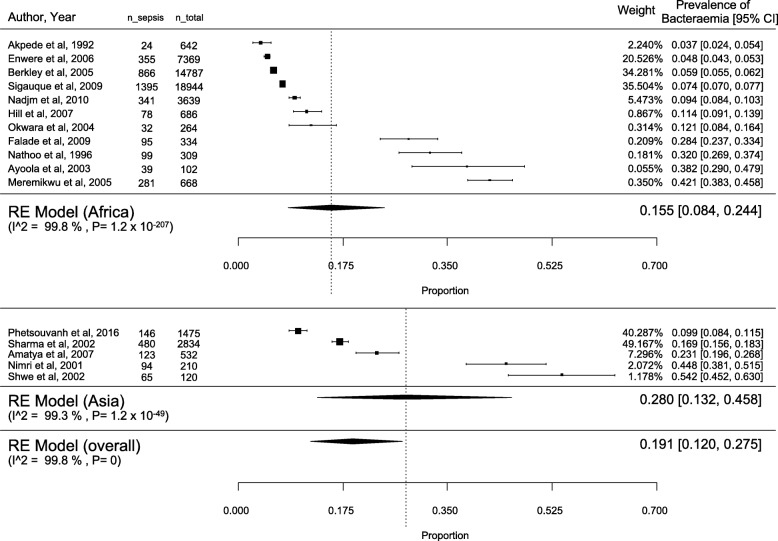
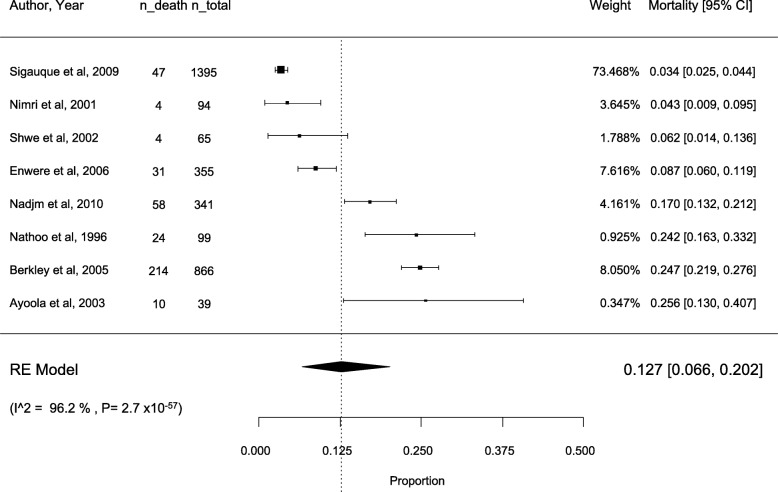
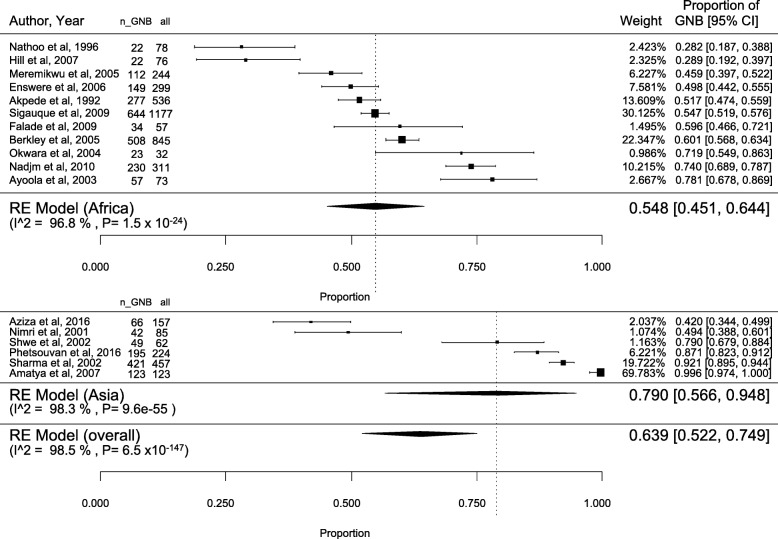
Results: We identified 2403 eligible studies, 17 were included in the final review including 52,915 children (11 in Africa and 6 in Asia). The overall percentage of positive blood culture was 19.1% [95% CI: 12.0-27.5%]; 15.5% [8.4-24.4%] in Africa and 28.0% [13.2-45.8%] in Asia. A total of 4836 bacterial isolates were included in the studies; 2974 were Gram-negative (63.9% [52.2-74.9]) and 1858 were Gram-positive (35.8% [24.9-47.5]). In Asia, Salmonella typhi (26.2%) was the most commonly isolated pathogen, followed by Staphylococcus aureus (7.7%) whereas in Africa, S. aureus (17.8%) and Streptococcus pneumoniae (16.8%) were predominant followed by Escherichia coli (10.7%). S. aureus was more likely resistant to methicillin in Africa (29.5% vs. 7.9%), whereas E. coli was more frequently resistant to third-generation cephalosporins (31.2% vs. 21.2%), amikacin (29.6% vs. 0%) and ciprofloxacin (36.7% vs. 0%) in Asia. The overall estimate for case-fatality rate among 8 studies was 12.7% [6.6-20.2%]. Underlying conditions, such as malnutrition or HIV infection were assessed as a factor associated with bacteraemia in 4 studies each.
Conclusions: We observed a marked variation in pathogen distribution and their resistance profiles between Asia and Africa. Very limited data is available on underlying risk factors for bacteraemia, patterns of treatment of multidrug-resistant infections and predictors of adverse outcomes.
Keywords: Antimicrobial resistance; Bacteraemia; Bloodstream infection; Children; Epidemiology; Resource-limited settings; Sepsis.
© The Author(s). 2019.
Conflict of interest statement
Competing interestsThe authors declare that they have no competing interests.
Figures

References
-
- Mahavanakul W, Nickerson EK, Srisomang P, Teparrukkul P, Lorvinitnun P, Wongyingsinn M, et al. Feasibility of modified surviving sepsis campaign guidelines in a resource-restricted setting based on a cohort study of severe S. aureus sepsis [corrected] PLoS One. 2012;7:e29858. doi: 10.1371/journal.pone.0029858. - DOI - PMC - PubMed
Publication types
MeSH terms
Substances
LinkOut - more resources
Full Text Sources
Medical
