


R-(-)-carvone Attenuated Doxorubicin Induced Cardiotoxicity In Vivo and Potentiated Its Anticancer Toxicity In Vitro
- PMID: 31893584
- PMCID: PMC7094179
- DOI: 10.4274/balkanmedj.galenos.2019.2019.7.117
R-(-)-carvone Attenuated Doxorubicin Induced Cardiotoxicity In Vivo and Potentiated Its Anticancer Toxicity In Vitro
Abstract
Background: Doxorubicin is one of the most potent broad-spectrum antitumor and chemotherapeutic agents. However, it produces cardiotoxicity.
Aims: To investigate whether R-(-)-carvone exerts a cardioprotective effect against doxorubicin toxicity in vivo and in vitro.
Study design: Cell culture and animal experiment.
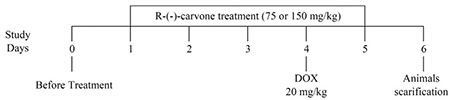
Methods: The synergistic effect of R-(-)-carvone with doxorubicin was evaluated in the MCF 7 cancer cell line while its protective effect against doxorubicin toxicity was evaluated in the normal heart cell line (H9C2) and in vivo. Furthermore, the mechanism of its cardioprotective effect was studied.
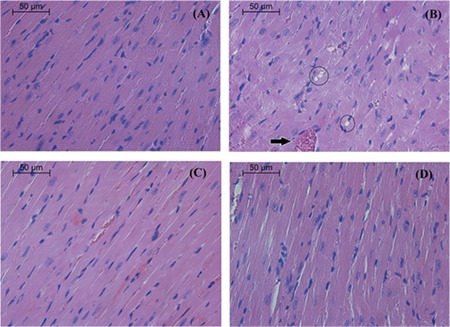
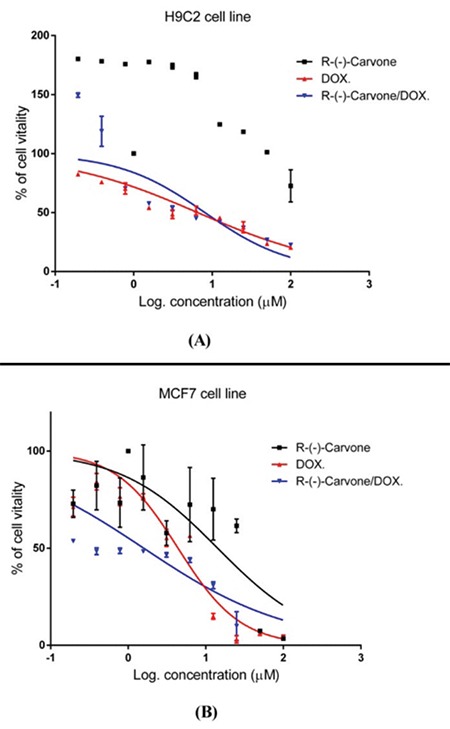
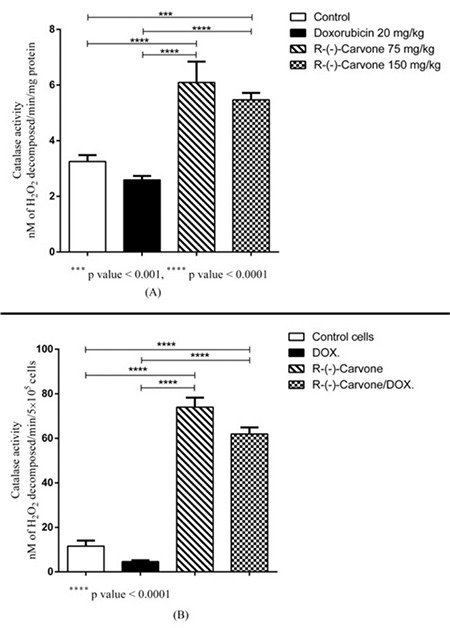
Results: R-(-)-carvone exerted cytotoxic action on the MCF 7 cancer cell line with an IC50 value of 14.22 μM and potentiated the cytotoxic action of doxorubicin, while it decreased the toxicity of doxorubicin on a normal heart cell line. In BALB/c mice, R-(-)-carvone protected the heart from the toxic action of doxorubicin, as was evident by biochemical and histological studies. The protective effect of R-(-)-carvone on the H9C2 heart cell line and on heart in vivo was due to an increase in catalase activity.
Conclusion: R-(-)-carvone has synergistic anticancer action with doxorubicin on the MCF 7 cell line while decreasing its cardiotoxicity.
Keywords: Cardiotoxicity; R-(-)-carvone; H9C2; catalase; doxorubicin; MCF 7.
Conflict of interest statement
Figures
References
-
- Hanusova V, Bousova I, Skalova L. Possibilities to increase the effectiveness of doxorubicin in cancer cells killing. Drug Metab Rev. 2011;43:540–57. - PubMed
-
- Osman HE, Abohassan AA. Morphological and Analytical characterization of Moringa peregrina Populations In Western Saudi Arabia. IJTAS. 2012;4:174–84.
-
- Trivedi PP, Kushwaha S, Tripathi DN, Jena GB. Cardioprotective effects of hesperetin against doxorubicin-induced oxidative stress and DNA damage in rat. Cardiovasc Toxicol. 2011;11:215–25. - PubMed
Publication types
MeSH terms
Substances
LinkOut - more resources
Full Text Sources
