Review
. 2019 Nov 7;11(21):5198-5211.
doi: 10.1002/cctc.201901215. Epub 2019 Aug 30.

Frontiers in Halogen and Chalcogen-Bond Donor Organocatalysis

Affiliations
Review

Frontiers in Halogen and Chalcogen-Bond Donor Organocatalysis

Julia Bamberger et al. ChemCatChem. .

Abstract

Non-covalent molecular interactions on the basis of halogen and chalcogen bonding represent a promising, powerful catalytic activation mode. However, these "unusual" non-covalent interactions are typically employed in the solid state and scarcely exploited in catalysis. In recent years, an increased interest in halogen and chalcogen bonding has been awaken, as they provide profound characteristics that make them an appealing alternative to the well-explored hydrogen bonding. Being particularly relevant in the binding of "soft" substrates, the similar strength to hydrogen bonding interactions and its higher directionality allows for solution-phase applications with halogen and chalcogen bonding as the key interaction. In this mini-review, the special features, state-of-the-art and key examples of these so-called σ-hole interactions in the field of organocatalysis are presented.

Keywords: Chalcogen; Halogen-bonding; Non-covalent activation; Organocatalysis; Sigma-hole.


Conflict of interest statement

The authors declare no conflict of interest.

Figures

Figure 1
Figure 1
a) σ‐Holes that are predicted to increase with heavier atoms and a higher polarizability. b) Model structures candidates explored in catalysis.14
Scheme 1
Scheme 1
Pioneer XB‐bond‐catalyzed reduction of quinolines by Bolm et al.
Scheme 2
Scheme 2
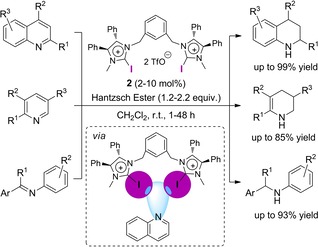
XB‐bond‐catalyzed reduction of quinolines, pyridines and imines.
Scheme 3
Scheme 3
Diels‐Alder reaction catalyzed by bidentate iodo‐imidazolium salts.
Scheme 4
Scheme 4
XB‐donor‐catalyzed Michael additions by Huber and Breugst et al.
Scheme 5
Scheme 5
Activation of benzaldehydes: CBr4‐catalyzed Aldol and Knoevenagel condensation reactions.
Scheme 6
Scheme 6
Cross‐enolate coupling catalyzed by monodentate XB‐donor 6.
Scheme 7
Scheme 7
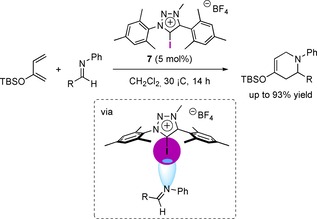
XB‐donor 7‐catalyzed aza‐Diels‐Alder reaction of imines and 2‐siloxy‐1,3‐butadienes.
Scheme 8
Scheme 8
XB‐donor 8‐catalyzed aza‐Diels‐Alder reaction between imines and the Danishefsky's diene.
Scheme 9
Scheme 9
Plausible reaction mechanism via a) a Mannich‐Michael or b) a [4+2]‐aza‐Diels‐Alder pathway.
Scheme 10
Scheme 10
XB‐donor 9‐catalyzed aziridine synthesis.
Scheme 11
Scheme 11
XB‐donor‐catalyzed, TMS‐I induced activation of alcohols.
Scheme 12
Scheme 12
Iodoalkyne 11‐catalyzed benzoxazole formation.
Scheme 13
Scheme 13
NBS‐catalyzed benzothiazole formation.
Scheme 14
Scheme 14
Early XB‐donor‐mediated solvolysis of benzhydryl bromides.
Scheme 15
Scheme 15
Stoichiometric hypervalent iodine(III) X‐donor 15 in the solvolysis of benzhydryl chloride.
Scheme 16
Scheme 16
XB‐donor‐mediated Friedel‐Crafts alkylation of electron rich arenes.
Scheme 17
Scheme 17
SN1‐type nucleophilic addition to 1‐chloroisochroman.
Scheme 18
Scheme 18
XB‐donor‐mediated glycosylation using 3‐OTf as activating reagent.
Scheme 19
Scheme 19
XB‐donor‐catalyzed controlled cationic polymerization reaction.
Scheme 20
Scheme 20
[4+2]‐Cycloaddition of 2‐alkenylindoles catalyzed by C–I–π‐halogen‐bond‐interactions.
Scheme 21
Scheme 21
Intramolecular Aldol lactonization for the enantioselective preparation of β‐lactones via a secondary Ch‐bonding stabilization.
Figure 2
Figure 2
Conformational stabilization of the isothiourea moiety.19, 23
Scheme 22
Scheme 22
Organoselenides as Lewis basic organocatalysts.
Scheme 23
Scheme 23
ChB‐donor‐catalyzed transfer hydrogenation reported by Matile et al.
Scheme 24
Scheme 24
Carbon‐halogen bond activation by Se‐based Ch‐bonding reported by Huber et al.
Scheme 25
Scheme 25
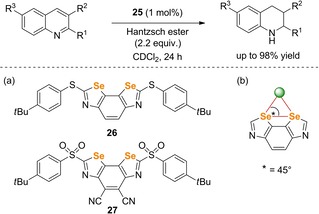
(a) ChB‐donor‐based BDS catalysts 2627 developed by Matile et al. and (b) schematic illustration of chloride (green) bound to the BDS core showing an ideal bite angle of 45°.
Scheme 26
Scheme 26
ChB‐donor‐catalyzed reaction of 1‐chloroisochroman with a silyl ketene acetal. TBS=tert‐butyldimethylsilyl.
Scheme 27
Scheme 27
Chloride abstraction of 1‐chloroisochroman and Troc‐protected 1‐chloroisoquinoline by ChB‐catalysts 28 and 29.
Scheme 28
Scheme 28
ChB‐donor‐catalyzed assembly of small molecules: Synthesis of fused N‐heterocycles via Michael/aldol/cyclization tandem reaction.

References

    1. Schreiner P. R., Chem. Soc. Rev. 2003, 32, 289–296. - PubMed
    1. None
    1. Knowles R. R., Jacobsen E. N., Proc. Mont. Acad. Sci. 2010, 107, 20678–20685; - PMC - PubMed
    1. MacMillan D. W. C., Nature 2008, 455, 304–308. - PubMed
    1. None

LinkOut - more resources