


Heaviness-brightness correspondence and stimulus-response compatibility
- PMID: 31898071
- PMCID: PMC7297857
- DOI: 10.3758/s13414-019-01963-6
Heaviness-brightness correspondence and stimulus-response compatibility
Abstract
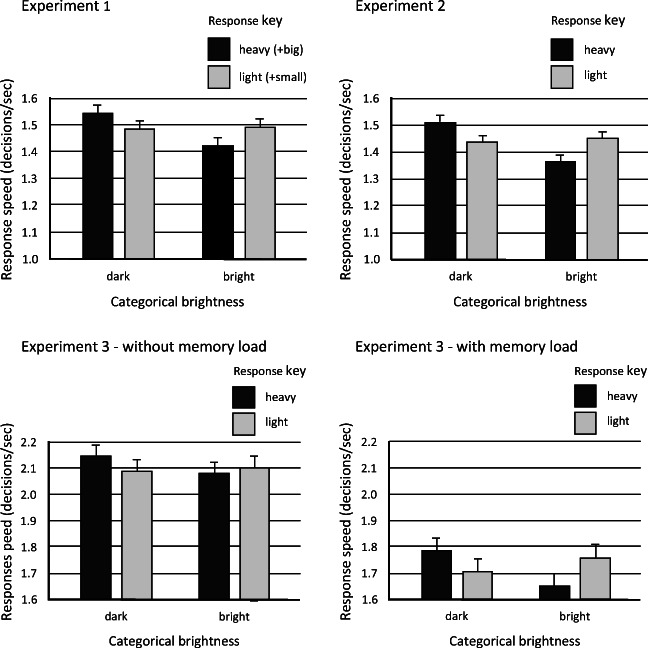
Cross-sensory correspondences can reflect crosstalk between aligned conceptual feature dimensions, though uncertainty remains regarding the identities of all the dimensions involved. It is unclear, for example, if heaviness contributes to correspondences separately from size. Taking steps to dissociate variations in heaviness from variations in size, the question was asked if a heaviness-brightness correspondence will induce a congruity effect during the speeded brightness classification of simple visual stimuli. Participants classified the stimuli according to whether they were brighter or darker than the mid-gray background against which they appeared. They registered their speeded decisions by manipulating (e.g., tapping) the object they were holding in either their left or right hand (e.g., left for bright, right for dark). With these two otherwise identical objects contrasting in their weight, stimuli were classified more quickly when the relative heaviness of the object needing to be manipulated corresponded with the brightness of the stimulus being classified (e.g., the heavier object for a darker stimulus). This novel congruity effect, in the guise of a stimulus-response (S-R) compatibility effect, was induced when heaviness was isolated as an enduring feature of the object needing to be manipulated. It was also undiminished when participants completed a concurrent verbal memory load task, countering claims that the heaviness-brightness correspondence is verbally mediated. Heaviness, alongside size, appears to contribute to cross-sensory correspondences in its own right and in a manner confirming the far-reaching influence of correspondences, extending here to the fluency with which people communicate simple ideas by manipulating a hand-held object.
Keywords: Brightness; Cross-sensory correspondences; Heaviness; Stimulus-response compatibility.
Figures

References
-
- Baneberry, Y. (2007). Bittersweet Nightshade. Xlibris. p. 75.
-
- Bates D., Maechler, M., Bolker, B. & Walker, S. (2014). lme4: Linear mixed-effects models using Eigen and S4. R package version 1.1-7, <URL:http://CRAN.R-project.org/package=lme4>.
-
- Becker L, van Rompay TJL, Schifferstein HNJ, Galetzka M. Tough package, strong taste: The influence of packaging design on taste impressions and product evaluation. Food Quality and Preference. 2011;22:17–23.
-
- Bomba PC, Siqueland ER. The nature and structure of infant form categories. Journal of Experimental Child Psychology. 1983;35:294–328.
-
- Bradford, M. (2015). Button Hill. Victoria, British Columbia: ORCA Book Publishers. p. 24.
MeSH terms
LinkOut - more resources
Full Text Sources
Research Materials
