


Daytime napping and successful aging among older adults in China: a cross-sectional study
- PMID: 31898552
- PMCID: PMC6941277
- DOI: 10.1186/s12877-019-1408-4
Daytime napping and successful aging among older adults in China: a cross-sectional study
Abstract
Background: The study aimed to examine the association between daytime napping and successful aging (including its five dimensions, "low probability of disease," "no disease-related disability," "high cognitive functioning," "high physical functioning," and "active engagement with life") among China's older adults using data from the Chinese Health and Retirement Longitudinal Study conducted in 2015.
Methods: Cross-sectional data were used in the analysis. Multivariable logistic regressions were conducted to investigate the association between daytime napping and successful aging, and stratified analyses were performed to explore differences in nighttime sleep duration.
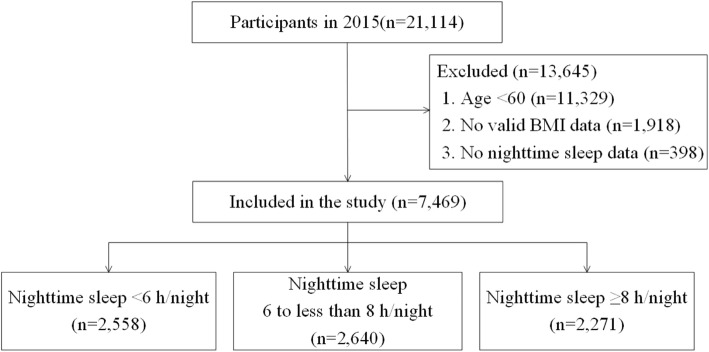
Results: A total of 7469 participants were included in the analysis. Daytime napping was prevalent in China's older adults (59.3%). The proportion of study participants with "successful aging" was 13.7%. Additionally, 48.6, 91.7, 54.1, 78.5, and 49.1% participants achieved "low probability of disease," "no disease-related disability," "high cognitive functioning," "high physical functioning," and "active engagement with life," respectively. Compared with the 0 min/day napping group, the > 60 min/day napping group was associated with a lower probability of achieving successful aging (OR, 0.762; 95% CI, 0.583-0.996). In the nighttime sleep duration stratification, the findings showed that in the ≥8 h/night group, napping > 60 min per day was associated with a lower likelihood of aging successfully (OR, 0.617; 95% CI, 0.387-0.984). Considering the five dimensions of successful aging, moderate and long daytime napping were negatively associated with "low probability of disease"; long daytime napping had negative associations with "no disease-related disability" and "high physical functioning"; moderate daytime napping had positive associations with "high cognitive functioning" and "active engagement with life."
Conclusions: Long daytime napping showed a lower likelihood of successful aging among the elderly in China. Special attention is necessary for elderly people who sleep for longer duration both during day and night. Biological and social factors affecting the relationship between daytime napping and successful aging need to be explored in depth in the future.
Keywords: Chinese health and retirement longitudinal study; Daytime napping; Older adults; Successful aging.
Conflict of interest statement
The authors declare that they have no competing interests.
References
-
- Nations U. Department of Economic and Social Affairs, population division. Int Migr Rep. 2015. Available: http://www.un.org/en/development/desa/news/population/2015-report.html.
-
- Ma J. National Bureau of Statistics of China. China statistical yearbook. Beijing: China Statistics Press; 2010.
-
- Baltes PB, Mayer KU. The Berlin aging study: aging from 70 to 100: Cambridge University Press; 2001.
Publication types
MeSH terms
Grants and funding
LinkOut - more resources
Full Text Sources
Medical
