


Behavioral Economics Incentives to Support HIV Treatment Adherence (BEST): Protocol for a randomized controlled trial in Uganda
- PMID: 31900193
- PMCID: PMC6942278
- DOI: 10.1186/s13063-019-3795-4
Behavioral Economics Incentives to Support HIV Treatment Adherence (BEST): Protocol for a randomized controlled trial in Uganda
Abstract
Background: Many HIV-positive patients do not appropriately adhere to their antiretroviral medication (ART). This leads to higher viral loads and greater probability of HIV transmission. Present bias-a tendency to give in to short-term temptations at the expense of long-term outcomes-is a potential driver of low adherence. In this study we test a novel intervention rooted in behavioral economics that is designed to overcome present bias and increase ART adherence.
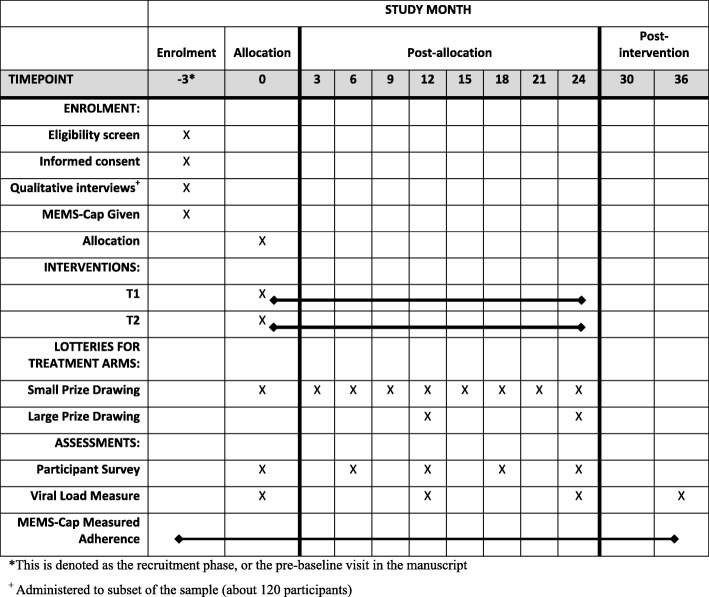
Methods/design: We will enroll 330 HIV-positive patients at Mildmay Hospital in Kampala, Uganda, into a 2-year randomized controlled trial. Participants will be randomized to one of three groups. The first intervention group (T1, n = 110) will be eligible for small lottery prizes based on timely clinic visits and demonstration of viral suppression. Group 2 (T2, n = 110) will be eligible for the same lottery prizes conditional on high adherence measured by a medication event management system (MEMS) cap. The control group (n = 110) will receive the usual standard of care. Adherence will be measured continuously throughout the intervention period and for 12 months post-intervention to evaluate effect persistence. Surveys will be conducted at baseline and then every 6 months. Viral loads will be measured annually. Primary outcomes are whether the viral load is detectable and MEMS-measured adherence. Secondary outcomes are the log-transformed viral load as a continuous measure and a binary measure for whether the person took at least 90% of their ART pills.
Discussion: Our study is one of the first to investigate the effectiveness of lottery incentives for improving ART adherence, and in addition, it compares the relative efficacy of using electronically measured adherence versus viral load to determine lottery eligibility. MEMS caps are relatively costly, whereas viral load testing is now part of routine clinical care in Uganda. BEST will test whether directly incentivizing viral suppression (which can be implemented using readily available clinic data) is as effective as incentivizing electronically measured adherence. Cost-effectiveness analyses of the two implementation modes will also be performed.
Trial registration: ClinicalTrials.gov, NCT03494777. Registered on 11 April 2018.
Keywords: Behavioral Economics; Global Health; HIV/AIDS; Incentives; Lottery; Present Bias; Randomized Controlled Trial; Uganda.
Conflict of interest statement
The authors declare that they have no competing interests.
Figures
References
-
- UNAIDS. HIV and AIDS estimates. 2014. https://www.unaids.org/en/regionscountries/countries/uganda. Accessed 6 Dec 2019.
-
- UNAIDS. Global AIDS Monitoring 2018: Indicators for monitoring the 2016 United Nations Political Declaration on Ending AIDS. 2017. http://www.unaids.org/sites/default/files/media_asset/2017-Global-AIDS-M.... Accessed 6 Dec 2019.
-
- UNAIDS. Report on the global AIDS epidemic. 2012. http://www.unaids.org/sites/default/files/media_asset/20121120_UNAIDS_Gl.... Accessed 6 Dec 2019.
Publication types
MeSH terms
Substances
Associated data
Grants and funding
LinkOut - more resources
Full Text Sources
Medical
Miscellaneous
