Review
. 2020 Jan 24;23(1):100789.
doi: 10.1016/j.isci.2019.100789. Epub 2019 Dec 19.

Sharpening the Molecular Scissors: Advances in Gene-Editing Technology

Affiliations
Review

Sharpening the Molecular Scissors: Advances in Gene-Editing Technology

Mike Broeders et al. iScience. .

Abstract

The ability to precisely modify human genes has been made possible by the development of tools such as meganucleases, zinc finger nucleases, TALENs, and CRISPR/Cas. These now make it possible to generate targeted deletions, insertions, gene knock outs, and point variants; to modulate gene expression by targeting transcription factors or epigenetic machineries to DNA; or to target and modify RNA. Endogenous repair mechanisms are used to make the modifications required in DNA; they include non-homologous end joining, homology-directed repair, homology-independent targeted integration, microhomology-mediated end joining, base-excision repair, and mismatch repair. Off-target effects can be monitored using in silico prediction and sequencing and minimized using Cas proteins with higher accuracy, such as high-fidelity Cas9, enhanced-specificity Cas9, and hyperaccurate Cas9. Alternatives to Cas9 have been identified, including Cpf1, Cas12a, Cas12b, and smaller Cas9 orthologs such as CjCas9. Delivery of gene-editing components is performed ex vivo using standard techniques or in vivo using AAV, lipid nanoparticles, or cell-penetrating peptides. Clinical development of gene-editing technology is progressing in several fields, including immunotherapy in cancer treatment, antiviral therapy for HIV infection, and treatment of genetic disorders such as β-thalassemia, sickle cell disease, lysosomal storage disorders, and retinal dystrophy. Here we review these technological advances and the challenges to their clinical implementation.

Keywords: Genetics; Molecular Biology; Techniques in Genetics.


Conflict of interest statement

Declaration of Interests A.T.v.d.P. has provided consulting services for various industries in the field of Pompe disease under an agreement between these industries and Erasmus MC, Rotterdam, The Netherlands.

Figures
None
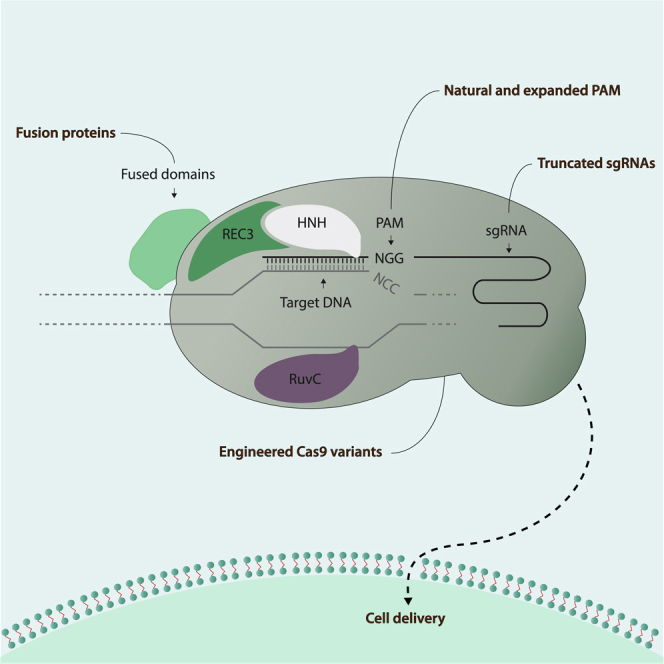
Graphical abstract
Figure 1
Figure 1
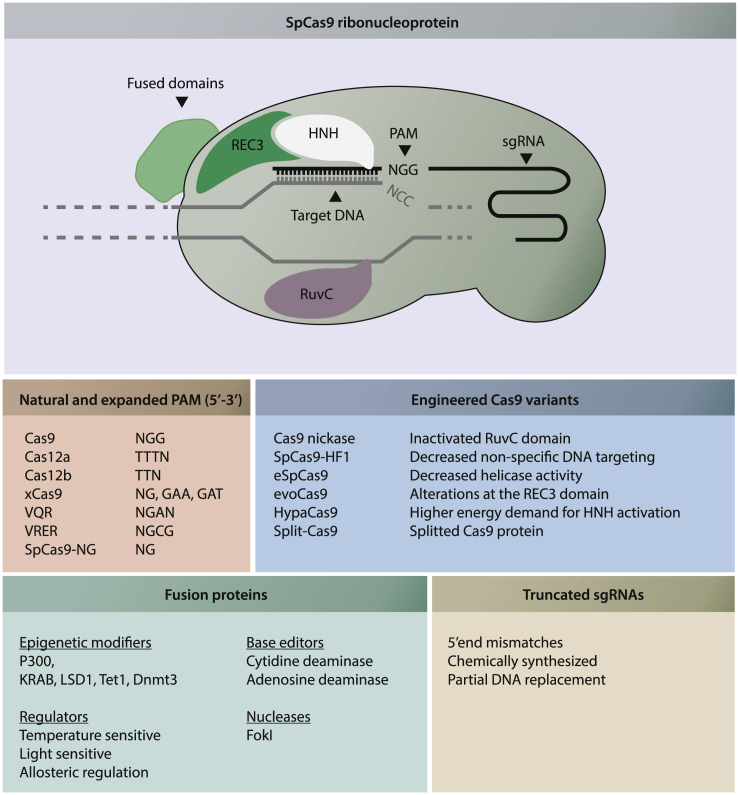
SpCas9 Ribonucleoprotein Variants with Altered Targeting Capacities Engineered SpCas9 nuclease variants with potential therapeutic advantages. Variants with expanded PAM recognition sequences include natural Cas9 and its well-described homologs Cas12a and Cas12b. Designed engineered nucleases with improved specificity include the split-Cas9 variant, which was created to improve the packaging of Cas9 proteins in AAV vehicles. Cas9 nucleases have also been fused with multiple functional domains to allow for targeted epigenetic modifications, single nucleotide modifications, single-strand nicking activity, or temporal regulation of CRISPR/Cas activity. Truncated versions of sgRNAs have been successfully used to increase targeting specificity. SpCas9, streptococcus pyogenes Cas9.
Figure 2
Figure 2
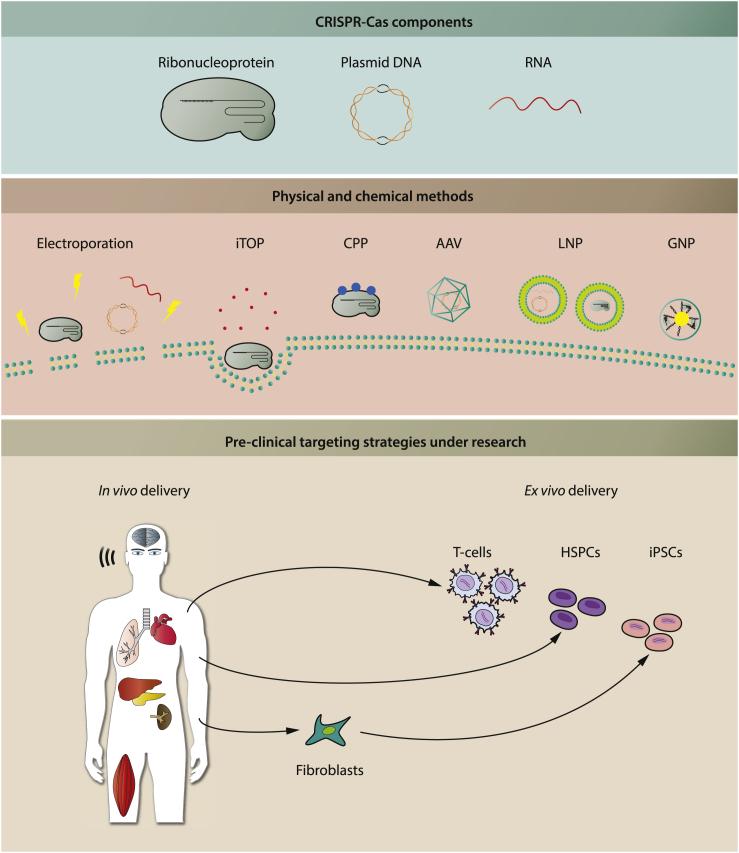
Delivery Strategies Used in Preclinical Studies CRISPR/Cas gene-editing tools have been delivered as ribonucleoprotein complexes, plasmid DNA, or RNA. They can be delivered as naked components using chemical or physical methods or in delivery vehicles including virus and/or different types of nanocomplexes. There are two main strategies for delivering precision gene-editing platforms. In multiple organs and tissues in animal models, in vivo delivery strategies have been successfully used, some of which have been clinically approved for application in humans. Ex vivo delivery strategies are being extensively used in T cell engineering, hematopoietic stem-cell gene editing, and iPSCs modeling. iTOP, induced transduction by osmocytosis and propanebetaine; CPP, cell-penetrating peptide; LNP, lipid nanoparticle; GNP, gold nanoparticle, HSPCs, hematopoietic stem and progenitor cells; iPSCs, induced pluripotent stem cells.
Figure 3
Figure 3
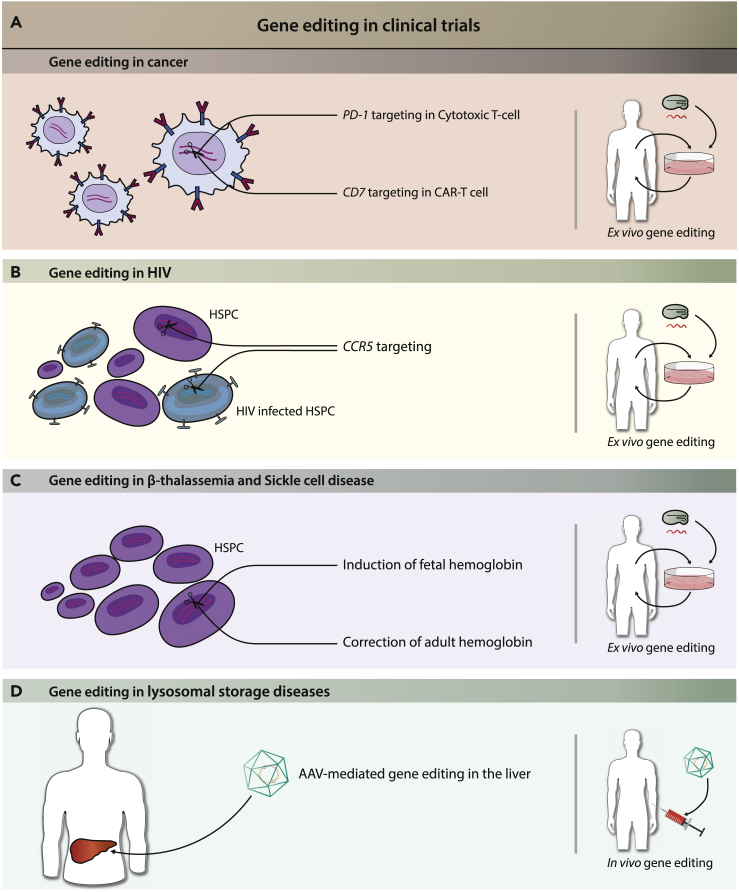
Examples of Gene-Editing Strategies in Current Clinical Trials (A) In cancer, gene-editing targets PD-1 or CD7 in T cells to enhance immune responses. (B) In patients with HIV, CCR5 is targeted in HSPCs to prevent HIV entry. (C) In β-thalassemia and sickle cell disease, induction of fetal hemoglobin or correction of adult hemoglobin in HSPCs is used. (D) AAV-mediated gene editing in the liver provides circulating enzymes in lysosomal storage diseases.

References

    1. Abudayyeh O.O., Gootenberg J.S., Konermann S., Joung J., Slaymaker I.M., Cox D.B., Shmakov S., Makarova K.S., Semenova E., Minakhin L. C2c2 is a single-component programmable RNA-guided RNA-targeting CRISPR effector. Science. 2016;353:aaf5573. - PMC - PubMed
    1. Akcakaya P., Bobbin M.L., Guo J.A., Lopez J.M., Clement M.K., Garcia S.P., Fellows M.D., Porritt M.J., Firth M.A., Carreras A. In vivo CRISPR-Cas gene editing with no detectable genome-wide off-target mutations. Nature. 2018;561:416–419. - PMC - PubMed
    1. Allen F., Crepaldi L., Alsinet C., Strong A.J., Kleshchevnikov V., De Angeli P., Palenikova P., Kosicki M., Bassett A.R., Harding H. Mutations generated by repair of Cas9-induced double strand breaks are predictable from surrounding sequence. Nat. Biotechnol. 2018;37:64–72. - PMC - PubMed
    1. Amoasii L., Hildyard J.C.W., Li H., Sanchez-Ortiz E., Mireault A., Caballero D., Harron R., Stathopoulou T.R., Massey C., Shelton J.M. Gene editing restores dystrophin expression in a canine model of Duchenne muscular dystrophy. Science. 2018;362:86–91. - PMC - PubMed
    1. Anzalone A.V., Randolph P.B., Davis J.R., Sousa A.A., Koblan L.W., Levy J.M., Chen P.J., Wilson C., Newby G.A., Raguram A., Liu D.R. Search-and-replace genome editing without double-strand breaks or donor DNA. Nature. 2019;576:149–157. - PMC - PubMed

LinkOut - more resources