


Eribulin mesylate use as third-line therapy in patients with metastatic breast cancer (VESPRY): a prospective, multicentre, observational study
- PMID: 31903098
- PMCID: PMC6923689
- DOI: 10.1177/1758835919895755
Eribulin mesylate use as third-line therapy in patients with metastatic breast cancer (VESPRY): a prospective, multicentre, observational study
Abstract
Background: In real-world practice, eribulin mesylate provides significant survival benefit, with a manageable safety profile in heavily pretreated patients with metastatic breast cancer (MBC).
Methods: In this prospective, open-label, multicentre, observational study we evaluated the effectiveness and tolerability of eribulin as third-line treatment in a homogeneous population. The primary endpoints were the safety profile and response in metastatic sites; secondary endpoints included the response in different subtypes, overall response rate (ORR), progression-free survival (PFS) and overall survival (OS).
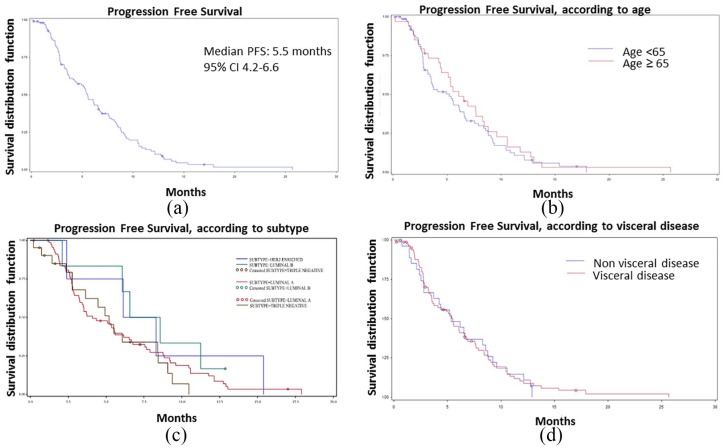
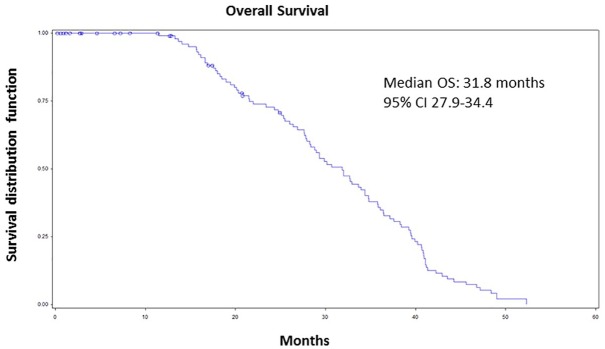
Results: From 2013 to 2016, 118 women were treated in 21 Sicilian institutions; the median age was 58 years (range 29-79), with 69% of patients under 65. The median cycles of eribulin were 5.5 (range 1-26). The most common adverse event was neutropenia (9.3%, 3 cases of grade 3, 4 of grade 4); only 1 case of QT prolongation was reported. Eribulin was effective in controlling metastatic disease in all sites, and it achieved the highest ORR in brain (16%) and liver (14.9%). Median OS was 31.8 months (95% CI 27.9-34.4) and median PFS 5.5 months (95% CI 4.2-6.6). PFS was 5.2 months (95% CI 2.8-8.4) in patients with triple-negative subtype. Median PFS was longer in patients over 65 years (6.1 months, 95% CI 4.4-8.3). In patients who had visceral metastases PFS was 5.5 months (95% CI 95% 3.5-6.6) and OS 33.9 months (95% CI 29.8-40.8).
Conclusions: Eribulin as third-line treatment shows an acceptable safety profile and a substantial antitumour activity in the treatment of MBC, even in elderly patients and in those with visceral disease.
Keywords: eribulin; metastatic breast cancer; multicentre; prospective; real world; third line.
© The Author(s), 2019.
Conflict of interest statement
Conflict of interest statement: The author(s) declare that there are no conflicts of interest.
Figures
References
-
- National Cancer Institute. SEER*Stat Databases: November 2012 Submission, https://seer.cancer.gov/data-software/documentation/seerstat/nov2012/ (2013).
-
- Towle MJ, Salvato KA, Wels BF, et al. Eribulin induces irreversible mitotic blockade: implications of cell-based pharmacodynamics for in vivo efficacy under intermittent dosing conditions. Cancer Res 2011; 71: 496–505. - PubMed
-
- Cortes J, O’Shaughnessy J, Loesch D, et al. Eribulin monotherapy versus treatment of physician’s choice in patients with metastatic breast cancer (EMBRACE): a phase 3 open-label randomised study. Lancet 2011; 377: 914–923. - PubMed
LinkOut - more resources
Full Text Sources
