Review
. 2019 Nov 4:11:730-743.
doi: 10.1016/j.dadm.2019.08.009. eCollection 2019 Dec.

The diagnostic performance of neurofilament light chain in CSF and blood for Alzheimer's disease, frontotemporal dementia, and amyotrophic lateral sclerosis: A systematic review and meta-analysis

Affiliations
Review

The diagnostic performance of neurofilament light chain in CSF and blood for Alzheimer's disease, frontotemporal dementia, and amyotrophic lateral sclerosis: A systematic review and meta-analysis

Lauren M Forgrave et al. Alzheimers Dement (Amst). .

Abstract

Introduction: A systematic review and meta-analysis was performed regarding the diagnostic performance of neurofilament light chain (NfL) in CSF and blood.

Methods: A database search was conducted for NfL biomarker studies in the context of Alzheimer's disease (AD), frontotemporal dementia (FTD), and amyotrophic lateral sclerosis (ALS) compared with controls (i.e., cognitively unimpaired, mild cognitive impairment, or disease mimics).

Results: In groups with a sufficient number of studies, the performance of NfL in blood and CSF was similar. Compared with disease mimics, we observed that CSF NfL had strong discriminatory power for ALS, modest discriminatory power for FTD, and no discriminatory power for AD. NfL provided the greatest separation between ALS and cognitively unimpaired controls in both the blood and CSF, followed by FTD (CSF and blood), then AD (blood and CSF).

Discussion: Comparable performance of CSF and blood NfL in many groups demonstrates the promise of NfL as a noninvasive biomarker of neurodegeneration; however, its utility in clinically meaningful scenarios requires greater scrutiny. Toward clinical implementation, a more comprehensive understanding of NfL concentrations in disease subtypes with overlapping phenotypes and at defined stages of disease, and the development of a harmonization program, are warranted.

Keywords: Alzheimer's disease; Amyotrophic lateral sclerosis; Biomarker; Dementia; Frontotemporal dementia; Meta-analysis; Neurodegeneration; Neurofilament light chain.


Figures

Fig. 1
Fig. 1
Retrieval process of peer-reviewed studies that included NfL quantitation in CSF, plasma, and serum from individuals with AD, ALS, FTD, and controls. Abbreviations: AD, Alzheimer's disease; ALS, amyotrophic lateral sclerosis; FTD, frontotemporal dementia; NfL, neurofilament light chain.
Fig. 2
Fig. 2
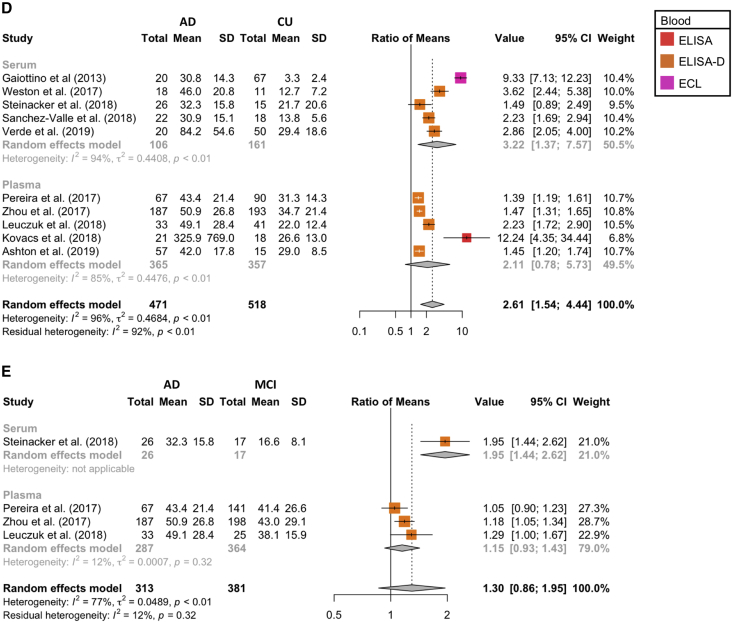
Comparison of the average ratio of NfL concentration in AD to (A) cognitively unimpaired (CU) controls in CSF, (B) MCI controls in CSF, (C) disease mimic (DM) controls in CSF, (D) cognitively unimpaired controls in blood, and (E) MCI controls in blood. Abbreviations: AD, Alzheimer's disease; NfL, neurofilament light chain; MCI, mild cognitive impairment.
Fig. 2
Fig. 2
Comparison of the average ratio of NfL concentration in AD to (A) cognitively unimpaired (CU) controls in CSF, (B) MCI controls in CSF, (C) disease mimic (DM) controls in CSF, (D) cognitively unimpaired controls in blood, and (E) MCI controls in blood. Abbreviations: AD, Alzheimer's disease; NfL, neurofilament light chain; MCI, mild cognitive impairment.
Fig. 3
Fig. 3
Comparison of average ratio of NfL concentration in FTD to (A) cognitively unimpaired controls in CSF, (B) MCI controls in CSF, (C) disease mimic controls in CSF (D) cognitively unimpaired controls in blood, and (E) MCI controls in blood. Abbreviations: FTD, frontotemporal dementia; NfL, neurofilament light chain; MCI, mild cognitive impairment.
Fig. 3
Fig. 3
Comparison of average ratio of NfL concentration in FTD to (A) cognitively unimpaired controls in CSF, (B) MCI controls in CSF, (C) disease mimic controls in CSF (D) cognitively unimpaired controls in blood, and (E) MCI controls in blood. Abbreviations: FTD, frontotemporal dementia; NfL, neurofilament light chain; MCI, mild cognitive impairment.
Fig. 4
Fig. 4
Comparison of average ratio of NfL concentration in ALS to (A) cognitively unimpaired controls in CSF, (B) disease mimic controls in CSF, (C) cognitively unimpaired controls in blood, and (D) disease mimic controls in blood. Abbreviations: ALS, amyotrophic lateral sclerosis; NfL, neurofilament light chain; MCI, mild cognitive impairment.
Fig. 5
Fig. 5
Summary of the diagnostic performance of NfL concentration in CSF or blood in AD, FTD, and ALS compared to control groups (i.e., cognitively unimpaired, MCI and disease mimics) displayed as average ROM statistic and 95% CI, with the number of studies annotated. Abbreviations: AD, Alzheimer's disease; ALS, amyotrophic lateral sclerosis; FTD, frontotemporal dementia; NfL, neurofilament light chain: MCI, mild cognitive impairment; ROM, ratio of means.

References

    1. Petzold A. Neurofilament phosphoforms: surrogate markers for axonal injury, degeneration and loss. J Neurol Sci. 2005;233:183–198. - PubMed
    1. Yao N.Y., Broedersz C.P., Lin Y.C., Kasza K.E., Mackintosh F.C., Weitz D.A. Elasticity in ionically cross-linked neurofilament networks. Biophys J. 2010;98:2147–2153. - PMC - PubMed
    1. Gillespie M.J., Stein R.B. The relationship between axon diameter, myelin thickness and conduction velocity during atrophy of mammalian peripheral nerves. Brain Res. 1983;259:41–56. - PubMed
    1. Gaiottino J., Norgren N., Dobson R., Topping J., Nissim A., Malaspina A. Increased neurofilament light chain blood levels in neurodegenerative neurological diseases. PLoS One. 2013;8:e75091. - PMC - PubMed
    1. Jack C.R., Jr., Bennett D.A., Blennow K., Carrillo M.C., Feldman H.H., Frisoni G.B. A/T/N: an unbiased descriptive classification scheme for Alzheimer disease biomarkers. Neurology. 2016;87:539–547. - PMC - PubMed