


Impairment of left atrial function and cryptogenic stroke: Potential insights in the pathophysiology of stroke in the young
- PMID: 31909178
- PMCID: PMC6938855
- DOI: 10.1016/j.ijcha.2019.100454
Impairment of left atrial function and cryptogenic stroke: Potential insights in the pathophysiology of stroke in the young
Erratum in
-
Erratum regarding missing Declaration of Competing Interest statements in previously published articles.Int J Cardiol Heart Vasc. 2020 Nov 18;31:100676. doi: 10.1016/j.ijcha.2020.100676. eCollection 2020 Dec. Int J Cardiol Heart Vasc. 2020. PMID: 33364333 Free PMC article.
Abstract
Background: Stroke is one of the leading causes of morbidity and mortality with a significant percentage classified as cryptogenic. Left atrial (LA) remodelling, a substrate for atrial fibrillation (AF) and stroke development, may play a role in identification of the aetiology of cryptogenic stroke. We aimed to examine LA function to gain mechanistic insights into the pathophysiology of cryptogenic stroke in young patients otherwise at low risk for cardiovascular disease.
Methods: Patients aged <60 years without traditional cardiovascular risk factors and who were diagnosed with ischaemic cryptogenic stroke or TIA were evaluated and compared to healthy controls and patients with paroxysmal AF with a CHA2DS2-VA score of 0. Conventional and novel left ventricular (LV) and LA echocardiographic parameters between the three groups were assessed.
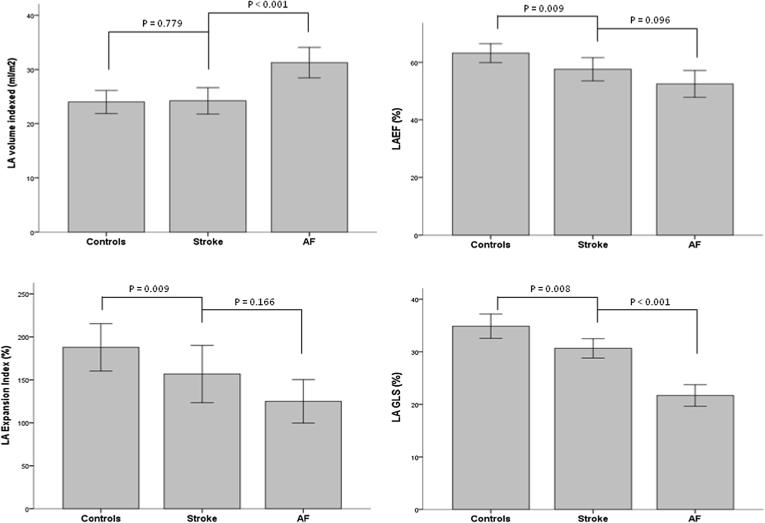
Results: Each group consisted of thirty patients. There were no significant differences in LV parameters (LVEF, LV endoGLS) between groups. LA strain in stroke patients was significantly lower compared to the controls (median 33%; interquartile range (IQ) [32/39] vs 31 [27/34]; p = 0.008). LA strain was significantly lower in AF patients compared to stroke patients (median 21% [19/22] vs 31% [27/34]; p < 0.0001).
Conclusion: A stepwise reduction in measures of LA function was appreciated between controls, young stroke and paroxysmal AF groups. This may indicate dynamic LA remodelling occurring in the young stroke population and suggest a shared causal mechanism for stroke development in this group. LA strain may further refine the risk for cardioembolic stroke.
Keywords: Atrial fibrillation; LA GLS, Left atrial global longitudinal strain; LA, Left atrial; LAEF, Left atrial ejection fraction; LV GLS, Left ventricular global longitudinal strain; LVEDD, Left ventricular end diastolic diameter; LVEF, Left ventricular ejection fraction; LVESD, Left ventricular end systolic diameter; Left atrial function; RA, Right atrial; RV, Right ventricle; RVSP, Right ventricular systolic pressure; Stroke; TAPSE, Tricuspid annular plane systolic excursion.
© 2019 The Authors.
Figures
References
-
- Medin J., Nordlund A., Ekberg K. Increasing stroke incidence in Sweden between 1989 and 2000 among persons aged 30 to 65 years: evidence from the Swedish Hospital Discharge Register. Stroke. 2004;35:1047–1051. - PubMed
-
- Aigner A., Grittner U., Rolfs A., Norrving B., Siegerink B., Busch M.A. Contribution of established stroke risk factors to the burden of stroke in young adults. Stroke. 2017;48:1744–1751. - PubMed
-
- Healey J.S., Connolly S.J., Gold M.R., Carsten W.I., Gelder I.C., Capucci A., Lau C.P., Fain E., Yang S., Bailleul C., Morillo C.A., Carlson M., Themeles E., Kaufman E.S., Hohnloser S.H. Subclinical atrial fibrillation and the risk of stroke. N. Engl. J. Med. 2012;366:120. - PubMed
-
- Brambatti M., Connolly S.J., Gold M.R., Morillo C.A., Capucci A., Muto C., Lau C.P., Van Gelder I.C., Hohnloser S.H., Carlson M., Fain E., Nakamya J., Mairesse G.H., Halytska M., Deng W.Q., Israel C.W., Healey J.S., ASSERT Investigators Temporal relationship between subclinical atrial fibrillation and embolic events. Circulation. 2014;129:2094–2099. - PubMed
LinkOut - more resources
Full Text Sources
Miscellaneous
