Work-related exposure to violence or threats and risk of mental disorders and symptoms: a systematic review and meta-analysis
- PMID: 31909816
- PMCID: PMC8506313
- DOI: 10.5271/sjweh.3877
Work-related exposure to violence or threats and risk of mental disorders and symptoms: a systematic review and meta-analysis
Abstract
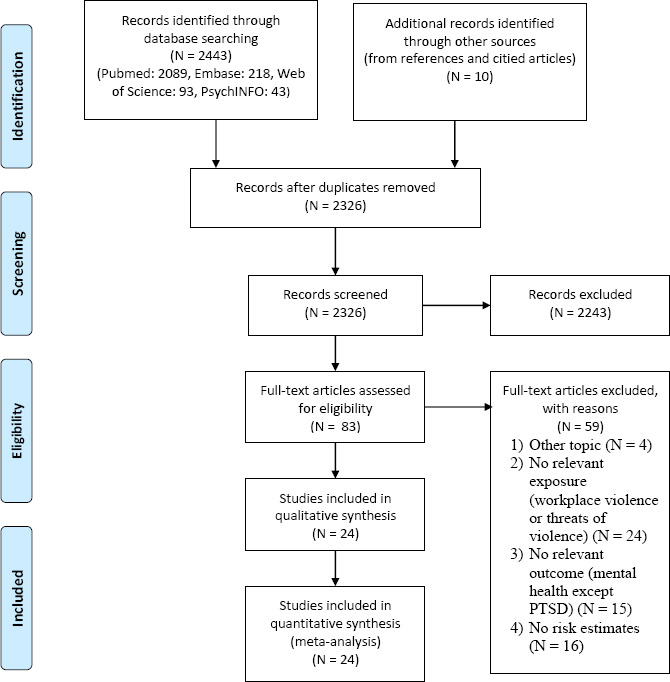
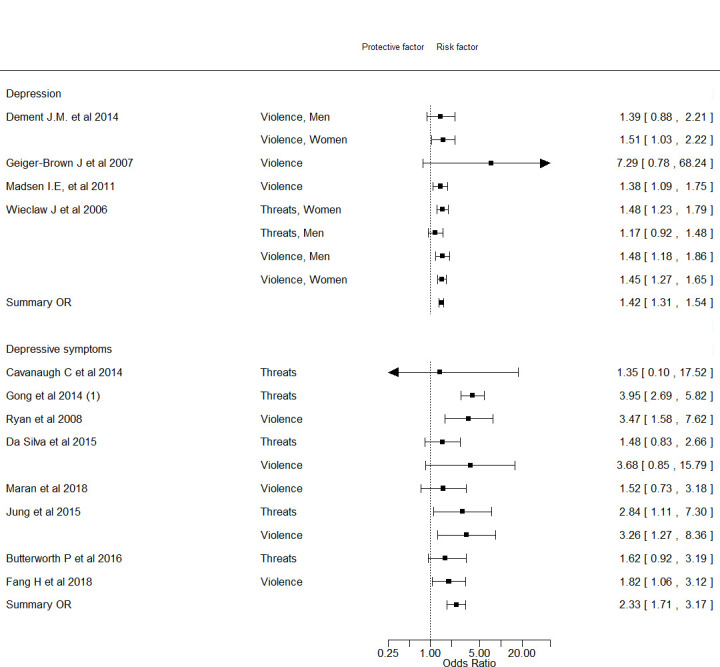
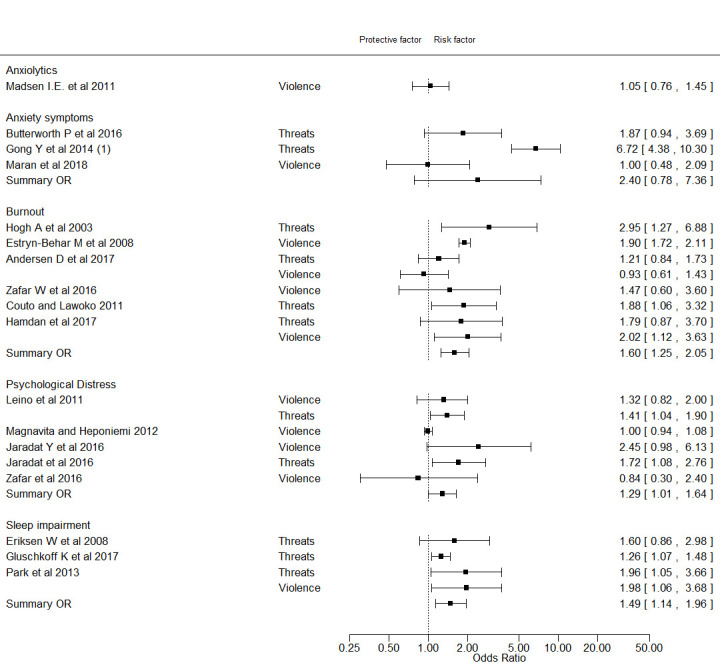
Objective This review aimed to examine systematically the epidemiological evidence linking work-related exposure to violence and threats thereof with risk of mental disorders and mental ill-health symptoms. Methods We searched PubMed, EMBASE, PsycINFO and Web of Science to identify original studies that provide quantitative risk estimates. The evidence was weighted according to completeness of reporting, potential common method bias, and bias due to differential selection and drop out, selective reporting, and misclassification of exposure and outcome. Results We identified 14 cross-sectional and 10 cohort studies with eligible risk estimates, of which 4 examined depressive disorder and reported an elevated risk among the exposed [pooled relative risk (RR) 1.42, 95% confidence interval (CI) 1.31-1.54, I 2=0%]. The occurrence of depressive and anxiety symptoms, burnout and psychological distress was examined in 17 studies (pooled RR 2.33, 95% CI 3.17, I 2=42%), and 3 studies examined risk of sleep disturbance (pooled RR 1.22, 95% CI 1.09-1.37, I2=0%). In most studies, common method bias and confounding could not be ruled out with confidence and strong heterogeneity in most outcome definitions invalidate the strict interpretation of most pooled risk estimates. Conclusion The reviewed studies consistently indicate associations between workplace violence and mental health problems. However, due to methodological limitations the causal associations (if any) may be stronger or weaker than the ones reported in this study. Prospective studies with independent and validated reporting of exposure and outcome and repeated follow-up with relevant intervals are highly warranted.
Conflict of interest statement
The authors declare no conflicts of interest.
Figures
References
-
- Lanctôt N, Guay S. The aftermath of workplace violence among healthcare workers:A systematic literature review of the consequences. Aggress Violent Behav. 2014;19(5):492–501. https://doi.org/10.1016/j.avb.2014.07.010.
-
- Wieclaw J, Agerbo E, Mortensen PB, Burr H, Tüchsen F, Bonde JP. Work related violence and threats and the risk of depression and stress disorders. J Epidemiol Community Health. 2006 Sep;60(9):771–5. https://doi.org/10.1136/jech.2005.042986. - PMC - PubMed
-
- Menckel E, Viitasara E. Threats and violence in Swedish care and welfare--magnitude of the problem and impact on municipal personnel. Scand J Caring Sci. 2002 Dec;16(4):376–85. https://doi.org/10.1046/j.1471-6712.2002.00103.x. - PubMed
-
- Gerberich SG, Church TR, McGovern PM, Hansen HE, Nachreiner NM, Geisser MS, et al. An epidemiological study of the magnitude and consequences of work related violence:the Minnesota Nurses'Study. Occup Environ Med. 2004 Jun;61(6):495–503. https://doi.org/10.1136/oem.2003.007294. - PMC - PubMed
-
- Gacki-Smith J, Juarez AM, Boyett L, Homeyer C, Robinson L, MacLean SL. Violence against nurses working in US emergency departments. J Healthc Prot Manage. 2010;26(1):81–99. - PubMed
Publication types
MeSH terms
LinkOut - more resources
Full Text Sources
Medical