Review
. 2020 Jan 7;17(1):4.
doi: 10.1186/s12985-019-1276-8.

The forces driving clonal expansion of the HIV-1 latent reservoir

Affiliations
Review

The forces driving clonal expansion of the HIV-1 latent reservoir

Runxia Liu et al. Virol J. .

Abstract

Despite antiretroviral therapy (ART) which halts HIV-1 replication and reduces plasma viral load to clinically undetectable levels, viral rebound inevitably occurs once ART is interrupted. HIV-1-infected cells can undergo clonal expansion, and these clonally expanded cells increase over time. Over 50% of latent reservoirs are maintained through clonal expansion. The clonally expanding HIV-1-infected cells, both in the blood and in the lymphoid tissues, contribute to viral rebound. The major drivers of clonal expansion of HIV-1-infected cells include antigen-driven proliferation, homeostatic proliferation and HIV-1 integration site-dependent proliferation. Here, we reviewed how viral, immunologic and genomic factors contribute to clonal expansion of HIV-1-infected cells, and how clonal expansion shapes the HIV-1 latent reservoir. Antigen-specific CD4+ T cells specific for different pathogens have different clonal expansion dynamics, depending on antigen exposure, cytokine profiles and exhaustion phenotypes. Homeostatic proliferation replenishes the HIV-1 latent reservoir without inducing viral expression and immune clearance. Integration site-dependent proliferation, a mechanism also deployed by other retroviruses, leads to slow but steady increase of HIV-1-infected cells harboring HIV-1 proviruses integrated in the same orientation at specific sites of certain cancer-related genes. Targeting clonally expanding HIV-1 latent reservoir without disrupting CD4+ T cell function is a top priority for HIV-1 eradication.

Keywords: Aberrant proliferation; Antigen-driven proliferation; Chromatin accessibility; Clonal expansion; Defective HIV-1 proviruses; HIV-1 cure; HIV-1 integration site; HIV-1 latent reservoir; HIV-1 proviral landscape; Homeostatic proliferation.


Conflict of interest statement

The authors declare that they have no competing interests.

Figures
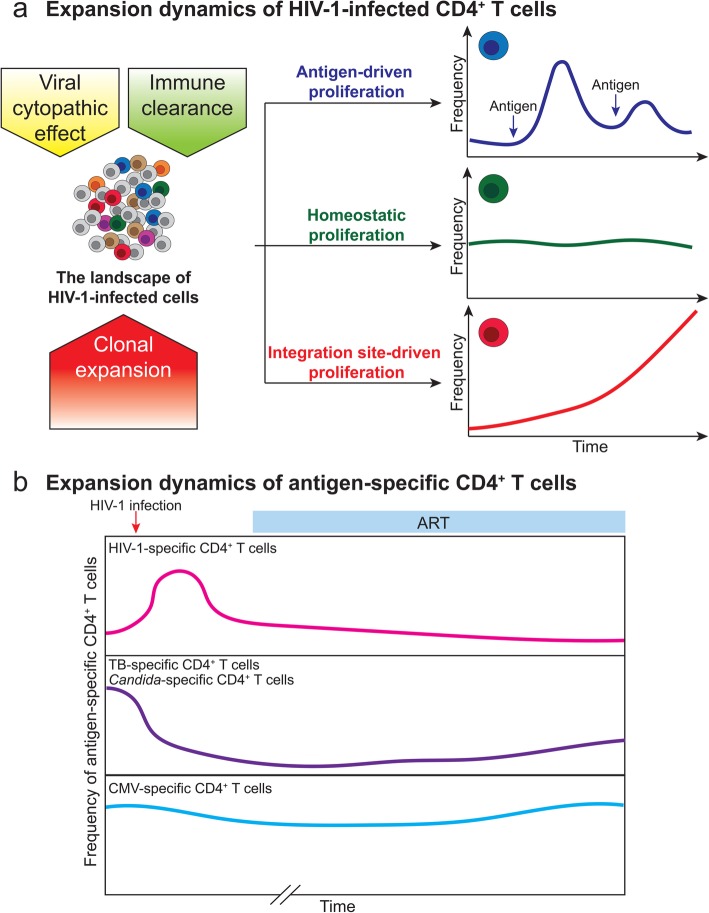
Fig. 1
Fig. 1
Expansion dynamics of HIV-1-infected CD4+ T cells during HIV-1 infection. a The landscape of HIV-1-infected cells is shaped by viral cytopathic effect, immune clearance and clonal expansion of the HIV-1-infected cells. The major drives of clonal expansion of HIV-1-infected cells include antigen-driven proliferation, homeostatic proliferation, and integration site-driven proliferation. HIV-1-infected antigen-specific cells surge as antigen stimulation peaks and wane as the antigen-specific response subsides. Homeostatic proliferation driven by cytokines such as IL-7 and IL-15 does not induce viral antigen expression and evades immune clearance. These two mechanisms are controlled by physiologic immune responses. In contrast, HIV-1 integration may drive aberrant cellular proliferation, which is not affected by host immune feedback controls. Thus, HIV-1 integration site-driven clonal expansion leads to a slow but steady increase of HIV-1-infected cells. Y axis, frequency of HIV-1-infected cells. b The clonal expansion dynamics of antigen-specific CD4+ T cells depends on antigen exposure, cytokine profiles and exhaustion phenotypes. HIV-1-specific CD4+ T cells increase during acute HIV-1 infection and decline after ART initiation as the majority of HIV-1 antigen is eliminated. Despite chronic antigen exposure, these HIV-1-specific CD4+ T cells are few, dysfunctional and impaired in proliferation capacity. On the other hand, TB-specific and Candida-specific CD4+ T cells are preferentially infected and depleted during HIV-1-infection, which can be partially restored upon ART. In contrast, CMV-specific CD4+ T cells are relatively protected from HIV-1 infection and remain relatively abundant and functional during HIV-1 infection
Fig. 2
Fig. 2
Mechanisms of integration site-dependent clonal expansion of HIV-1-infected cells. HIV-1-host interactions at the integration site when HIV-1 is integrated in the same (a) or opposite (b) orientation in respect to the transcription unit. c HIV-1-driven integration site-dependent proliferation depends on the orientation, orientation and the functional consequences of the host gene in which HIV-1 is integrated in

References

    1. Chun TW, Carruth L, Finzi D, Shen X, DiGiuseppe JA, Taylor H, Hermankova M, Chadwick K, Margolick J, Quinn TC, et al. Quantification of latent tissue reservoirs and total body viral load in HIV-1 infection. Nature. 1997;387:183–188. doi: 10.1038/387183a0. - DOI - PubMed
    1. Finzi D, Hermankova M, Pierson T, Carruth LM, Buck C, Chaisson RE, Quinn TC, Chadwick K, Margolick J, Brookmeyer R, et al. Identification of a reservoir for HIV-1 in patients on highly active antiretroviral therapy. Science (New York, NY) 1997;278:1295–1300. doi: 10.1126/science.278.5341.1295. - DOI - PubMed
    1. Wong JK, Hezareh M, Gunthard HF, Havlir DV, Ignacio CC, Spina CA, Richman DD. Recovery of replication-competent HIV despite prolonged suppression of plasma viremia. Science (New York, NY) 1997;278:1291–1295. doi: 10.1126/science.278.5341.1291. - DOI - PubMed
    1. Siliciano JD, Kajdas J, Finzi D, Quinn TC, Chadwick K, Margolick JB, Kovacs C, Gange SJ, Siliciano RF. Long-term follow-up studies confirm the stability of the latent reservoir for HIV-1 in resting CD4+ T cells. Nat Med. 2003;9:727–728. doi: 10.1038/nm880. - DOI - PubMed
    1. Crooks AM, Bateson R, Cope AB, Dahl NP, Griggs MK, Kuruc JD, Gay CL, Eron JJ, Margolis DM, Bosch RJ, Archin NM. Precise quantitation of the latent HIV-1 reservoir: implications for eradication strategies. J Infect Dis. 2015;212:1361–1365. doi: 10.1093/infdis/jiv218. - DOI - PMC - PubMed

Publication types
