Review
. 2020 Feb 21;295(8):2375-2384.
doi: 10.1074/jbc.REV119.009847. Epub 2020 Jan 7.

The (un)structural biology of biomolecular liquid-liquid phase separation using NMR spectroscopy

Affiliations
Review

The (un)structural biology of biomolecular liquid-liquid phase separation using NMR spectroscopy

Anastasia C Murthy et al. J Biol Chem. .

Abstract

Liquid-liquid phase separation (LLPS) of proteins and nucleic acids is a phenomenon that underlies membraneless compartmentalization of the cell. The underlying molecular interactions that underpin biomolecular LLPS have been of increased interest due to the importance of membraneless organelles in facilitating various biological processes and the disease association of several of the proteins that mediate LLPS. Proteins that are able to undergo LLPS often contain intrinsically disordered regions and remain dynamic in solution. Solution-state NMR spectroscopy has emerged as a leading structural technique to characterize protein LLPS due to the variety and specificity of information that can be obtained about intrinsically disordered sequences. This review discusses practical aspects of studying LLPS by NMR, summarizes recent work on the molecular aspects of LLPS of various protein systems, and discusses future opportunities for characterizing the molecular details of LLPS to modulate phase separation.

Keywords: RNA-binding proteins; heterogeneous nuclear ribonucleoprotein (hnRNP); intrinsically disordered protein; liquid-liquid phase separation; nuclear magnetic resonance (NMR); protein-protein interaction; structural biology.


Conflict of interest statement

The authors declare that they have no conflicts of interest with the contents of this article

Figures
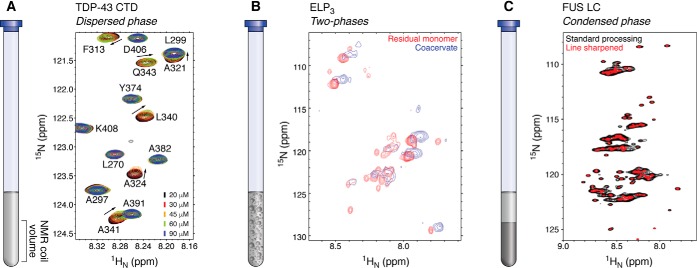
Figure 1.
Figure 1.
Methods to study the condensed phase by NMR spectroscopy. A, the dispersed phase can be used to garner information about the condensed phase indirectly. A titration of the phase separation–prone C-terminal region of TDP-43 shows chemical shift perturbations of certain residues that are involved in LLPS. Adapted from Ref. 9). This research was originally published in Structure. Conicella, A. E., Zerze, G. H., Mittal, J., and Fawzi, N. L. Structure. 2016; 24:1537–1549. © Cell Press. B, a biphasic sample containing the dispersed and condensed phases can be used to study properties of both. Spectra of an elastin-like peptide recorded with an R2 relaxation rate filter or a pulsed-field gradient diffusion rate filter select for signals arising from either the dispersed or condensed phases, respectively. Adapted from Ref. 23). This research was originally published in Proceedings of the National Academy of Sciences of the United States of America. Reichheld, S. E., Muiznieks, L. D., Keeley, F. W., and Sharpe, S. Proc. Natl. Acad. Sci. U.S.A. 2017; 114:E4408–E4415. © United States National Academy of Sciences. C, the condensed phase can be studied directly by creating a macroscopic phase that fills the coil volume of the NMR spectrometer. Spectra of the condensed phase of the low-complexity domain of FUS produce one set of broad resonances. Adapted from Ref. 24). This research was originally published in Molecular Cell. Burke, K. A., Janke, A. M., Rhine, C. L., and Fawzi, N. L. Mol. Cell. 2015; 60:231–241. © Cell Press.
Figure 2.
Figure 2.
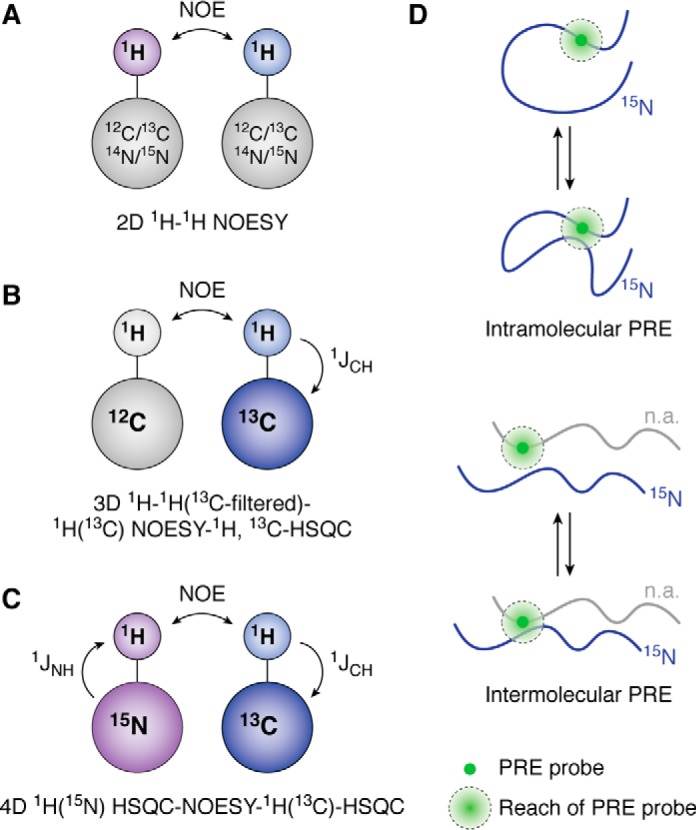
Structural analysis of LLPS systems using NOESY and PREs. A, basic 1H-1H NOESY experiment transfers magnetization between protons in close proximity through space. This is used to study both intra- and intermolecular contacts within protein systems. B, 13C/12C-filtered/edited NOESY experiments utilize the basic 1H-1H NOESY but select for differentially isotopic-labeled protein through the HSQC transfer. C, to increase selectivity, an HSQC-NOESY-HSQC experiment can be run on a sample containing both 15N-labeled protein and 13C-labeled protein. D, intra- and intermolecular paramagnetic relaxation enhancement experiments measure the frequency of contact within a single molecule to investigate collapse (intramolecular PRE) or between two molecules (one NMR visible by 15N isotopic labeling and the other at natural isotopic abundance (n.a.) and hence NMR invisible) to detect interactions (intermolecular PRE).
Figure 3.
Figure 3.
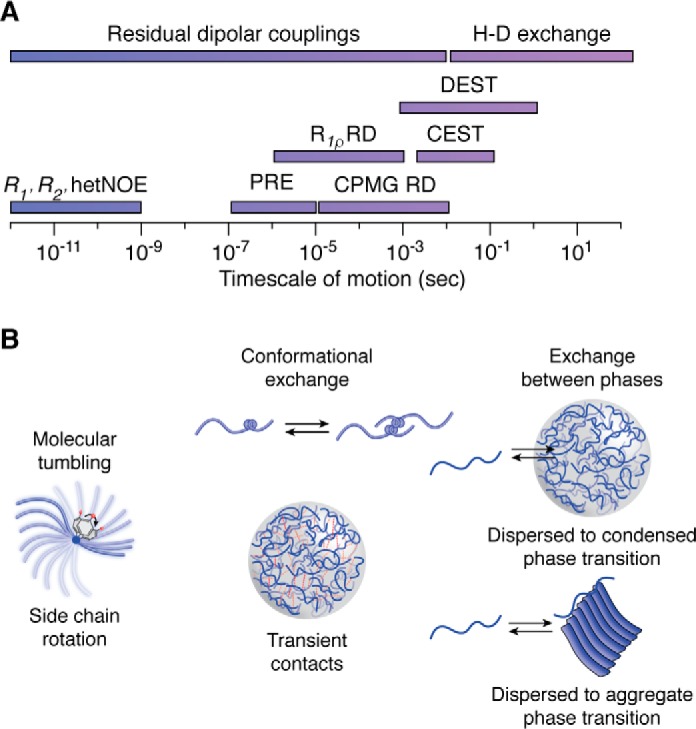
NMR timescale of motion for studying the dynamics of LLPS systems. A, various types of NMR experiments can probe for processes from the picosecond to second timescale. B, fast motions (picosecond-to-nanosecond) that involve overall molecular tumbling and fluctuations of the peptide backbone and side-chain rotations can be measured using R1, R2, and heteronuclear NOE experiments. Intermediate motion processes (microsecond-to-millisecond) that involve conformational exchange and transient contacts can be measured by a variety of experiments, such as paramagnetic relaxation enhancement, CPMG relaxation dispersion, and R. Slower processes (millisecond-to-second), such as the exchange between liquid and solid phases can be probed using saturation transfer techniques as well as hydrogen-deuterium exchange.

References

    1. Brangwynne C. P., Mitchison T. J., and Hyman A. A. (2011) Active liquid-like behavior of nucleoli determines their size and shape in Xenopus laevis oocytes. Proc. Natl. Acad. Sci. U.S.A. 108, 4334–4339 10.1073/pnas.1017150108 - DOI - PMC - PubMed
    1. Brangwynne C. P., Eckmann C. R., Courson D. S., Rybarska A., Hoege C., Gharakhani J., Jülicher F., and Hyman A. A. (2009) Germline P granules are liquid droplets that localize by controlled dissolution/condensation. Science 324, 1729–1732 10.1126/science.1172046 - DOI - PubMed
    1. Molliex A., Temirov J., Lee J., Coughlin M., Kanagaraj A. P., Kim H. J., Mittag T., and Taylor J. P. (2015) Phase separation by low complexity domains promotes stress granule assembly and drives pathological fibrillization. Cell 163, 123–133 10.1016/j.cell.2015.09.015 - DOI - PMC - PubMed
    1. Shorter J. (2019) Phase separation of RNA-binding proteins in physiology and disease: an introduction to the JBC Reviews thematic series. J. Biol. Chem. 294, 7113–7114 10.1074/jbc.REV119.007944 - DOI - PMC - PubMed
    1. King O. D., Gitler A. D., and Shorter J. (2012) The tip of the iceberg: RNA-binding proteins with prion-like domains in neurodegenerative disease. Brain Res. 1462, 61–80 10.1016/j.brainres.2012.01.016 - DOI - PMC - PubMed

Publication types

MeSH terms

Substances

LinkOut - more resources