


Need for dental care drives utilisation of dental services among children in Saudi Arabia
- PMID: 31912900
- PMCID: PMC9379191
- DOI: 10.1111/idj.12539
Need for dental care drives utilisation of dental services among children in Saudi Arabia
Abstract
Objectives: This study used Andersen's predisposing, enabling and need behavioural model to predict factors that influence utilisation of oral health services for children in Saudi Arabia.
Methods: The model was tested in a random sample of parents of third- and eighth-grade children in Jeddah (n = 1,668) using the access to care questionnaire adapted from the Basic Screening Survey. Predisposing (sex, parent education, nationality); enabling (school type, family income, government financial support, health insurance); and need for dental care (examined or perceived) were modelled to assess children's use of dental services. Univariate and multivariate logistic regression models were conducted. Significant findings were reported at P ≤ 0.05.
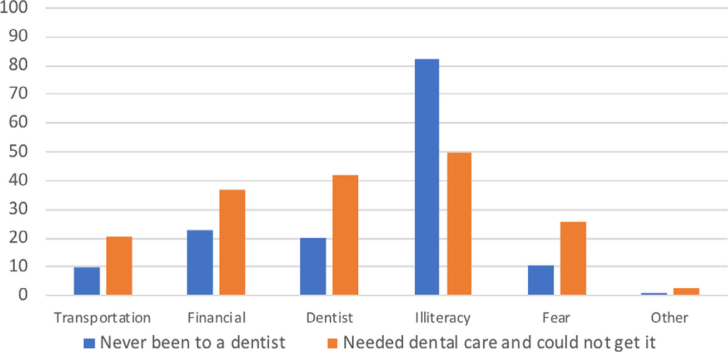
Results: About 84% of parents responded to our questionnaire (n = 1,397). One in four children have never visited a dentist. Our findings indicate that need and predisposing factors explained oral health services' use among younger children, whereas need, predisposing and enabling factors predicted use of services among older children. Perceived barriers to dental care for children who never went to a dentist and for those who needed dental care and could not get it included oral health illiteracy (82.3%, 49.7%), dentist-related (19.9%, 42.1%), financial (22.8%, 37.1%) and transportation (9.8%, 20.8%), respectively.
Conclusions: The need for dental care, predominantly for illness-related dental care, drives utilisation of dental health services among children in Saudi Arabia. Enhancing oral health literacy and mitigating organisational and financial barriers to dental care for families will increase children's access to quality oral healthcare, and promote better oral health practices and outcomes.
Keywords: Basic Screening Survey; Saudi Arabia; Utilisation; children; oral health literacy; oral health services.
© 2020 FDI World Dental Federation.
Figures
References
-
- United States Department of Health and Human Services . Department of Health and Human Services, National Institute of Dental and Craniofacial Research, National Institutes of Health; Rockville, MD: 2010. Oral Health in America: A Report of the Surgeon General – Executive Summary.
-
- Petersen PE. The World Oral Health Report 2003: continuous improvement of oral health in the 21st century–the approach of the WHO Global Oral Health Programme. Community Dent Oral Epidemiol. 2003;31(Suppl 1):3–23. - PubMed
-
- Newacheck PW, McManus M, Fox HB, et al. Access to health care for children with special health care needs. Pediatrics. 2004;105(4 Pt 1):760–766. - PubMed
MeSH terms
Grants and funding
LinkOut - more resources
Full Text Sources
Medical
