. 2020 Jan 8;10(1):23.
doi: 10.1038/s41598-019-56897-8.

Sevoflurane Pre-conditioning Ameliorates Diabetic Myocardial Ischemia/Reperfusion Injury Via Differential Regulation of p38 and ERK

Affiliations

Sevoflurane Pre-conditioning Ameliorates Diabetic Myocardial Ischemia/Reperfusion Injury Via Differential Regulation of p38 and ERK

Dina Xie et al. Sci Rep. .

Abstract

Diabetes mellitus (DM) significantly increases myocardial ischemia/reperfusion (MI/R) injury. During DM, cardioprotection induced by conventional pre-conditioning (PreCon) is decreased due to impaired AMP-activated protein kinase (AMPK) signaling. The current study investigated whether PreCon with inhaled anesthetic sevoflurane (SF-PreCon) remains cardioprotective during DM, and identified the involved mechanisms. Normal diet (ND) and high-fat diet (HFD)-induced DM mice were randomized into control and SF-PreCon (3 cycles of 15-minute period exposures to 2% sevoflurane) groups before MI/R. SF-PreCon markedly reduced MI/R injury in DM mice, as evidenced by improved cardiac function (increased LVEF and ±Dp/dt), decreased infarct size, and decreased apoptosis. To determine the relevant role of AMPK, the effect of SF-PreCon was determined in cardiac-specific AMPKα2 dominant negative expressing mice (AMPK-DN). SF-PreCon decreased MI/R injury in AMPK-DN mice. To explore the molecular mechanisms responsible for SF-PreCon mediated cardioprotection in DM mice, cell survival molecules were screened. Interestingly, in ND mice, SF-PreCon significantly reduced MI/R-induced activation of p38, a pro-death MAPK, without altering ERK and JNK. In DM and AMPK-DN mice, the inhibitory effect of SF-PreCon upon p38 activation was significantly blunted. However, SF-PreCon significantly increased phosphorylation of ERK1/2, a pro-survival MAPK in DM and AMPK-DN mice. We demonstrate that SF-PreCon protects the heart via AMPK-dependent inhibition of pro-death MAPK in ND mice. However, SF-PreCon exerts cardioprotective action via AMPK-independent activation of a pro-survival MAPK member in DM mice. SF-PreCon may be beneficial compared to conventional PreCon in diabetes or clinical scenarios in which AMPK signaling is impaired.


Conflict of interest statement

The authors declare no competing interests.

Figures
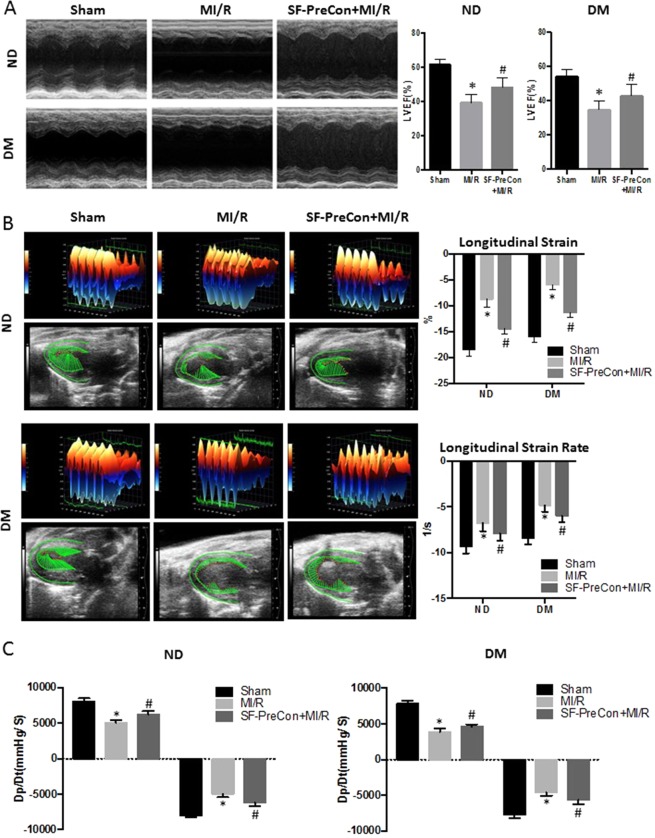
Figure 1
Figure 1
SF-PreCon increased cardiac function in ND and HFD DM mice after MI/R. (A) Sevoflurane preconditioning improved cardiac function in ND and HFD DM mice, evidenced by echocardiography. (B) Three-dimensional regional wall velocity diagrams showing contraction (orange/positive values) or relaxation (blue/negative values) of 3 consecutive cardiac cycles. Vector diagrams showing the direction and magnitude of endocardial contraction at midsystole. Global averages of strain and strain rate measured in the longitudinal axes across the LV endocardium. (C) ±Dp/dt (via hemodynamics assay) of Sham, MI/R, SF-PreCon+MI/R groups. Abbreviations: ND, Normal diet; HFD, High fat diet; DM, diabetes.
Figure 2
Figure 2
SF-PreCon reduced MI/R injury in ND and HFD DM mice. (A) Representative images of cardiac sections of (left to right) Sham, MI/R, SF-PreCon+MI/R groups. Infarct size was diminished in SF-PreCon group compared to MI/R group, both in ND and HFD DM mice after MI/R injury. (B) TUNEL staining (C) Caspase-3 activity assay (n = 6–10, *p < 0.05 compared with Sham, #p < 0.05 compared to MI/R).
Figure 3
Figure 3
SF-PreCon increased cardiac function in ND and AMPK-DN mice. To determine the role of AMPK in cardioprotection by SF-PreCon, a cardiac specific AMPKα2 dominant negative mouse (AMPK-DN) was employed. (A) SF-PreCon significantly increased heart function both in WT and AMPK-ND mice after MI/R, evidenced by echocardiography. (B) Three-dimensional regional wall velocity diagrams and vector diagrams. (C) Hemodynamic measurements. Abbreviations: WT, Wild type.
Figure 4
Figure 4
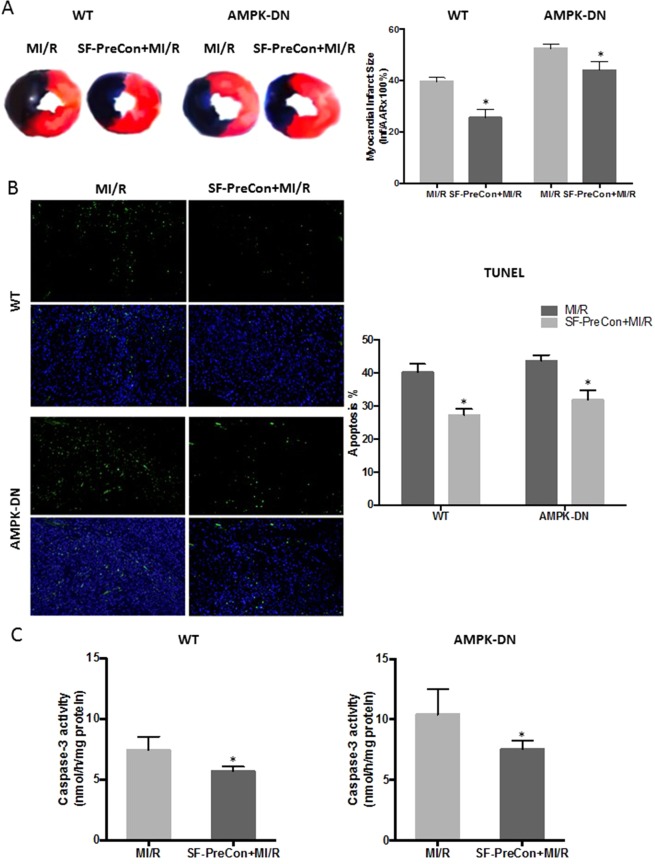
SF-PreCon reduced MI/R injury in ND and AMPK-DN mice. SF-PreCon significantly reduced MI/R injury both in WT and AMPK-DN mice. Showing (A) Infarct size. (B) TUNEL staining. (C) Caspase-3 activity. (n = 10–15, *p < 0.05 compared with respective MI/R) Abbreviations: WT, Wild type.
Figure 5
Figure 5
SF-PreCon ameliorates diabetic myocardial ischemia/reperfusion injury via differential regulation of p38 and ERK. (A) High-fat diet markedly reduced AMPK. (B) SF-PreCon reduced MI/R-induced activation of p38 in WT mice. The inhibitory effect of SF-PreCon upon p38 activation was blunted compared to WT, and virtually abolished in AMPK-DN mice. (C) SF-PreCon had no effect upon ERK1/2 phosphorylation in WT, but significantly increased phosphorylation of ERK1/2 in DM and AMPK-DN mice. (n = 10–12, *p < 0.05 compared to respective MI/R. **P < 0.01, compared with respective MI/R) Abbreviations: ND, Normal diet; DM, Diabetes.
Figure 6
Figure 6
SF-PreCon augmented cardiac mitochondrial function in WT, DM, and AMPK-DN mice subjected to MI/R. (A) No significant SF-PreCon-induced effect upon JNK was observed in mice subjected to MI/R. (B) SF-PreCon significantly increased mitochondrial function in WT, DM, and AMPK-DN mice, evidenced by elevated respiratory control ratio and maximal respiration. (n = 8–12,*p < 0.05, compared to MI/R) Abbreviations: ND, Normal diet; DM, Diabetes.
Figure 7
Figure 7
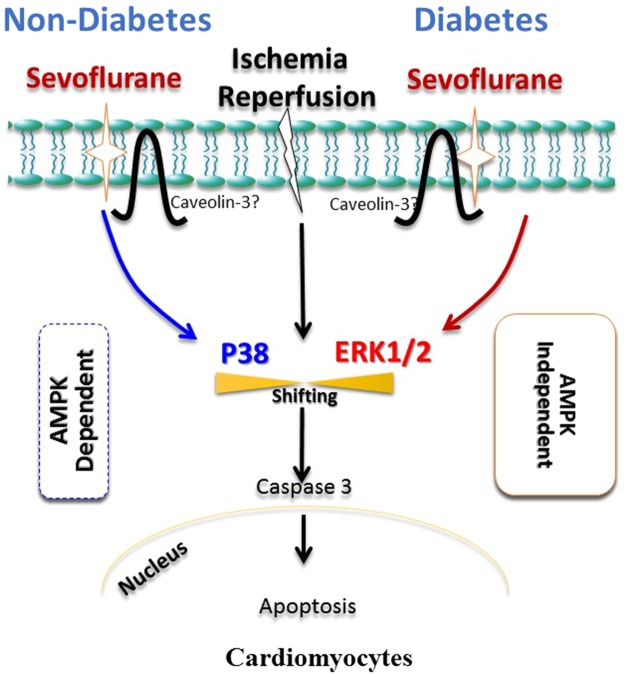
Diagram illustrating sevoflurane preconditioning diminishes MI/R injury via inhibition of pro-death MAPK pathway.

References

    1. Wang D, et al. Diabetes Exacerbates Myocardial Ischemia/Reperfusion Injury by Down-Regulation of MicroRNA and Up-Regulation of O-GlcNAcylation. JACC Basic Transl Sci. 2018;3:350–362. doi: 10.1016/j.jacbts.2018.01.005. - DOI - PMC - PubMed
    1. Brioni JD, Varughese S, Ahmed R, Bein B. A clinical review of inhalation anesthesia with sevoflurane: from early research to emerging topics. J Anesth. 2017;31:764–778. doi: 10.1007/s00540-017-2375-6. - DOI - PMC - PubMed
    1. Landoni G, et al. Desflurane and sevoflurane in cardiac surgery: a meta-analysis of randomized clinical trials. J Cardiothorac Vasc Anesth. 2007;21:502–511. doi: 10.1053/j.jvca.2007.02.013. - DOI - PubMed
    1. Symons JA, Myles PS. Myocardial protection with volatile anaesthetic agents during coronary artery bypass surgery: a meta-analysis. Br J Anaesth. 2006;97:127–136. doi: 10.1093/bja/ael149. - DOI - PubMed
    1. Yu CH, Beattie WS. The effects of volatile anesthetics on cardiac ischemic complications and mortality in CABG: a meta-analysis. Can J Anaesth. 2006;53:906–918. doi: 10.1007/BF03022834. - DOI - PubMed

Publication types

MeSH terms

Substances