. 2020 May 1;77(5):503-512.
doi: 10.1001/jamapsychiatry.2019.4188.

Shared Genetic Loci Between Body Mass Index and Major Psychiatric Disorders: A Genome-wide Association Study

Affiliations

Shared Genetic Loci Between Body Mass Index and Major Psychiatric Disorders: A Genome-wide Association Study

Shahram Bahrami et al. JAMA Psychiatry. .

Abstract

Importance: People with major psychiatric disorders (MPDs) have a 10- to 20-year shorter life span than the rest of the population, and this difference is mainly due to comorbid cardiovascular diseases. Genome-wide association studies have identified common variants involved in schizophrenia (SCZ), bipolar disorder (BIP), and major depression (MD) and body mass index (BMI), a key cardiometabolic risk factor. However, genetic variants jointly influencing MPD and BMI remain largely unknown.

Objective: To assess the extent of the overlap between the genetic architectures of MPDs and BMI and identify genetic loci shared between them.

Design, setting, and participants: Using a conditional false discovery rate statistical framework, independent genome-wide association study data on individuals with SCZ (n = 82 315), BIP (n = 51 710), MD (n = 480 359), and BMI (n = 795 640) were analyzed. The UK Biobank cohort (n = 29 740) was excluded from the MD data set to avoid sample overlap. Data were collected from August 2017 to May 2018, and analysis began July 2018.

Main outcomes and measures: The primary outcomes were a list of genetic loci shared between BMI and MPDs and their functional pathways.

Results: Genome-wide association study data from 1 380 284 participants were analyzed, and the genetic correlation between BMI and MPDs varied (SCZ: r for genetic = -0.11, P = 2.1 × 10⁻¹⁰; BIP: r for genetic = -0.06, P = .0103; MD: r for genetic = 0.12, P = 6.7 × 10⁻¹⁰). Overall, 63, 17, and 32 loci shared between BMI and SCZ, BIP, and MD, respectively, were analyzed at conjunctional false discovery rate less than 0.01. Of the shared loci, 34% (73 of 213) in SCZ, 52% (36 of 69) in BIP, and 57% (56 of 99) in MD had risk alleles associated with higher BMI (conjunctional false discovery rate <0.05), while the rest had opposite directions of associations. Functional analyses indicated that the overlapping loci are involved in several pathways including neurodevelopment, neurotransmitter signaling, and intracellular processes, and the loci with concordant and opposite association directions pointed mostly to different pathways.

Conclusions and relevance: In this genome-wide association study, extensive polygenic overlap between BMI and SCZ, BIP, and MD were found, and 111 shared genetic loci were identified, implicating novel functional mechanisms. There was mixture of association directions in SCZ and BMI, albeit with a preponderance of discordant ones.


Conflict of interest statement

Conflict of Interest Disclosures: Dr Steen reports grants from the National Institutes of Health, the Research Council of Norway, South-Eastern Norway Regional Health Authority, and the Kristian Gerhard Jebsen Foundation during the conduct of the study. Dr Fan reports personal fees from MultiModal Imaging Service, dba HealthLytix outside the submitted work. Dr Dale reports grants from the National Institutes of Health outside the submitted work; has US Provisional Patent Application Serial No. 61/751,420 pending about systems and methods for identifying polymorphisms; is founder of and holds equity in CorTechs Labs and serves on its scientific advisory board; is a member of the scientific advisory board of Human Longevity; and receives funding through research grants with GE Healthcare. Dr Andreassen reports grants from the Research Council of Norway, the Kristian Gerhard Jebsen Foundation, and South-Eastern Norway Regional Health Authority during the conduct of the study; personal fees from Lundbeck outside the submitted work; consultant fees from HealthLytix outside the submitted work; and has US Provisional Patent Application Serial No. 61/751,420 pending about systems and methods for identifying polymorphisms. No other disclosures were reported.

Figures

Figure 1.
Figure 1.. Conditional Quantile-Quantile Plots
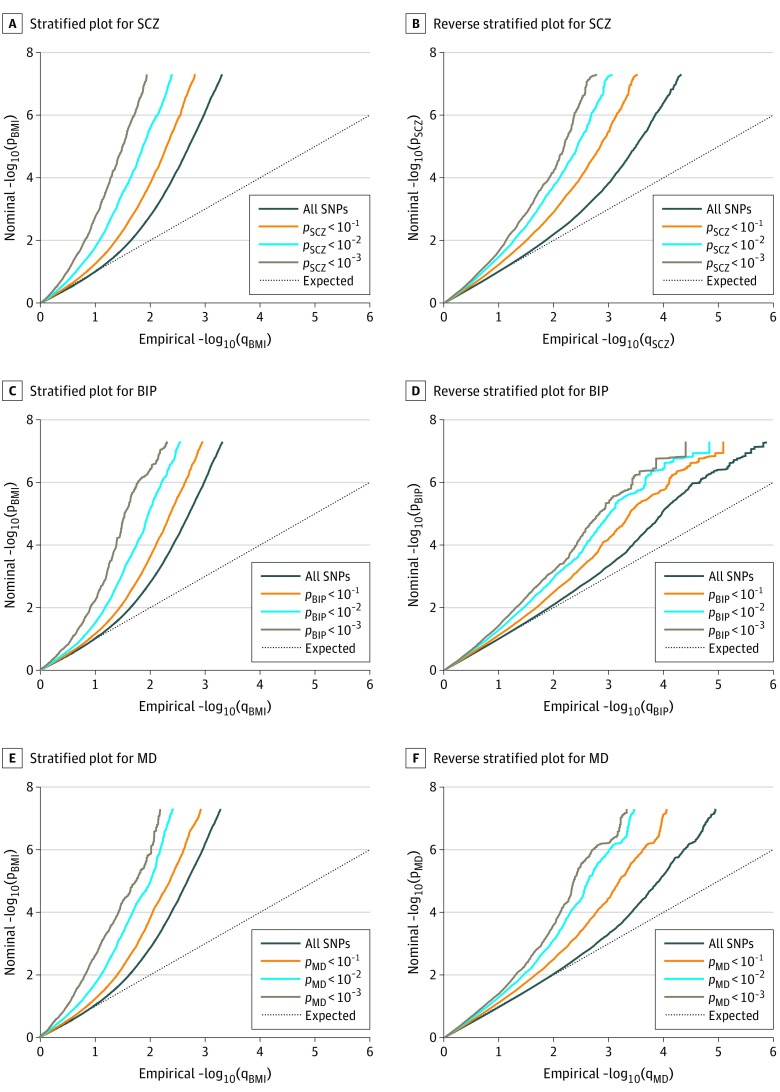
A, C, and E, Conditional quantile-quantile plots of nominal vs empirical body mass index (BMI) −log10 P values (corrected for inflation) below the standard genome-wide association study threshold of P < 5 × 10−8 as a function of the significance of the association with schizophrenia (SCZ), bipolar disorder (BIP), and major depression (MD) at the level of P ≤ .10, P ≤ .01, and P ≤ .001, respectively. B, D, and F, Conditional quantile-quantile plots of nominal vs empirical SCZ, BIP, and MD −log10 P values (corrected for inflation) below the standard genome-wide association study threshold of P < 5 × 10−8 as a function of the significance of the association with BMI, at the level of P ≤ .10, P ≤ .01, and P ≤ .001, respectively. The dashed line indicates the null hypothesis. SNP indicates single-nucleotide polymorphism.
Figure 2.
Figure 2.. Common Genetic Variants Jointly Associated With Body Mass Index, Schizophrenia, Bipolar Disorder, and Major Depression at Conjunctional False Discovery Rate (conjFDR) Less Than 0.01
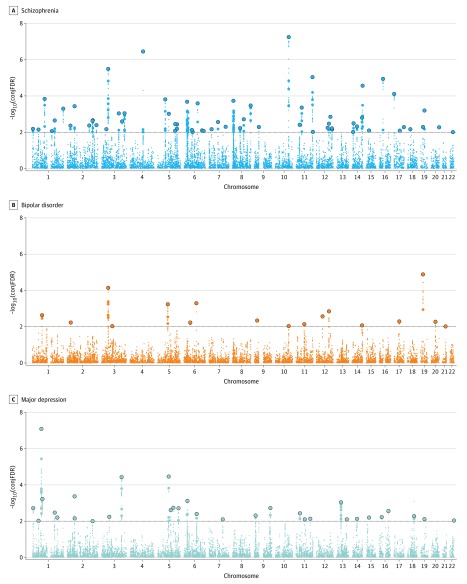
Manhattan plot showing the –log10 transformed conjFDR values for each single-nucleotide polymorphism on the y-axis and chromosomal positions along the x-axis. The dotted horizontal line represents the threshold chosen for reporting shared associations (conjFDR < 0.01). Independent lead single-nucleotide polymorphisms are encircled in outlined circle. The significant shared signal in the major histocompatibility complex region (chr6:25119106–33854733) is represented by 1 independent lead single-nucleotide polymorphism. Further details are provided in eTables 3, 12, and 19 in Supplement 1.
Figure 3.
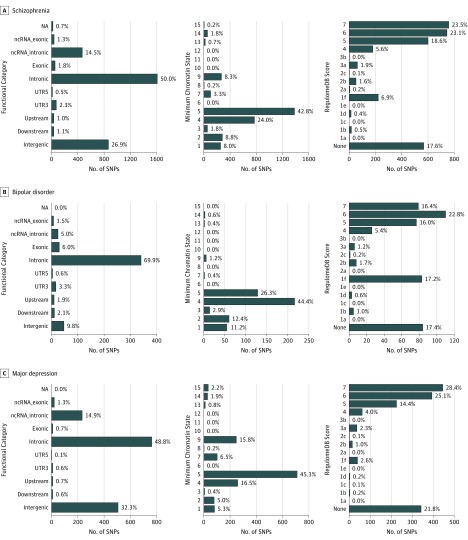
Figure 3.. Distribution of the Annotation for All SNPs Jointly Associated With Body Mass Index and Schizophrenia, Bipolar Disorder, and Major Depression at Conjunctional False Discovery Rate Less Than 0.10 Including Functional Consequences of SNPs
A low RegulomeDB score indicates a higher likelihood of having a regulatory function. A lower minimum chromatin state across 127 tissue and cell types indicates higher accessibility, and states 1 to 7 refer to open chromatin states. NA indicates not applicable; ncRNA, noncoding RNA; SNP, single-nucleotide polymorphism; UTR, untranslated region.

References

    1. McElroy SL, Keck PE Jr. Obesity in bipolar disorder: an overview. Curr Psychiatry Rep. 2012;14(6):650-658. doi:10.1007/s11920-012-0313-8 - DOI - PubMed
    1. Ringen PA, Engh JA, Birkenaes AB, Dieset I, Andreassen OA. Increased mortality in schizophrenia due to cardiovascular disease: a non-systematic review of epidemiology, possible causes, and interventions. Front Psychiatry. 2014;5:137. doi:10.3389/fpsyt.2014.00137 - DOI - PMC - PubMed
    1. Wahlbeck K, Westman J, Nordentoft M, Gissler M, Laursen TM. Outcomes of Nordic mental health systems: life expectancy of patients with mental disorders. Br J Psychiatry. 2011;199(6):453-458. doi:10.1192/bjp.bp.110.085100 - DOI - PubMed
    1. Laursen TM, Plana-Ripoll O, Andersen PK, et al. . Cause-specific life years lost among persons diagnosed with schizophrenia: is it getting better or worse? Schizophr Res. 2019;206:284-290. doi:10.1016/j.schres.2018.11.003 - DOI - PubMed
    1. Laursen TM, Munk-Olsen T, Gasse C. Chronic somatic comorbidity and excess mortality due to natural causes in persons with schizophrenia or bipolar affective disorder. PLoS One. 2011;6(9):e24597. doi:10.1371/journal.pone.0024597 - DOI - PMC - PubMed

Publication types

MeSH terms