


The problem of colorectal anastomosis safety
- PMID: 31914032
- PMCID: PMC6959889
- DOI: 10.1097/MD.0000000000018560
The problem of colorectal anastomosis safety
Abstract
Introduction: Anastomotic leakage (AL) remains one of the most threatening complications in colorectal surgery with the incidence of up to 20%. The aim of the study is to evaluate the safety and feasibility of novel - trimodal intraoperative colorectal anastomosis testing technique.
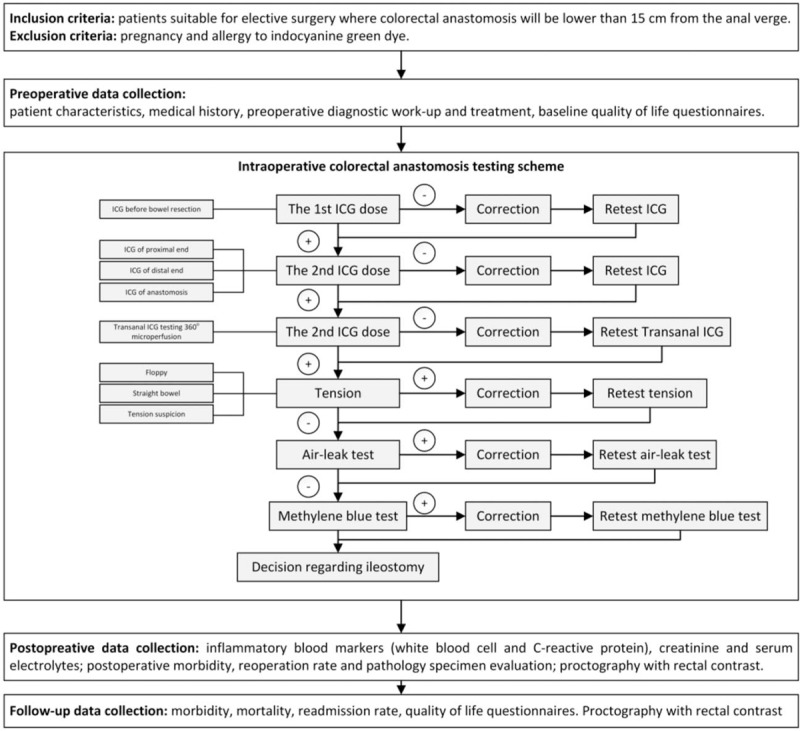
Methods and analysis: This multi-center prospective cohort pilot study will include patients undergoing colorectal anastomosis formation below 15 cm from the anal verge. Trimodal anastomosis testing will include testing for blood supply by ICG fluorescence trans-abdominally and trans-anally, testing of mechanical integrity of anastomosis by air-leak and methylene blue leak tests and testing for tension. The primary outcome of the study will be AL rate at day 60. The secondary outcomes will include: the frequency of changed location of bowel resection; ileostomy rate; the rate of intraoperative AL; time, taken to perform trimodal anastomosis testing; postoperative morbidity and mortality; quality of life.
Discussion: Trimodal testing of colorectal anastomosis may be a novel and comprehensive way to investigate colorectal anastomosis and to reveal insufficient blood supply and integrity defects intraoperatively. Thus, prevention of these two most common causes of AL may lead to decreased rate of leakage.
Study registration: Clinicaltrials.gov (https://clinicaltrials.gov/): NCT03958500, May, 2019.
Conflict of interest statement
We declare that this study is funded by Vilnius University. The individual data of the patients will remain confidential. The results of this study may be presented at national and international conferences and published. The study is a part of doctoral thesis of M.K. at the Faculty of Medicine Vilnius University. The proctoscope and an additional laparoscopic system with near-infrared fluorescence imaging camera were provided without pay by Karl Storz, Germany. No other financial support was received by any of the authors. All the authors declare that they have no additional conflict of interest.
References
-
- Mirnezami A, Mirnezami R, Chandrakumaran K, et al. Increased local recurrence and reduced survival from colorectal cancer following anastomotic leak: systematic review and meta-analysis. Ann Surg 2011;253:890–9. - PubMed
-
- Fujita F, Torashima Y, Kuroki T, et al. The risk factors and predictive factors for anastomotic leakage after resection for colorectal cancer: reappraisal of the literature. Surg Today 2014;44:1595–602. - PubMed
-
- Rullier, Laurent, Garrelon, et al. Risk factors for anastomotic leakage after resection of rectal cancer. Br J Surg 1998;85:355–8. - PubMed
Publication types
MeSH terms
Substances
Associated data
LinkOut - more resources
Full Text Sources
Medical
