Comparisons between non-alcoholic steatohepatitis and alcohol-related hepatocellular carcinoma
- PMID: 31914720
- PMCID: PMC7160352
- DOI: 10.3350/cmh.2019.0012
Comparisons between non-alcoholic steatohepatitis and alcohol-related hepatocellular carcinoma
Abstract
Background/aims: Non-alcoholic liver disease and alcoholic liver disease begin as simple steatosis that may progress to steatohepatitis and ensuing liver-related complications such as cirrhosis and hepatocellular carcinoma (HCC). We explored differences in characteristics between non-alcoholic steatohepatitis (NASH) and alcoholic steatohepatitis-related (ASH) HCC.
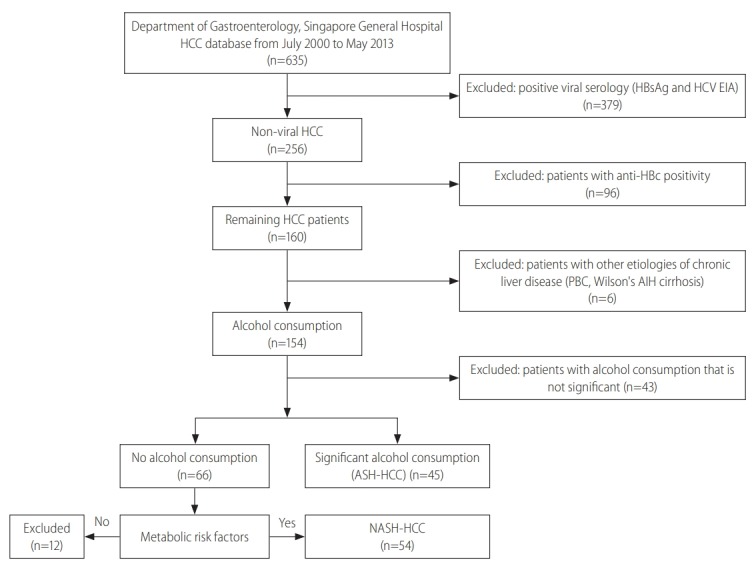
Methods: NASH and ASH patients were identified from our department's prospective HCC database. A total of 54 and 45 patients met predefined inclusion and exclusion criteria for the NASH-HCC and ASH-HCC groups, respectively. Clinical, biochemical and tumor characteristics were studied.
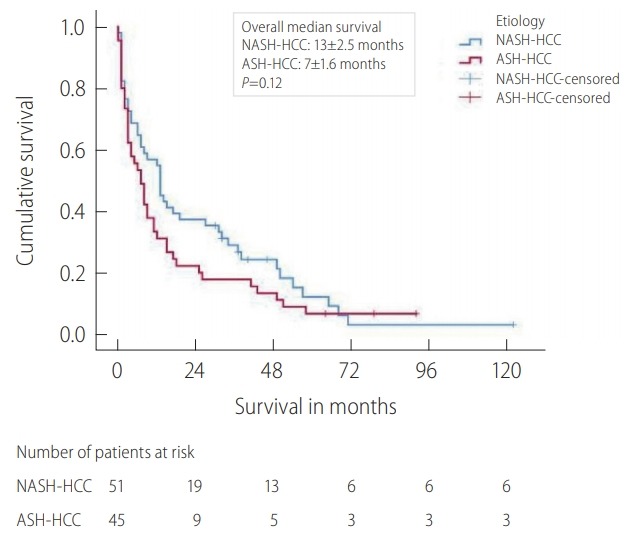
Results: NASH-HCC patients were older compared to ASH-HCC patients (72±9 vs. 66±9 years, P<0.001) and less male predominant (65% vs. 98%, P<0.001). Prevalence of diabetes mellitus (78% vs. 36%, P<0.001) and hypertension (80% vs. 58%, P<0.001) were significantly higher in the NASH-HCC group. Liver function tests and Child-Pugh scores were similar. There were no differences in alpha-fetoprotein level, lesions found at diagnosis (unifocal/multifocal) or prevalence of portal vein invasion. In both groups, almost half of the patients were in TNM stage 4 at the time of diagnosis and more than 50% of patients were not suitable for any therapy. Median survival in the NASH-HCC and ASH-HCC groups were 13 and 7 months respectively (P=0.113).
Conclusion: Despite significant differences in demography of the NASH-HCC and ASH-HCC groups, liver and tumor characteristics were comparable. Most patients were diagnosed late and were not amenable to curative or locoregional therapies. Better characterization of patients with NASH and ASH at risk of HCC is necessary to optimize screening, surveillance, and management strategies.
Keywords: Carcinoma, Hepatocellular; Fatty liver, Alcoholic; Non-alcoholic fatty liver disease; Survival.
Conflict of interest statement
The authors have no conflicts to disclose.
Figures
Comment in
-
Should you advocate for hepatocellular carcinoma surveillance in patients with alcohol-related liver disease or non-alcoholic fatty liver disease?Clin Mol Hepatol. 2020 Apr;26(2):183-184. doi: 10.3350/cmh.2020.0042. Epub 2020 Mar 12. Clin Mol Hepatol. 2020. PMID: 32160729 Free PMC article. No abstract available.
-
Intricate interpretation of etiology-specific outcome comparison in patients with hepatocellular carcinoma.Clin Mol Hepatol. 2020 Apr;26(2):238-239. doi: 10.3350/cmh.2020.0051. Epub 2020 Mar 18. Clin Mol Hepatol. 2020. PMID: 32178487 Free PMC article. No abstract available.
References
-
- El-Serag HB, Rudolph KL. Hepatocellular carcinoma: epidemiology and molecular carcinogenesis. Gastroenterology. 2007;132:2537–2576. - PubMed
-
- Goh GB, Chang PE, Tan CK. Changing epidemiology of Hepatocellular carcinoma in Asia. Best Pract Res Clin Gastroenterol. 2015;29:919–928. - PubMed
-
- Bosch FX, Ribes J, Cléries R, Díaz M. Epidemiology of hepatocellular carcinoma. Clin Liver Dis. 2005;9:191–211. v. - PubMed
-
- Chalasani N, Younossi Z, Lavine JE, Charlton M, Cusi K, Rinella M, et al. The diagnosis and management of non-alcoholic fatty liver disease: practice guidance from the American Association for the Study of Liver Diseases. Hepatology. 2018;67:328–357. - PubMed
Publication types
MeSH terms
LinkOut - more resources
Full Text Sources
Medical
Research Materials
Miscellaneous