


Examining the Potential of Blockchain Technology to Meet the Needs of 21st-Century Japanese Health Care: Viewpoint on Use Cases and Policy
- PMID: 31917371
- PMCID: PMC6996742
- DOI: 10.2196/13649
Examining the Potential of Blockchain Technology to Meet the Needs of 21st-Century Japanese Health Care: Viewpoint on Use Cases and Policy
Abstract
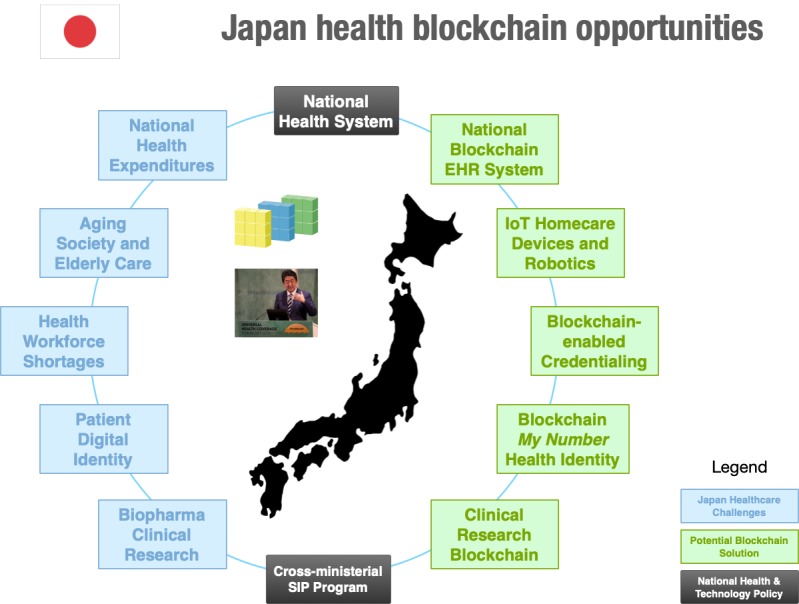
Japan is undergoing a major population health transition as its society ages, and it continues to experience low birth rates. An aging Japan will bring new challenges to its public health system, highlighted as a model for universal health coverage (UHC) around the world. Specific challenges Japan's health care system will face include an increase in national public health expenditures, higher demand for health care services, acute need for elder and long-term care, shortage of health care workers, and disparities between health care access in rural versus urban areas. Blockchain technology has the potential to address some of these challenges, but only if a health blockchain is conceptualized, designed, localized, and deployed in a way that is compatible with Japan's centralized UHC-centric public health system. Blockchain solutions must also be adaptive to opportunities and barriers unique to Japan's national health and innovation policy, including its regulatory sandbox system, while also seeking to learn from blockchain adoption in the private sector and in other countries. This viewpoint outlines the major opportunities and potential challenges to blockchain adoption for the future of Japan's health care.
Keywords: Japan; aging; blockchain; global health; health informatics; health policy; information storage and retrieval.
©Tim Ken Mackey, Hirofumi Bekki, Tokio Matsuzaki, Hiroshi Mizushima. Originally published in the Journal of Medical Internet Research (http://www.jmir.org), 09.01.2020.
Conflict of interest statement
Conflicts of Interest: TKM has received speaker fees and reimbursement for travel from Cardinal Health to present on blockchain and health care research. He is also the co-chair of the IEEE Standards Association Supply Chain/Clinical Trials Technology Implementation Industry Connections Program that focuses on stakeholder collaboration around blockchain technology for the pharmaceutical supply chain and has received reimbursement for travel expenses associated with speaking at IEEE-sponsored events. In addition, he is a noncompensated advisory board member for the blockchain and pharmaceutical company FarmaTrust. All other authors report no conflicts of interest associated with this paper.
Figures
References
-
- Nakamoto S. Bitcoin. 2008. [2019-10-07]. Bitcoin: A Peer-to-Peer Electronic Cash System https://bitcoin.org/bitcoin.pdf.
-
- Harvard Business School. 2015. [2019-10-06]. The Great Chain of Being Sure About Things https://www.hbs.edu/faculty/conferences/2015-strategy-research/Documents....
-
- Mackey TK, Kuo T, Gummadi B, Clauson KA, Church G, Grishin D, Obbad K, Barkovich R, Palombini M. 'Fit-for-purpose?' - challenges and opportunities for applications of blockchain technology in the future of healthcare. BMC Med. 2019 Mar 27;17(1):68. doi: 10.1186/s12916-019-1296-7. https://bmcmedicine.biomedcentral.com/articles/10.1186/s12916-019-1296-7 - DOI - DOI - PMC - PubMed
-
- Gartner. 2018. Oct 16, [2019-10-07]. The Reality of Blockchain https://www.gartner.com/smarterwithgartner/the-reality-of-blockchain/
-
- Kuo T, Kim H, Ohno-Machado L. Blockchain distributed ledger technologies for biomedical and health care applications. J Am Med Inform Assoc. 2017 Nov 1;24(6):1211–20. doi: 10.1093/jamia/ocx068. http://europepmc.org/abstract/MED/29016974 - DOI - PMC - PubMed
Publication types
MeSH terms
LinkOut - more resources
Full Text Sources
