. 2019 Dec 11:10:2857.
doi: 10.3389/fmicb.2019.02857. eCollection 2019.

Unbalanced Roles of Fungal Aggressiveness and Host Cultivars in the Establishment of the Fusarium Head Blight in Bread Wheat

Affiliations

Unbalanced Roles of Fungal Aggressiveness and Host Cultivars in the Establishment of the Fusarium Head Blight in Bread Wheat

Francis Fabre et al. Front Microbiol. .

Abstract

Fusarium head blight (FHB), caused mainly by Fusarium graminearum, is the foremost destructive disease of cereals worldwide. Effector-like molecules produced by F. graminearum play key roles in the infection process and are assumed to be one of the essential components of the pathogen's aggressiveness. However, their nature and role in the disease are still largely misunderstood. As a mean to provide relevant information about the molecular determinism of F. graminearum aggressiveness, we surveyed three F. graminearum strains on three wheat cultivars contrasted by their susceptibility to FHB. F. graminearum strains revealed large differences in aggressiveness which were mostly unchanged when facing hosts of contrasted susceptibility, suggesting that their behavior rely on intrinsic determinants. Surveying the fungal mass progress and the mycotoxin production rate in the spikes did not evidence any simple relationship with aggressiveness differences, while clues were found through a qualitative and quantitative characterization of the three strain proteomes established in planta especially with regards to early synthesized putative effectors. Independently of the wheat cultivar, the three F. graminearum strains produced systematically the same protein set during the infection but substantial differences in their abundance enabled the categorization of fungal aggressiveness. Overall, our findings show that the contrasts in F. graminearum aggressiveness were not based on the existence of strain-specific molecules but rather on the ability of the strain to ensure their sufficient accumulation. Protein abundance variance was mostly driven by the strain genetics and part was also influenced by the host cultivar but strain by cultivar interactions were marginally detected, depicting that strain-specific protein accumulations did not depend on the host cultivar. All these data provide new knowledge on fungal aggressiveness determinants and provide a resourceful repertoire of candidate effector proteins to guide further research.

Keywords: Fusarium graminearum; Gibberella zeae; aggressiveness; bread wheat; effector proteins; plant-pathogen interactions; proteomics.


Figures

FIGURE 1
FIGURE 1
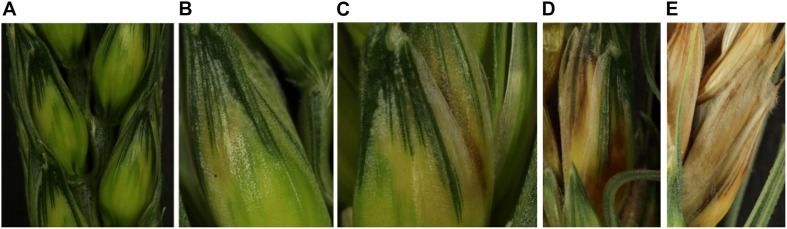
Determination of the symptom severity scale. (A) The picture represents spikelets with type-0 symptoms corresponding to asymptomatic spikelets. (B) Representation of type-1 symptoms on spikelet with the first yellowing spot. (C) The picture illustrates the type-2 symptoms characterized by a spikelet harboring the first browning spot. (D) The picture illustrates the type-3 symptoms characterized by a fully burnished spikelet. (E) The picture illustrates the type-4 symptoms characterized by a total drying of the spikelet with the visible mycelium outside the plant organ.
FIGURE 2
FIGURE 2
Symptom dynamics induced by the three F. graminearum strains on the three studied wheat cultivars (A) Recital, (B) Cadenza, and (C) Renan. Line plots show the course of the symptom severity observed for MDC_Fg1 (blue lines), MDC_Fg13 (pink lines), and MDC_FgU1 (green lines) on the three wheat cultivars. Values are means of six biological replicates until 72 hpi and means of three biological replicates from 96 hpi to 168 hpi. Each biological replicate was characterized from three spikes. Error bars indicate the confidence interval at 5% calculated for each time point independently.
FIGURE 3
FIGURE 3
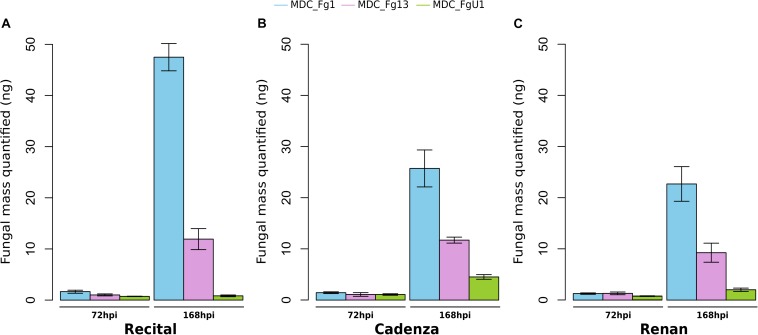
Fusarium graminearum strains development in infected wheat spikes. Fungal mass was assessed at 72 and 168 hpi in the cultivars Recital (A), Cadenza (B) and Renan (C), from the absolute quantification of the F. graminearum β-tubulin gene using qPCR (Nguyen et al., 2013). Values were estimated with a standard curve of 10-fold dilutions (ranging from 0.01–100 ng) of F. graminearum DNA purification for MDC_Fg1 (blue bars), MDC_Fg13 (pink bars) and MDC_FgU1 (green bars). Values are means of nine biological replicates computed for three biological replicates at 72 hpi and at 168 hpi. Each biological replicate was characterized from three spikes. Error bars indicate the confidence interval at 5% calculated for each time point independently.
FIGURE 4
FIGURE 4
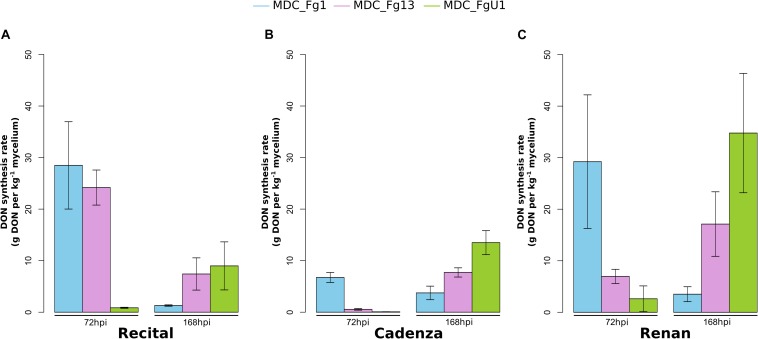
Fungal DON synthesis rate in infected wheat spikes. Bar graphs represent DON synthesis rate (in g of DON per kg–1 of fungal mycelium) in wheat heads infected with MDC_Fg1 (blue bars), MDC_Fg13 (pink bars) and MDC_FgU1 (green bars) in the cultivars Recital (A), Cadenza (B), and Renan (C). Measurements were performed by enzyme-linked immunosorbent assay at 72 and 168 hpi, and normalized by the fungal mass quantified by qPCR. Values are means of nine biological replicates computed for three biological replicates at 72 hpi and at 168 hpi. Each biological replicate was characterized from three spikes. Error bars indicate the confidence interval at 5% calculated for each time point independently.
FIGURE 5
FIGURE 5
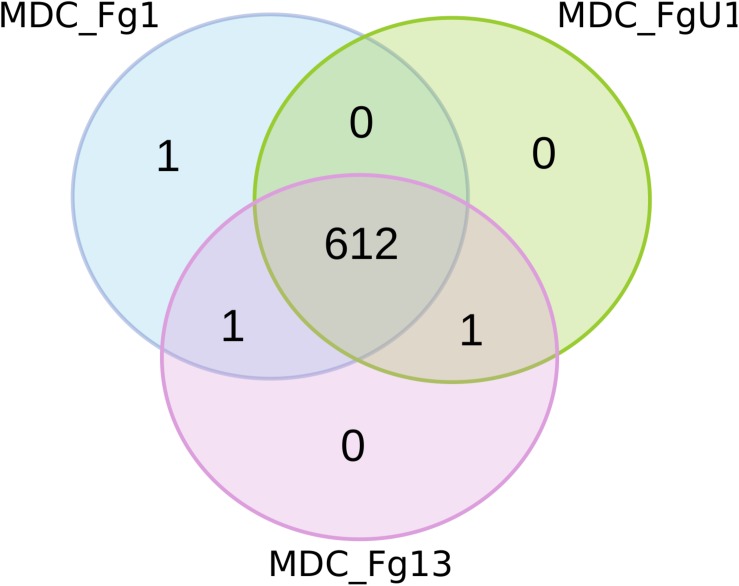
Number of fungal proteins identified for the three F. graminearum strains. For each quantified proteins, the Venn diagram represents the proteins that were strain-specific in the outer part of the circles and those quantified in samples inoculated with at least two different strains in the shared regions of the circles. MDC_Fg1, MDC_Fg13, and MDC_FgU1 proteomes are represented in blue, pink, and green color, respectively.
FIGURE 6
FIGURE 6
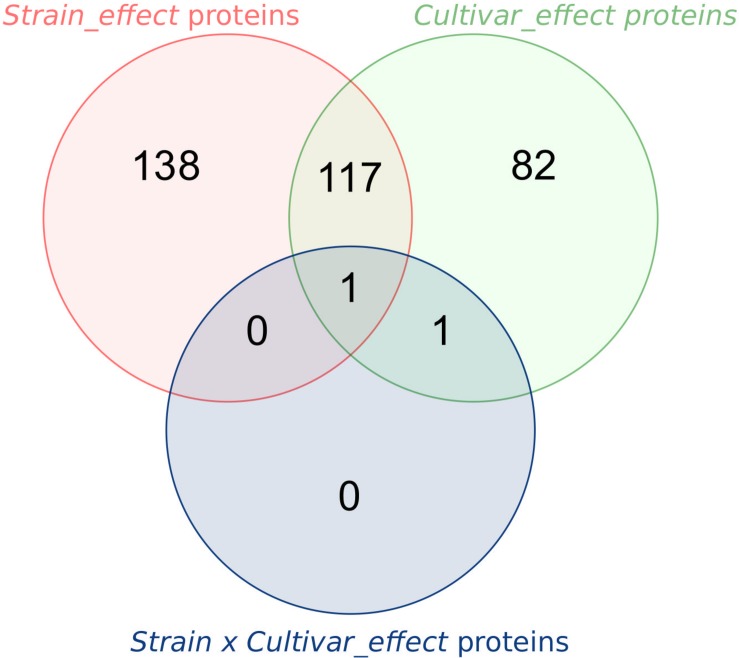
Number of F. graminearum proteins significantly impacted by the different effects in the two-way ANOVA. The Venn diagram shows the number of F. graminearum proteins whose abundance change was significant for each factor of the two-way ANOVA (Strain_effect proteins: FDR < 5%, P-value < 0.022; Cultivar_effect proteins: FDR < 5%, P-value < 0.017; and Strain×Cultivar_effect proteins: FDR < 5%, P-value < 0.00005).
FIGURE 7
FIGURE 7
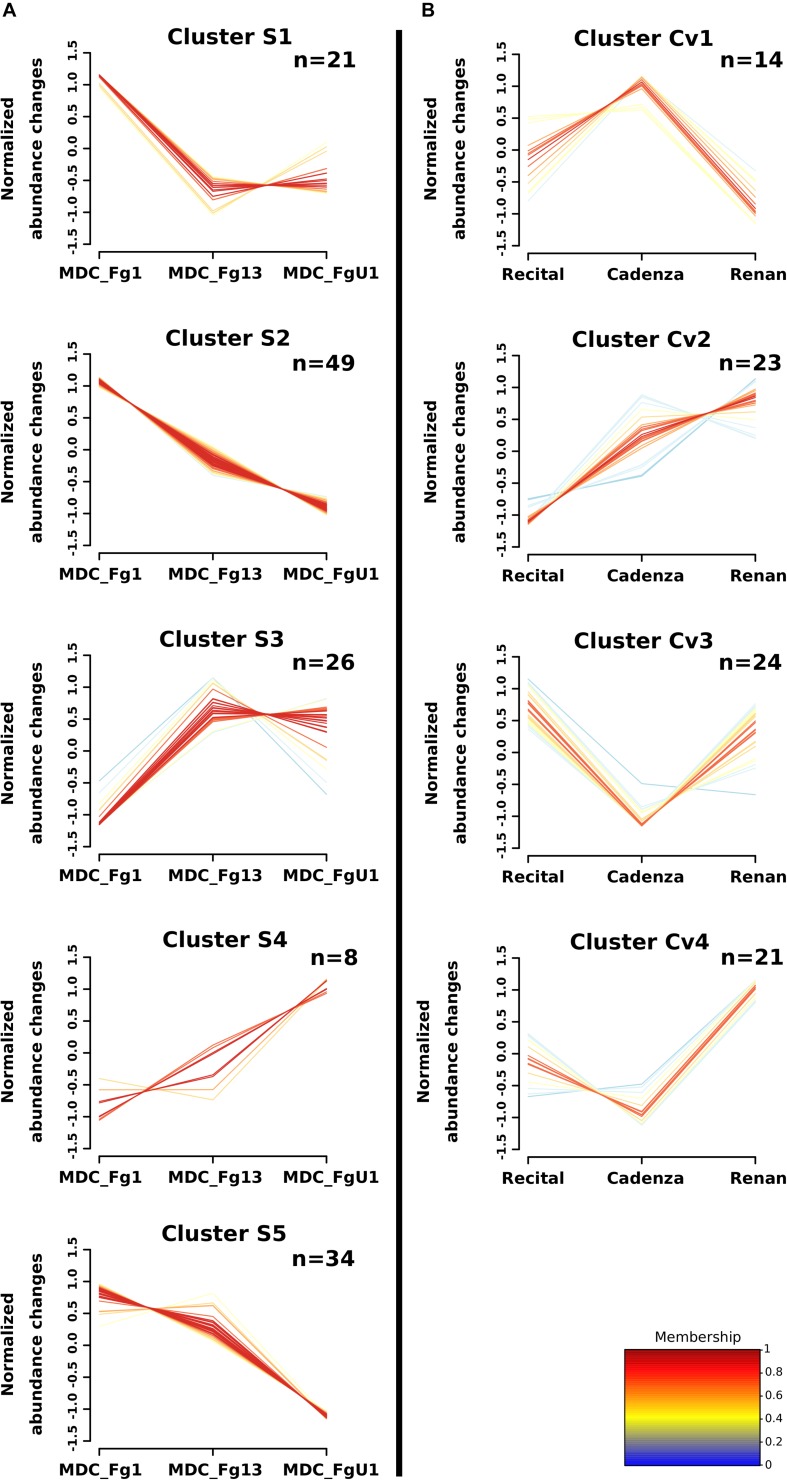
Clustering of F. graminearum Strain_effect and Cultivar_effect protein abundance patterns. Clustering was computed using the fuzzy C-means methods using Z-score transformed values to identify homogeneous patterns of protein abundance changes in (A) the Strain_effect proteins and in (B) the Cultivar_effect proteins. The number of proteins included in each cluster are specified in the right upper corner (n). The cluster membership of each protein profile is indicated by a color code from blue to red.
FIGURE 8
FIGURE 8
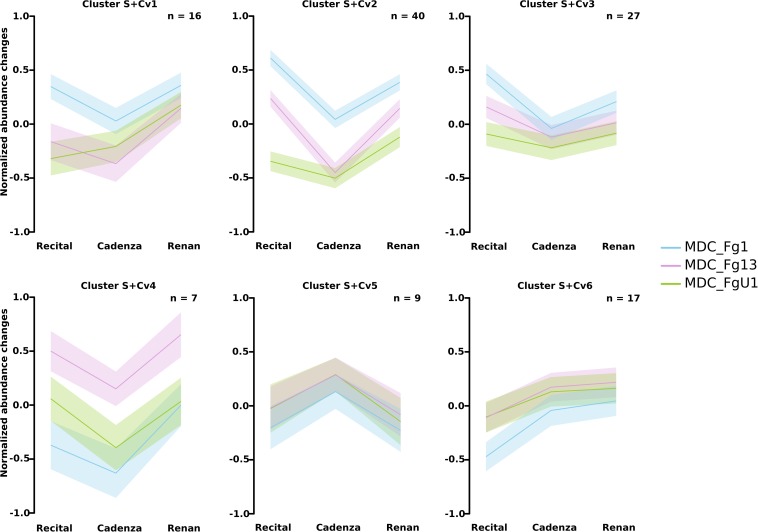
Clustering of F. graminearum Strain+Cultivar_effect protein abundance patterns. Clustering was computed using the fuzzy C-means methods using Z-score transformed values to identify homogeneous patterns. For each cluster, the average profile was represented by the line plot with the wheat cultivar in x-axis and a color code for the F. graminearum strains (blue: MDC_Fg1; pink: MDC_Fg13, and green: MDC_FgU1). Ribbons indicate the confidence interval at 5% following the same color code than the line plot. The number of proteins included in each cluster are specified in the right upper corner (n).

References

    1. Alouane T., Rimbert H., Fabre F., Cambon F., Langin T., Bonhomme L. (2018). Genome sequence of Fusarium graminearum strain MDC_Fg1, isolated from bread wheat grown in France. Microbiol. Resour. Announc. 7:e01260-18. 10.1128/MRA.01260-18 - DOI - PMC - PubMed
    1. Alvarez C. L., Somma S., Moretti A., Fernández Pinto V. (2010). Aggressiveness of Fusarium graminearum sensu stricto isolates in wheat kernels in Argentina. J. Phytopathol. 158 173–181. 10.1111/j.1439-0434.2009.01596.x - DOI
    1. Bai G.-H., Desjardins A. E., Plattner R. D. (2002). Deoxynivalenol-nonproducing Fusarium graminearum causes initial infection, but does not cause disease spread in wheat spikes. Mycopathologia 153 91–98. 10.1023/A:1014419323550 - DOI - PubMed
    1. Bai G.-H., Plattner R., Desjardins A., Kolb F., McIntosh R. A. (2001). Resistance to Fusarium head blight and deoxynivalenol accumulation in wheat. Plant Breed. 120 1–6. 10.1046/j.1439-0523.2001.00562.x - DOI
    1. Bai G.-H., Shaner G. (1996). Variation in Fusarium graminearum and cultivar resistance to wheat scab. Plant Dis. 80 975–979. 10.1094/PD-80-0975 - DOI