Review
. 2019 Dec 12:10:2866.
doi: 10.3389/fmicb.2019.02866. eCollection 2019.

Mechanisms of Action for Antimicrobial Peptides With Antibacterial and Antibiofilm Functions

Affiliations
Review

Mechanisms of Action for Antimicrobial Peptides With Antibacterial and Antibiofilm Functions

Nigare Raheem et al. Front Microbiol. .

Abstract

The antibiotic crisis has led to a pressing need for alternatives such as antimicrobial peptides (AMPs). Recent work has shown that these molecules have great potential not only as antimicrobials, but also as antibiofilm agents, immune modulators, anti-cancer agents and anti-inflammatories. A better understanding of the mechanism of action (MOA) of AMPs is an important part of the discovery of more potent and less toxic AMPs. Many models and techniques have been utilized to describe the MOA. This review will examine how biological assays and biophysical methods can be utilized in the context of the specific antibacterial and antibiofilm functions of AMPs.

Keywords: antimicrobial peptide; antimicrobial resistance; biological assays; biophysical methods; host defense peptide; mechanism of action.


Figures

FIGURE 1
FIGURE 1
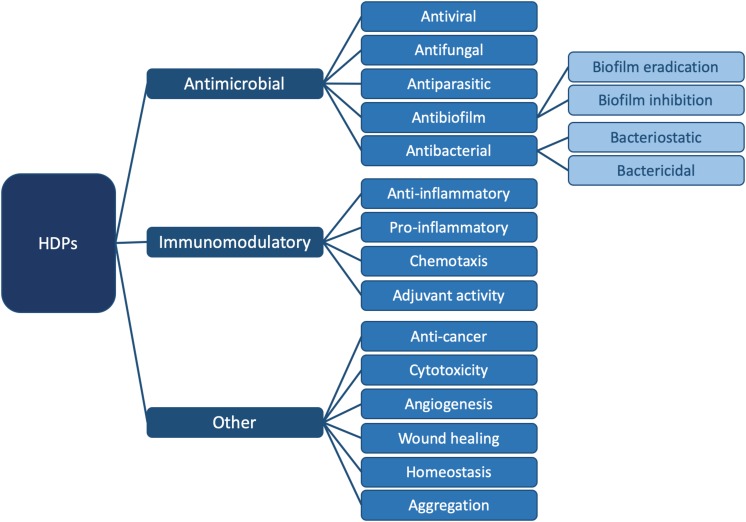
Summary of known functions for HDPs. In this review, we focus on the antibacterial (Figure 2) and antibiofilm (Figure 3) functions in particular. For specific examples of HDPs displaying antiviral, antifungal, antiparasitic, immunomodulatory, and other functions, please consult (Haney et al., 2019).
FIGURE 2
FIGURE 2
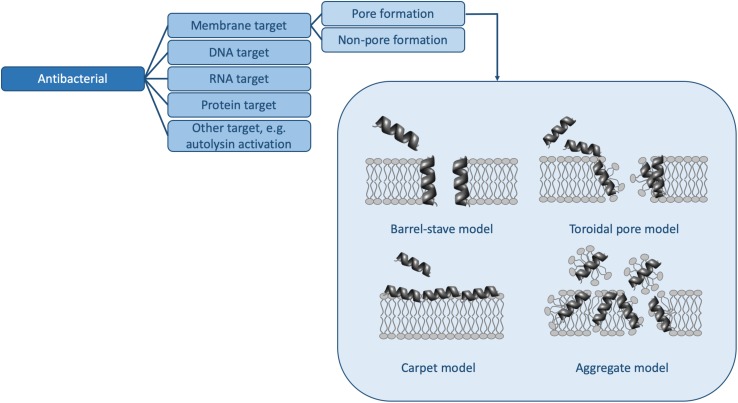
Mechanisms of action for antibacterial HDPs. The pore forming mechanisms, which have been characterized extensively in many papers (e.g., reviewed in Kumar et al., 2018), are shown in more detail. Table 1 contains detailed examples of HDPs which function via each of the listed MOAs.
FIGURE 3
FIGURE 3
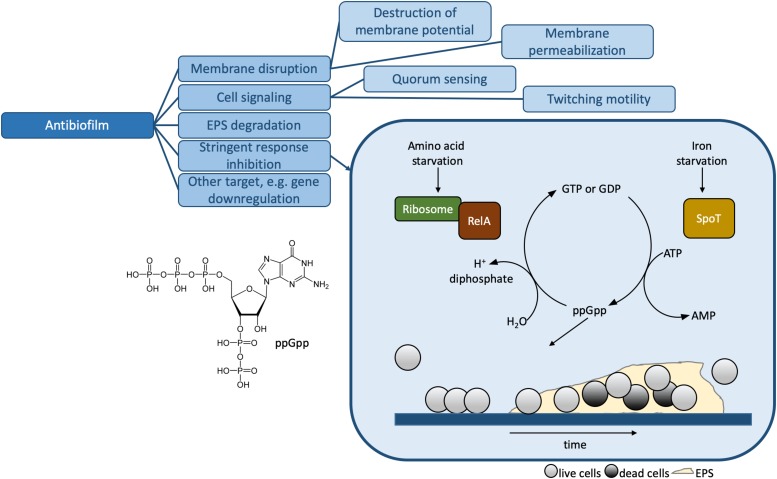
Mechanisms of action for antibiofilm HDPs. The stringent response inhibition mechanism involving ppGpp is shown in more detail. The presence of the alarmone leads to the formation of biofilms, illustrated at the bottom of the box. The biofilm consists of live cells (light gray circles), dead cells (dark gray circles) and the extracellular polymer substance or EPS. Table 1 contains detailed examples of HDPs which function via each of the listed MOAs.

References

    1. Abdillahi S. M., Maaß T., Kasetty G., Strömstedt A. A., Baumgarten M., Tati R., et al. (2018). Collagen VI contains multiple host defense peptides with potent in vivo activity. J. Immunol. 201 1007–1020. 10.4049/jimmunol.1700602 - DOI - PubMed
    1. Akbari R., Hakemi Vala M., Hashemi A., Aghazadeh H., Sabatier J.-M., Pooshang Bagheri K. (2018). Action mechanism of melittin-derived antimicrobial peptides, MDP1 and MDP2, de novo designed against multidrug resistant bacteria. Amino Acids 50 1231–1243. 10.1007/s00726-018-2596-5 - DOI - PubMed
    1. Andrea A., Molchanova N., Jenssen H. (2018). Antibiofilm peptides and peptidomimetics with focus on surface immobilization. Biomolecules 8:E27. 10.3390/biom8020027 - DOI - PMC - PubMed
    1. Ansari J. M., Abraham N. M., Massaro J., Murphy K., Smith-Carpenter J., Fikrig E. (2017). Anti-biofilm activity of a self-aggregating peptide against Streptococcus mutans. Front. Microbiol. 8:488. 10.3389/fmicb.2017.00488 - DOI - PMC - PubMed
    1. Arias M., Prenner E. J., Vogel H. J. (2017). Calorimetry methods to study membrane interactions and perturbations induced by antimicrobial host defense peptides. Methods Mol. Biol. 1548 119–140. 10.1007/978-1-4939-6737-7 - DOI - PubMed

LinkOut - more resources