


Gene Transmission in the One Health Microbiosphere and the Channels of Antimicrobial Resistance
- PMID: 31921068
- PMCID: PMC6927996
- DOI: 10.3389/fmicb.2019.02892
Gene Transmission in the One Health Microbiosphere and the Channels of Antimicrobial Resistance
Abstract
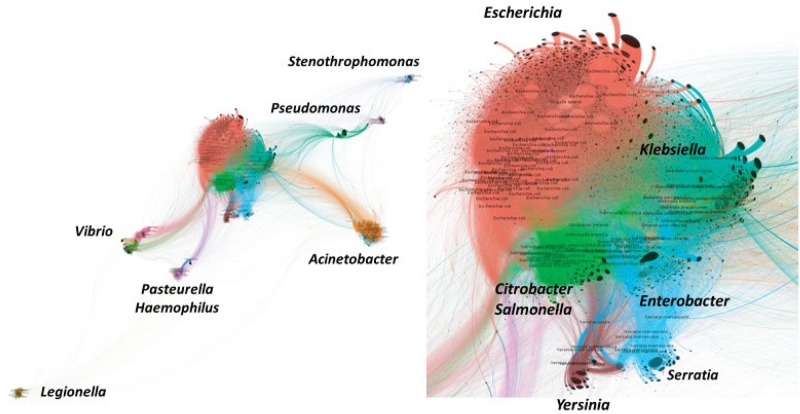
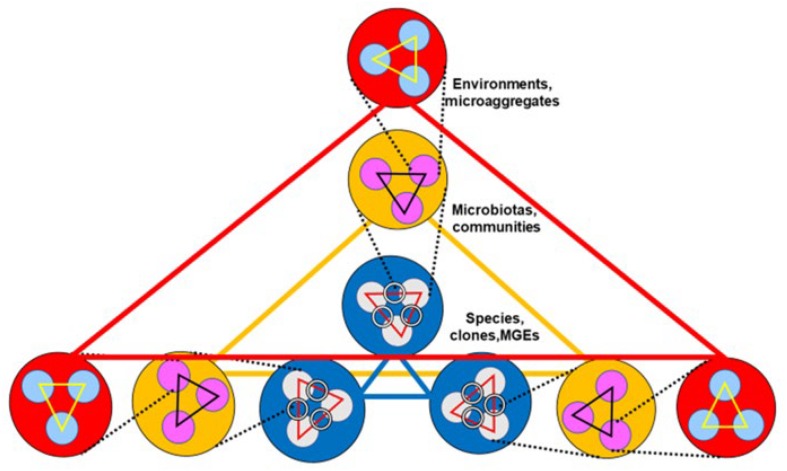
Antibiotic resistance is a field in which the concept of One Health can best be illustrated. One Health is based on the definition of communication spaces among diverse environments. Antibiotic resistance is encoded by genes, however, these genes are propagated in mobile genetic elements (MGEs), circulating among bacterial species and clones that are integrated into the multiple microbiotas of humans, animals, food, sewage, soil, and water environments, the One Health microbiosphere. The dynamics and evolution of antibiotic resistance depend on the communication networks linking all these ecological, biological, and genetic entities. These communications occur by environmental overlapping and merging, a critical issue in countries with poor sanitation, but also favored by the homogenizing power of globalization. The overwhelming increase in the population of highly uniform food animals has contributed to the parallel increase in the absolute size of their microbiotas, consequently enhancing the possibility of microbiome merging between humans and animals. Microbial communities coalescence might lead to shared microbiomes in which the spread of antibiotic resistance (of human, animal, or environmental origin) is facilitated. Intermicrobiome communication is exerted by shuttle bacterial species (or clones within species) belonging to generalist taxa, able to multiply in the microbiomes of various hosts, including humans, animals, and plants. Their integration into local genetic exchange communities fosters antibiotic resistance gene flow, following the channels of accessory genome exchange among bacterial species. These channels delineate a topology of gene circulation, including dense clusters of species with frequent historical and recent exchanges. The ecological compatibility of these species, sharing the same niches and environments, determines the exchange possibilities. In summary, the fertility of the One Health approach to antibiotic resistance depends on the progress of understanding multihierarchical systems, encompassing communications among environments (macro/microaggregates), among microbiotas (communities), among bacterial species (clones), and communications among MGEs.
Keywords: accessory genes; gene flow channels; microbiome merging; one health; resistance genes.
Copyright © 2019 Baquero, Coque, Martínez, Aracil-Gisbert and Lanza.
Figures
References
-
- Adeolu M., Alnajar S., Naushad S., Gupta R. S. (2016). Genome-based phylogeny and taxonomy of the ‘Enterobacteriales’: proposal for Enterobacterales ord. nov. divided into the families Enterobacteriaceae, Erwiniaceae fam. nov., Pectobacteriaceae fam. nov., Yersiniaceae fam. nov., Hafniaceae fam. nov., Morganellaceae fam. nov., and Budviciaceae fam. nov. Int. J. Syst. Evol. Microbiol. 66 5575–5599. 10.1099/ijsem.0.001485 - DOI - PubMed
-
- Arana D. M., Ortega A., González-Barberá E., Lara N., Bautista V., Gómez-Ruíz D., et al. (2017). Carbapenem-resistant Citrobacter spp. isolated in Spain from 2013 to 2015 produced a variety of carbapenemases including VIM-1, OXA-48, KPC-2, NDM-1 and VIM-2. J. Antimicrob. Chemother. 72 3283–3287. 10.1093/jac/dkx325 - DOI - PubMed
