. 2019 Dec 20:10:2907.
doi: 10.3389/fmicb.2019.02907. eCollection 2019.

A New High Throughput Sequencing Assay for Characterizing the Diversity of Natural Vibrio Communities and Its Application to a Pacific Oyster Mortality Event

Affiliations

A New High Throughput Sequencing Assay for Characterizing the Diversity of Natural Vibrio Communities and Its Application to a Pacific Oyster Mortality Event

William L King et al. Front Microbiol. .

Abstract

The Vibrio genus is notable for including several pathogens of marine animals and humans, yet characterization of Vibrio diversity using routine 16S rRNA sequencing methods is often constrained by poor resolution beyond the genus level. Here, a new high throughput sequencing approach targeting the heat shock protein (hsp60) as a phylogenetic marker was developed to more precisely discriminate members of the Vibrio genus in environmental samples. The utility of this new assay was tested using mock communities constructed from known dilutions of Vibrio isolates. Relative to standard and Vibrio-specific 16S rRNA sequencing assays, the hsp60 assay delivered high levels of fidelity with the mock community composition at the species level, including discrimination of species within the Vibrio harveyi clade. This assay was subsequently applied to characterize Vibrio community composition in seawater and delivered substantially improved taxonomic resolution of Vibrio species compared to 16S rRNA analysis. Finally, this assay was applied to examine patterns in the Vibrio community within oysters during a Pacific oyster mortality event. In these oysters, the hsp60 assay identified species-level Vibrio community shifts prior to disease onset, pinpointing V. harveyi as a putative pathogen. Given that shifts in the Vibrio community can precede, cause, and follow disease onset in numerous marine organisms, there is a need for an accurate high throughput assay for defining Vibrio community composition in natural samples. This Vibrio-centric hsp60 sequencing assay offers the potential for precise high throughput characterization of Vibrio diversity, providing an enhanced platform for dissecting Vibrio dynamics in the environment.

Keywords: DNA sequencing; Vibrio; Vibrio communities; hsp60; marine microbiology; oyster (Crassostrea gigas); seawater.


Figures

FIGURE 1
FIGURE 1
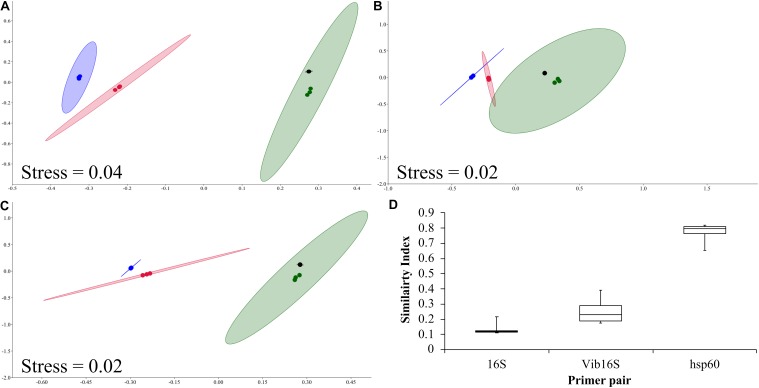
nMDS analysis of the 16S rRNA (blue dots), Vibrio-specific 16S rRNA (red dots), and Vibrio-centric hsp60 (green dots) characterized mock communities, and the true mock community (black dots). Mock communities 1, 2 and 3 are (A), (B) and (C) respectively. 95% ellipses are shown. (D) Box and whisker plot of Bray–Curtis similarity comparisons of community composition compared to the true mock communities. Data for all three mock communities are combined. For species assigned across two taxonomic assignments (e.g., group 2), they were combined with their respective species for D.
FIGURE 2
FIGURE 2
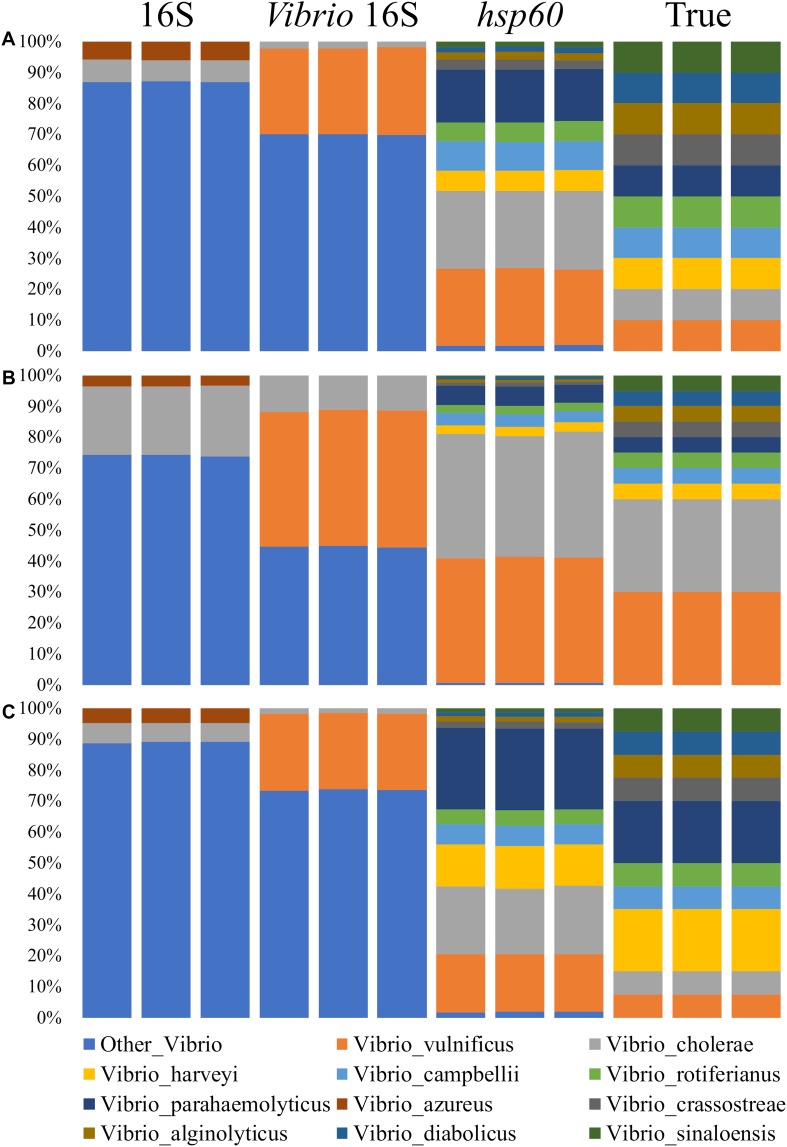
Comparison of amplicon sequenced phylogenetic markers for the Vibrio mock communities. Mock communities 1, 2 and 3 are (A), (B) and (C) respectively. Each bar represents the average across a biological triplicate for each sequencing assay. Communities were characterized using 16S rRNA V3-V4 (Herlemann et al., 2011), Vibrio-specific 16S rRNA (Thompson et al., 2004; Yong et al., 2006), and Vibrio-centric hsp60 primer pairs. The true mock community composition is also shown. Displayed data are relative abundance summarized at the species level. For sequences assigned to the second chromosome (group 2), they were combined with their respective species. Sequences representing less than 1% of the relative abundance were removed.
FIGURE 3
FIGURE 3
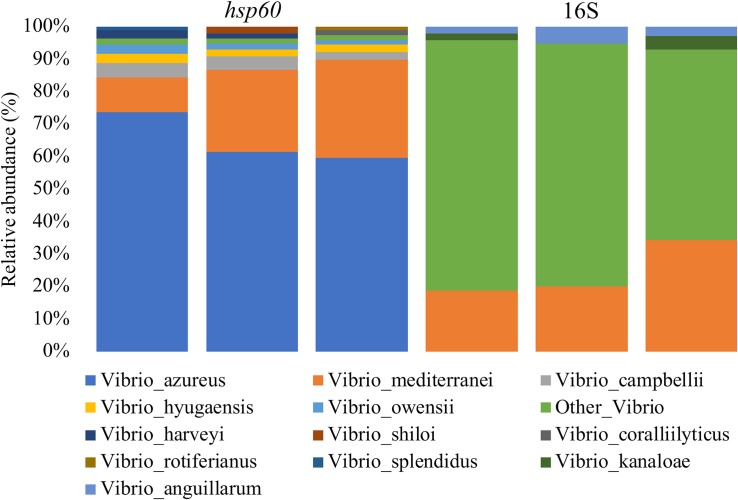
Vibrio diversity in seawater from Sydney Harbour. DNA was characterized with the Vibrio-centric hsp60 and 16S rRNA V3-V4 (Watermann et al., 2008) primer sets. Displayed data are relative abundance summarized at the species level.
FIGURE 4
FIGURE 4
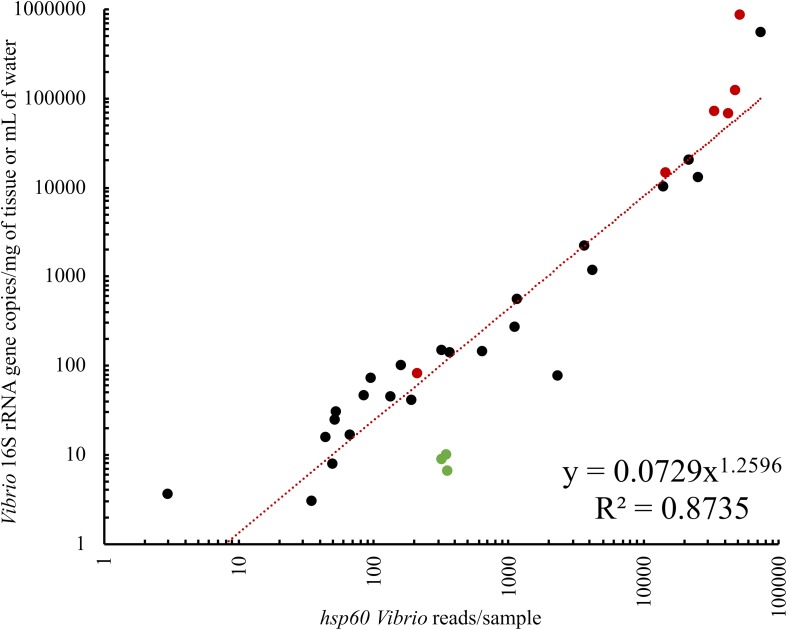
Ordinary least squares linear regression of Vibrio 16S rRNA gene copies and hsp60 sequences per sample. Vibrio 16S rRNA gene copies were determined with qPCR while hsp60 sequences refer to the analyzed Illumina sequencing data generated from the Vibrio-centric hsp60 assay. Black dots are oyster samples, red dots are oyster mortality samples, and green dots are seawater samples. Both axes are logarithmic in scale.
FIGURE 5
FIGURE 5
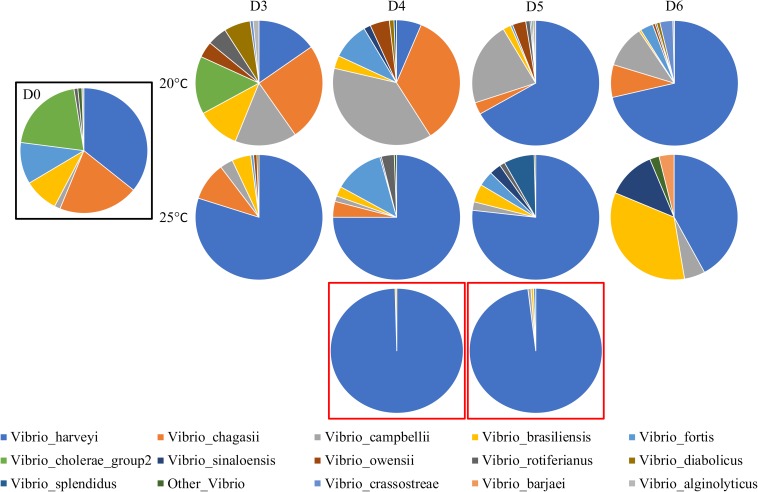
Vibrio community of C. gigas spat across 6 days and two temperature treatments. D0, D3, D4, D5, and D6 correspond to sampling days 0–6. Communities are averaged across three biological replicates and summarized at the species level. Communities in a black box are day 0. Communities in red boxes are dead C. gigas spat from the high (25°C) temperature treatment, taken on days 4 and 5, respectively. Sequences representing less than 1% of the relative abundance were removed.

References

    1. Austin B., Zhang X.-H. (2006). Vibrio harveyi: a significant pathogen of marine vertebrates and invertebrates. Lett. Appl. Microbiol. 43 119–124. 10.1111/j.1472-765X.2006.01989.x - DOI - PubMed
    1. Becker P., Gillan D., Lanterbecq D., Jangoux M., Rasolofonirina R., Rakotovao J., et al. (2004). The skin ulceration disease in cultivated juveniles of Holothuria scabra (Holothuroidea, Echinodermata). Aquaculture 242 13–30. 10.1016/j.aquaculture.2003.11.018 - DOI
    1. Ben-Haim Y., Rosenberg E. (2002). A novel Vibrio sp. pathogen of the coral Pocillopora damicornis. Mar. Biol. 141 47–55. 10.1007/s00227-002-0797-6 - DOI
    1. Brinker A., Pfeifer G., Kerner M. J., Naylor D. J., Hartl F. U., Hayer-Hartl M. (2001). Dual function of protein confinement in chaperonin-assisted protein folding. Cell 107 223–233. 10.1016/S0092-8674(01)00517-7 - DOI - PubMed
    1. Bruto M., James A., Petton B., Labreuche Y., Chenivesse S., Alunno-Bruscia M., et al. (2017). Vibrio crassostreae, a benign oyster colonizer turned into a pathogen after plasmid acquisition. ISME J. 11 1043–1052. 10.1038/ismej.2016.162 - DOI - PMC - PubMed