. 2019 Dec 18:10:1590.
doi: 10.3389/fpls.2019.01590. eCollection 2019.

A Snapshot of the Trehalose Pathway During Seed Imbibition in Medicago truncatula Reveals Temporal- and Stress-Dependent Shifts in Gene Expression Patterns Associated With Metabolite Changes

Affiliations

A Snapshot of the Trehalose Pathway During Seed Imbibition in Medicago truncatula Reveals Temporal- and Stress-Dependent Shifts in Gene Expression Patterns Associated With Metabolite Changes

Anca Macovei et al. Front Plant Sci. .

Abstract

Trehalose, a non-reducing disaccharide with multiple functions, among which source of energy and carbon, stress protectant, and signaling molecule, has been mainly studied in relation to plant development and response to stress. The trehalose pathway is conserved among different organisms and is composed of three enzymes: trehalose-6-phosphate synthase (TPS), which converts uridine diphosphate (UDP)-glucose and glucose-6-phosphate to trehalose-6-phosphate (T6P), trehalose-6-phosphatase (TPP), which dephosphorylates T6P to produce trehalose, and trehalase (TRE), responsible for trehalose catabolism. In plants, the trehalose pathway has been mostly studied in resurrection plants and the model plant Arabidopsis thaliana, where 11 AtTPS, 10 AtTPP, and 1 AtTRE genes are present. Here, we aim to investigate the involvement of the trehalose pathway in the early stages of seed germination (specifically, seed imbibition) using the model legume Medicago truncatula as a working system. Since not all the genes belonging to the trehalose pathway had been identified in M. truncatula, we first conducted an in silico analysis using the orthologous gene sequences from A. thaliana. Nine MtTPSs, eight MtTPPs, and a single MtTRE gene were hereby identified. Subsequently, the expression profiles of all the genes (together with the sucrose master-regulator SnRK1) were investigated during seed imbibition with water or stress agents (polyethylene glycol and sodium chloride). The reported data show a temporal distribution and preferential expression of specific TPS and TPP isoforms during seed imbibition with water. Moreover, it was possible to distinguish a small set of genes (e.g., MtTPS1, MtTPS7, MtTPS10, MtTPPA, MtTPPI, MtTRE) having a potential impact as precocious hallmarks of the seed response to stress. When the trehalose levels were measured by high-performance liquid chromatography, a significant decrease was observed during seed imbibition, suggesting that trehalose may act as an energy source rather than osmoprotectant. This is the first report investigating the expression profiles of genes belonging to the trehalose pathway during seed imbibition, thus ascertaining their involvement in the pre-germinative metabolism and their potential as tools to improve seed germination efficiency.

Keywords: Medicago truncatula; abiotic stress; gene expression; seed imbibition; trehalose.


Figures

Figure 1
Figure 1
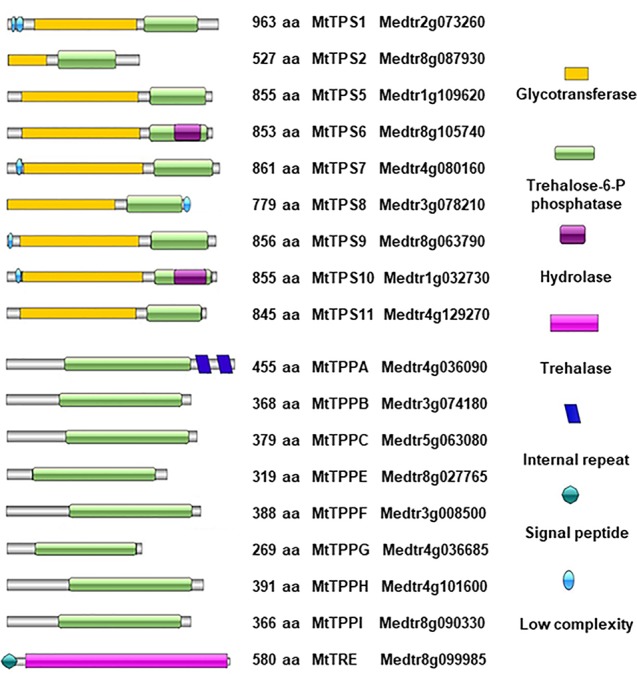
Domain architecture of Medicago truncatula MtTPS, MtTPP, and MtTRE proteins. Domain names are given according to SMART (Simple Modular Architecture Research Tool). Protein length and Phytozome accession numbers are indicated for each isoform; aa, amino acid.
Figure 2
Figure 2
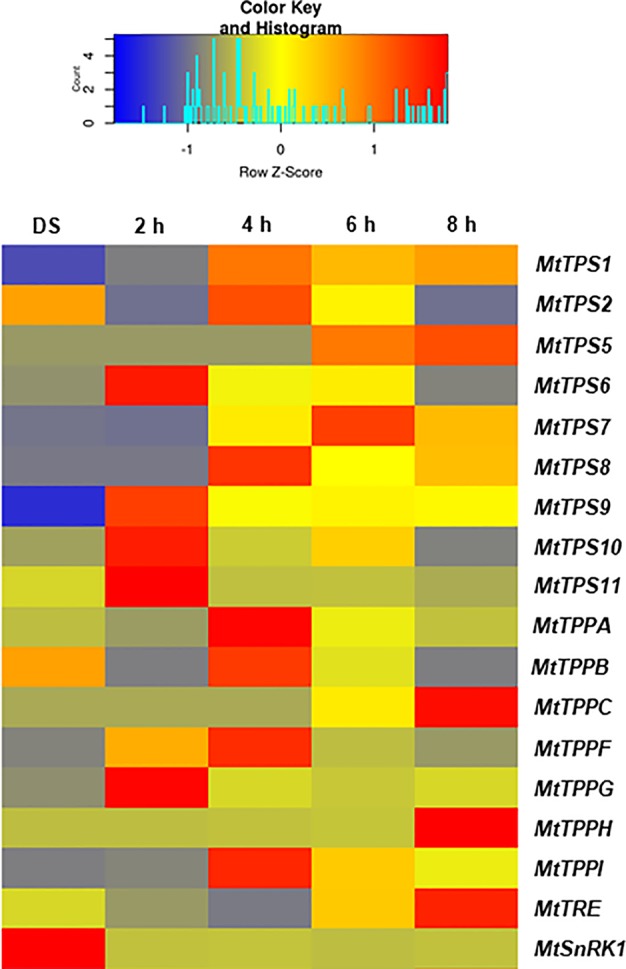
Heatmap representing the expression profiles of Medicago truncatula MtTPS, MtTPP, MtTRE, and MtSnRK1 genes in dry seed (DS) and during seed imbibition with water at the indicated timepoints (2, 4, 6, and 8 h, respectively). Expression levels are represented by with color codes, where red is the highest expression while blue is the lowest expression.
Figure 3
Figure 3
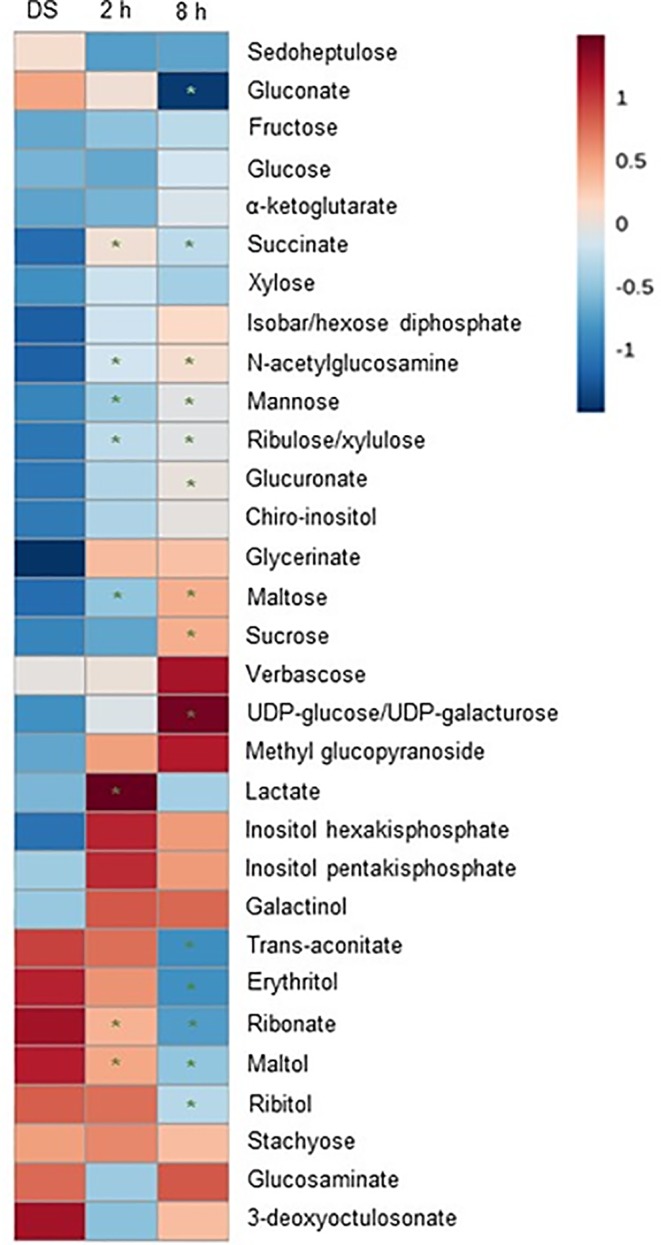
Heatmap of the 31 metabolites belonging to the carbohydrate metabolic pathway with significant changes (p ≤.05 and q ≤.1) during Medicago truncatula seed imbibition (at 2 and 8 h, respectively). The color (from red to blue) represents the mean value log transformed raw-scaled imputed value for each metabolite from high to low, respectively. Statistical significance (“*”) is given by Welch’s two-sample t-tests, focusing on comparisons between dry seeds (DS) and imbibed samples.
Figure 4
Figure 4
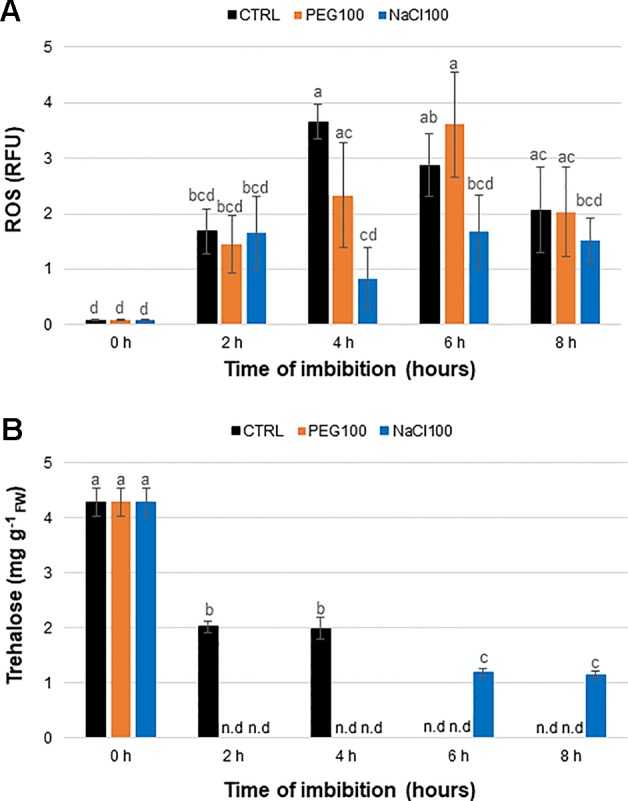
Detection of reactive oxygen species (A) and trehalose levels (B) in Medicago truncatula seeds during imbibition with water (CTRL), polyethylene glycol 100 g L−1 (PEG100), and sodium chloride 100 mM (NaCl100). Significant differences (as per Tukey’s test) are shown with lowercase letters; n.d., not determined.
Figure 5
Figure 5
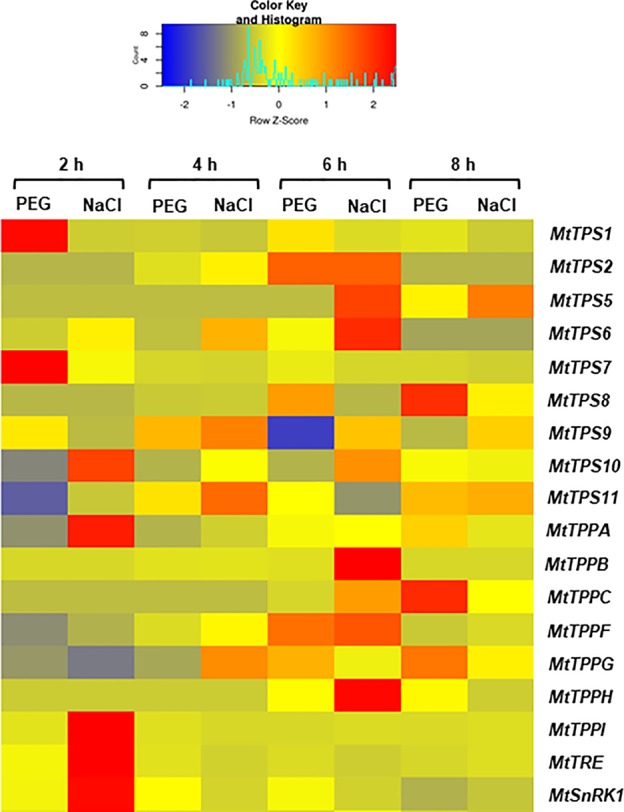
Heatmap representing the expression profiles of Medicago truncatula MtTPS, MtTPP, MtTRE, and MtSnRK1 genes during seed imbibition carried out in the presence of polyethylene glycol and sodium chloride. The profiles are presented as fold-change to their respective controls (imbibition with water at each corresponding timepoint). Expression levels are represented by with color codes, where red is the highest expression while blue is the lowest expression.
Figure 6
Figure 6
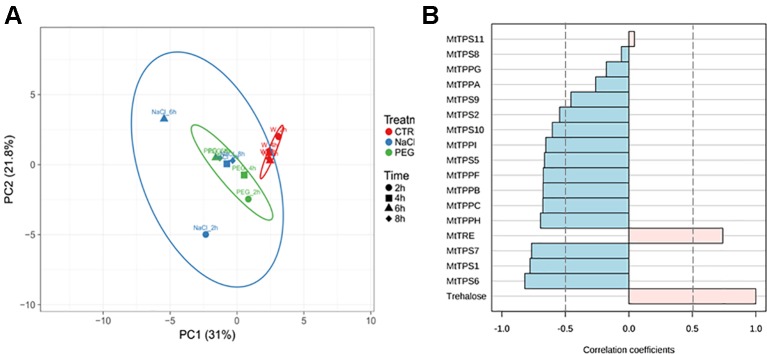
Integrative data analysis. (A) Principal component analysis loading plot explaining the distribution of samples based on the imposed conditions and measured variables. (B) Pattern search distribution of samples using all the data collected from gene expression profiles and trehalose detection at the indicated treatments and time points.

References

    1. Araújo S. S., Pagano A., Dondi D., Lazzaroni S., Pinela E., Macovei A., et al. (2019). Metabolic signatures of germination triggered by kinetin in Medicago truncatula . Sci. Rep. 9, 10466. 10.1038/s41598-019-46866-6 - DOI - PMC - PubMed
    1. Assaad H. I., Hou Y., Zhou L., Carroll R. J., Wu G. (2015). Rapid publication-ready MS-Word tables for two-way ANOVA. SpringerPlus 4, 33. 10.1186/s40064-015-0795-z - DOI - PMC - PubMed
    1. Avonce N., Leyman B., Mascorro-Gallardo J. O., Van Dijck P., Thevelein J. M., Iturriaga G. (2004). The Arabidopsis trehalose-6-P synthase AtTPS1 gene is a regulator of glucose, abscisic acid, and stress signaling. Plant Physiol. 136, 3649–3659. 10.1104/pp.104.052084 - DOI - PMC - PubMed
    1. Avonce N., Mendoza-Vargas A., Morett E., Iturriaga G. (2006). Insights on the evolution of trehalose biosynthesis. BMC Evol. Biol. 6, 109. 10.1186/1471-2148-6-109 - DOI - PMC - PubMed
    1. Bassel G. W., Fung P., Chow T. F., Foong J. A., Provart N. J., Cutler S. R. (2008). Elucidating the germination transcriptional program using small molecules. Plant Physiol. 147, 143–155. 10.1104/pp.107.110841 - DOI - PMC - PubMed

LinkOut - more resources