. 2019 Dec 18:10:1622.
doi: 10.3389/fpls.2019.01622. eCollection 2019.

Inflorescence Meristem Fate Is Dependent on Seed Development and FRUITFULL in Arabidopsis thaliana

Affiliations

Inflorescence Meristem Fate Is Dependent on Seed Development and FRUITFULL in Arabidopsis thaliana

Vicente Balanzà et al. Front Plant Sci. .

Abstract

After a vegetative phase, plants initiate the floral transition in response to both environmental and endogenous cues to optimize reproductive success. During this process, the vegetative shoot apical meristem (SAM), which was producing leaves and branches, becomes an inflorescence SAM and starts producing flowers. Inflorescences can be classified in two main categories, depending on the fate of the inflorescence meristem: determinate or indeterminate. In determinate inflorescences, the SAM differentiates directly, or after the production of a certain number of flowers, into a flower, while in indeterminate inflorescences the SAM remains indeterminate and produces continuously new flowers. Even though indeterminate inflorescences have an undifferentiated SAM, the number of flowers produced by a plant is not indefinite and is characteristic of each species, indicating that it is under genetic control. In Arabidopsis thaliana and other species with indeterminate inflorescences, the end of flower production occurs by a regulated proliferative arrest of inflorescence meristems on all reproductive branches that is reminiscent of a state of induced dormancy and does not involve the determination of the SAM. This process is controlled genetically by the FRUITFULL-APETALA2 (FUL-AP2) pathway and by a correlative control exerted by the seeds through a mechanism not well understood yet. In the absence of seeds, meristem proliferative arrest does not occur, and the SAM remains actively producing flowers until it becomes determinate, differentiating into a terminal floral structure. Here we show that the indeterminate growth habit of Arabidopsis inflorescences is a facultative condition imposed by the meristematic arrest directed by FUL and the correlative signal of seeds. The terminal differentiation of the SAM when seed production is absent correlates with the induction of AGAMOUS expression in the SAM. Moreover, terminal flower formation is strictly dependent on the activity of FUL, as it was never observed in ful mutants, regardless of the fertility of the plant or the presence/absence of the AG repression exerted by APETALA2 related factors.

Keywords: AGAMOUS; FRUITFULL; inflorescence development; inflorescence meristem; inflorescence proliferative arrest; terminal flower.


Figures

Figure 1
Figure 1
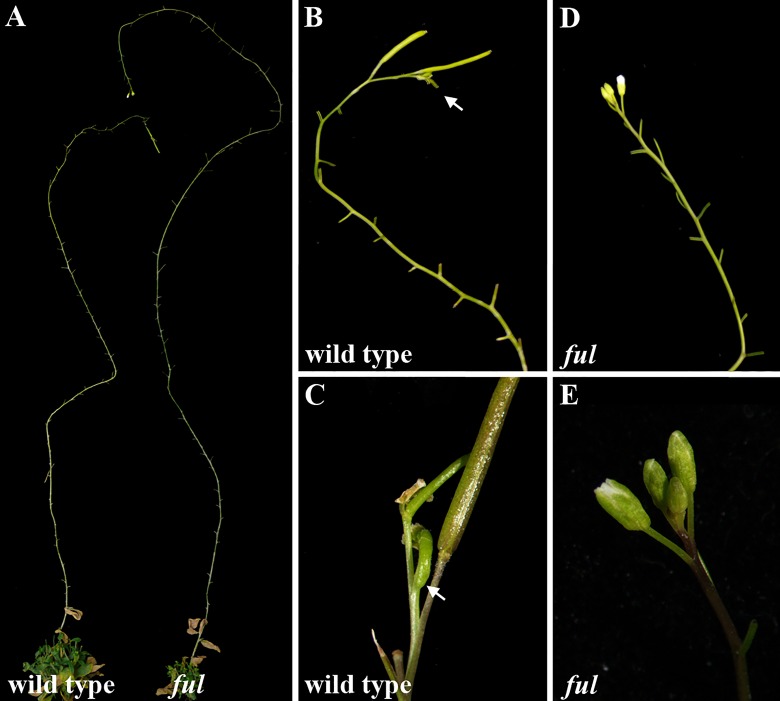
Inflorescence phenotype of pruned 14-week-old plants. All branches, as well as flowers in anthesis stage were removed in wild type and ful mutant plants (A). Plants stay alive for longer, delaying the end of flowering. At the end of the flowering phase, wild type inflorescence becomes determinate (B, C), producing a terminal flower (arrow) while ful mutant remains indeterminate (D, E).
Figure 2
Figure 2
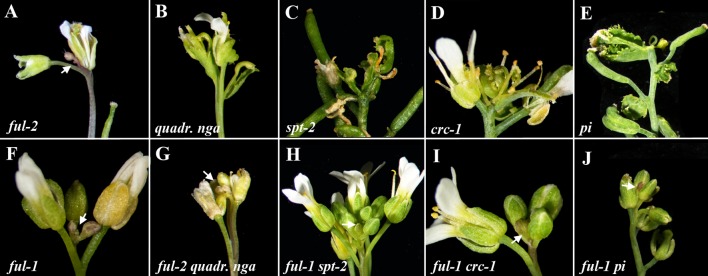
Terminal flower formation is never observed in ful mutants. ful mutants show an extended flowering phase with a morphologically distinct inflorescence meristem always present that remains active (A, F). Mutants with strongly reduced fertility show inflorescences that terminate with the formation of a terminal flower as shown for the quadruple nga (B), spt-2 (C), crc-1 (D), or pi (E). When these sterile mutants are combined with ful, the formation of the terminal structure is suppressed and meristems remain active until the death of the plant (G, H, I, J).
Figure 3
Figure 3
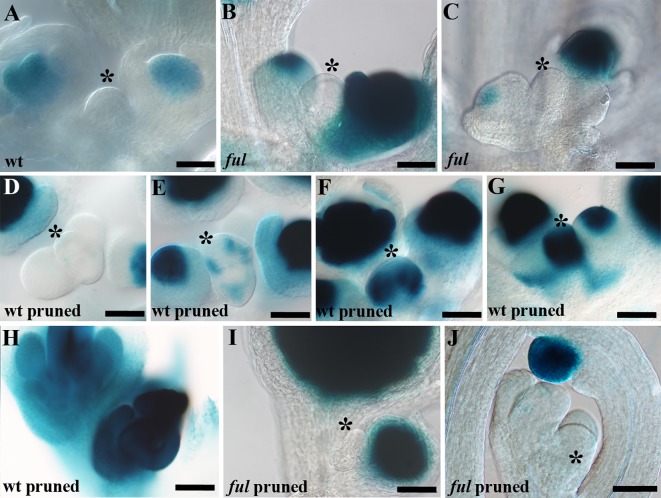
AGAMOUS expression at the end of the flowering phase. (A) Inflorescence shoot apical meristem (SAM) of a fertile wild type plant in Global Proliferative Arrest, at the end of the flowering phase, around 3–4 weeks after floral transition. AG::GUS reporter activity is detected in the central whorls of the flowers, but never in the SAM. (B) ful mutant inflorescence SAM, at 4 weeks after floral transition. As for wild type plants of same age, no AG::GUS activity is observed in the SAM (C) ful mutant inflorescence SAM, at 6 weeks after floral transition. Even 2–3 weeks after the arrest of the wild type plants, no AG::GUS activity is detected in the SAM. (D) Wild type plants where sterility was induced by pruning of flowers, 5 weeks after floral transition, still proliferative. AG::GUS signal is identical to that observed in control plants during the proliferative phase of the inflorescence. (E) Inflorescence meristem of pruned wild type plants at 5–6 weeks after floral transition. Preceding the visible morphological differentiation of the terminal structure, the GUS signal starts to be detected in the periphery of the SAM. (F–G) Inflorescence meristem of pruned wild type plants at 6–7 weeks after floral transition. AG::GUS signal extends to the whole SAM. (H) Terminal structure of a pruned wild type plant, 7 weeks after floral transition, showing high AG::GUS activity. (I) Pruned ful mutant, 7 weeks after floral transition. (J) Pruned ful mutant, 9 weeks after floral transition. In pruned ful mutants which never form a terminal flower, the GUS signal was never detected in the SAM. Black bars represent 50 μm. Asterisk indicates the SAM.
Figure 4
Figure 4
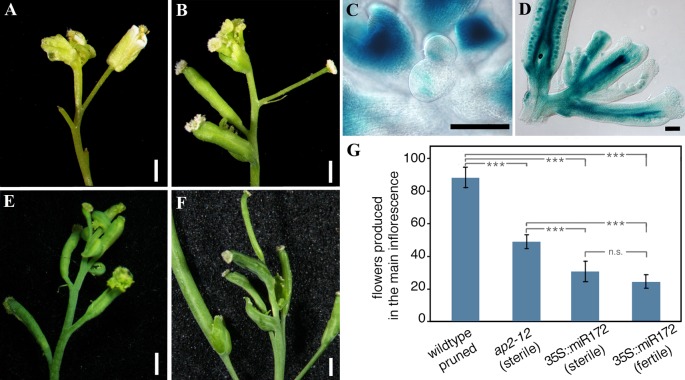
AP2 prevents terminal flower formation. (A) Pruned/wild type inflorescence 6 weeks after the floral transition. The inflorescence meristem differentiates into a terminal carpeloid structure. (B) The sterile ap2–12 mutant also ends flowering with the formation of an early terminal flower 3–4 weeks after floral transition. (C) The terminal floral structure observed in the ap2–12 mutant is preceded by ectopic AG expression in the SAM 3 weeks after floral transition. (D) AG::GUS activity is strongly detected in the terminal structure of ap2–12 inflorescences 4 weeks after floral transition. (E) The sterile 35S::miR172 plants also end the flowering phase with the formation of the terminal floral structure around 2 weeks after bolting. (F) A similar terminal flower formation is also observed in the 35S::miR172 that occasionally developed fertile pods, suggesting that the formation of the terminal floral structure depends on the activity level of AP2-like genes. (G) Flower production before terminal flower formation in the main inflorescence of wild type pruned plants, ap2–12 mutants (sterile), 35S::miR172 sterile lines, and 35S::miR172 fertile lines. The number of flowers produced in the lines where AP2 and AP2-like activity is reduced is much lower than in wild type plants where seed production was avoided. Error bars represent s.d. A pair-wise Student’s t-test, correcting with Holm method for multiple testing and linked to a post-hoc analysis, was performed to indicate genotypes with significant differences. *** indicate a significant difference (P < 0.001), n.s., not significative. N≥ 15. Black bars in (C, D) represent 100 μm. White bars in (A, B, E, F) represent 1 mm.
Figure 5
Figure 5
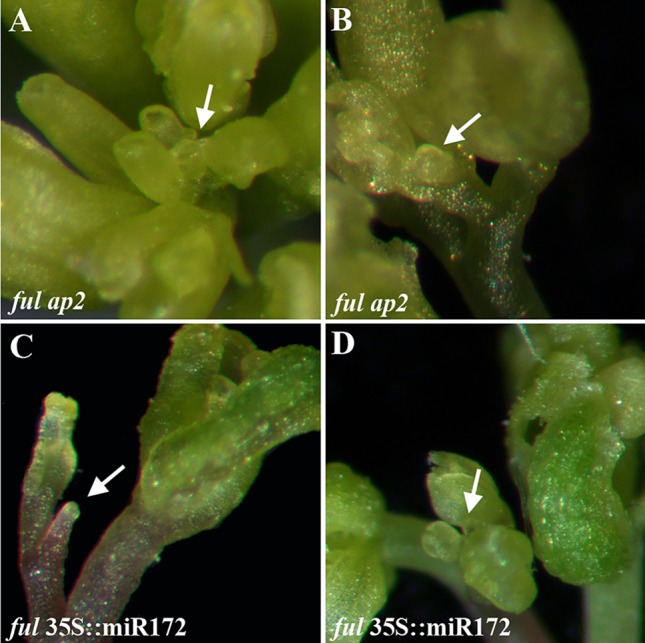
Terminal flower formation in the absence of AP2-like activity is dependent on FUL. The inflorescence meristem determination into a terminal structure observed in the ap2–12 single mutant is suppressed by ful mutations (A, B). In the 35S::miR172 plants, where the levels all the AP2-like genes are reduced and the terminal flower is formed very early in inflorescence development, the ful mutation also suppresses its formation (C, D).
Figure 6
Figure 6
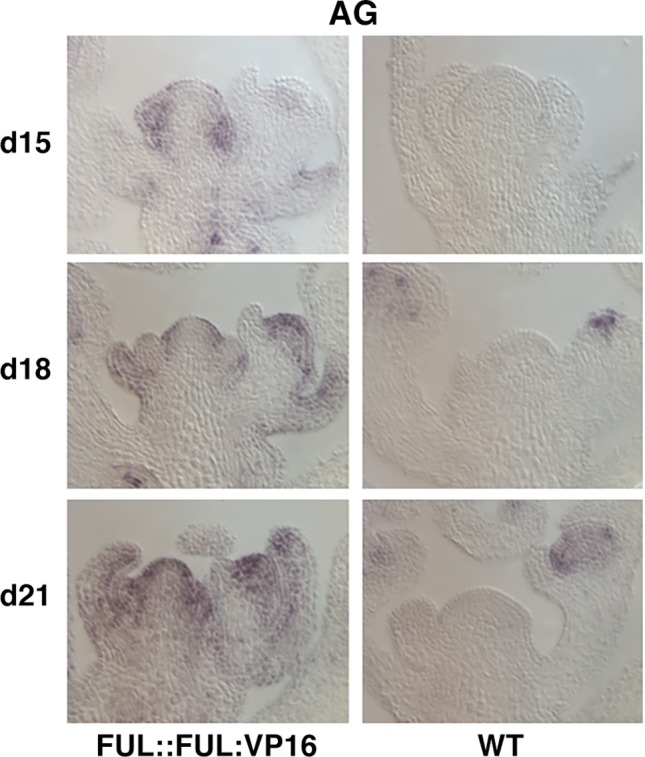
AG ISH on inflorescences of FUL::FUL:VP16 plants. AG expression was detected by ISH on FUL::FUL:VP16 (left) and wild-type (right) plants at early stages of inflorescence development. Samples were collected 15, 18, and 21 days after germination. While in the wild-type plants AG expression was only detected in the center of floral meristems, in FUL::FUL:VP16 plants AG expression was detected ectopically in the periphery of the shoot apical meristem (SAM) at 18 days after germination (approx. 1 week after floral transition), being present throughout the SAM 21 days after germination (approx. 2 weeks after floral transition).
Figure 7
Figure 7
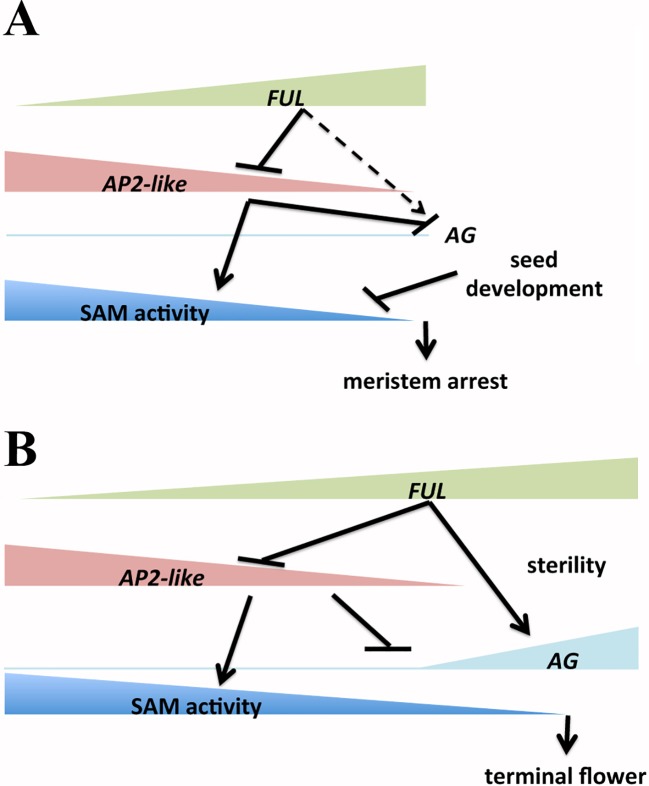
Proposed model for the control of the end of the flowering phase in Arabidopsis. (A) In normal growth conditions the activity of the inflorescence shoot apical meristem (SAM) is controlled by the FUL-AP2 pathway and the correlative control exerted by the developing seeds. The combined action of both mechanisms induces the meristem arrest and the end of the flowering phase. During inflorescence progression, AP2 and AP2-like proteins control positively SAM meristem activity, and at the same time, repress AG expression as well as avoid AG activation by FUL in the SAM. (B) When the arrest-inductive seed effect is absent (as in sterile mutants or in pruned plants) the inflorescence meristem activity is extended in time. In these conditions, the increasing activity of FUL in the inflorescence meristem should reduce the AP2 and AP2-like levels. The decreasing levels of AP2 proteins would facilitate the direct activation of AG by FUL in the SAM, allowing the AG accumulation and the formation of the terminal flower.

References

    1. Alvarez J., Smyth D. R. (1999). CRABS CLAW and SPATULA, two Arabidopsis genes that control carpel development in parallel with AGAMOUS. Development 126 (11), 2377–2386. - PubMed
    1. Aukerman M. J., Sakai H. (2003). Regulation of flowering time and floral organ identity by a MicroRNA and its APETALA2-like target genes. Plant Cell 15 (11), 2730–2741. 10.1105/tpc.016238 - DOI - PMC - PubMed
    1. Balanza V., Martinez-Fernandez I., Ferrandiz C. (2014). Sequential action of FRUITFULL as a modulator of the activity of the floral regulators SVP and SOC1. J. Exp. Bot. 65 (4), 1193–1203. 10.1093/jxb/ert482 - DOI - PMC - PubMed
    1. Balanza V., Martinez-Fernandez I., Sato S., Yanofsky M. F., Kaufmann K., Angenent G. C., et al. (2018). Genetic control of meristem arrest and life span in Arabidopsis by a FRUITFULL-APETALA2 pathway. Nat. Commun. 9 (1), 565. 10.1038/s41467-018-03067-5 - DOI - PMC - PubMed
    1. Bemer M., van Mourik H., Muino J. M., Ferrandiz C., Kaufmann K., Angenent G. C. (2017). FRUITFULL controls SAUR10 expression and regulates Arabidopsis growth and architecture. J. Exp. Bot. 68 (13), 3391–3403. 10.1093/jxb/erx184 - DOI - PMC - PubMed