. 2019 Dec 12:10:1311.
doi: 10.3389/fgene.2019.01311. eCollection 2019.

Population Structure and Genetic Diversity of Sheep Breeds in the Kyrgyzstan

Affiliations

Population Structure and Genetic Diversity of Sheep Breeds in the Kyrgyzstan

Tatiana Deniskova et al. Front Genet. .

Abstract

Sheep are a main livestock species of Kyrgyzstan, a Central Asian country with predominating mountain terrain. The current gene pool of local sheep resources has been forming under diverse climate conditions from the era of the trading caravans of the Great Silk Road, through the Soviet period of large-scale livestock improvements, which was followed by the deep crisis at the end of the 20th century, up to now. However, not much is known about the genetic background and variability of the local sheep populations. Therefore, our aims were to provide a characterization of the population structure and genetic relations within the Kyrgyz sheep breeds and to study their genetic connections with the global sheep breeds using SNP analysis. Samples of the Alai (n = 31), Gissar (n = 30), Kyrgyz coarse wool (n = 13), Aykol (n = 31), and Tien-Shan (n = 24) breeds were genotyped with the OvineSNP50 BeadChip or the Ovine Infinium HD BeadChip (Illumina Inc., USA). The measure of inbreeding based on runs of homozygosity showed a minimum value in the Aykol breed (FROH = 0.034), while the maximum was found in the Alai breed (FROH = 0.071). Short ROH segments (ROH ≤ 4 Mb) were predominant in all breeds. Long ROH segments (ROH > 16 Mb) were absent in the Gissar breed. The Gissar and Aykol breeds had the highest values of the effective population sizes estimated for five generations ago (Ne5 = 660 and 563), whereas the Alai and Kyrgyz coarse wool displayed lower values (Ne5 = 176 and 128, respectively). The synthetic origin of the Aykol breed was clearly evidenced by all analyses applied. Based on the network and admixture analyses of the Kyrgyz and global sheep breeds, the Tien-Shan and the Russian semi-fine wool breeds demonstrated a common ancestry that most likely is due to a contribution of the Lincoln breed. The Gissar, Aykol, and Kyrgyz coarse wool breeds showed a genetic background predominating in sheep populations from Iran and China whereas the Alai demonstrated the different ancestry type. The revealed admixture patterns probably resulted from the exchange and trade during the era of the Great Silk Road, which partly overlapped with historical and archeological findings.

Keywords: Great Silk Road; Kyrgyzstan; admixture; local sheep breeds; population structure; single nucleotide polymorphism.


Figures

Figure 1
Figure 1
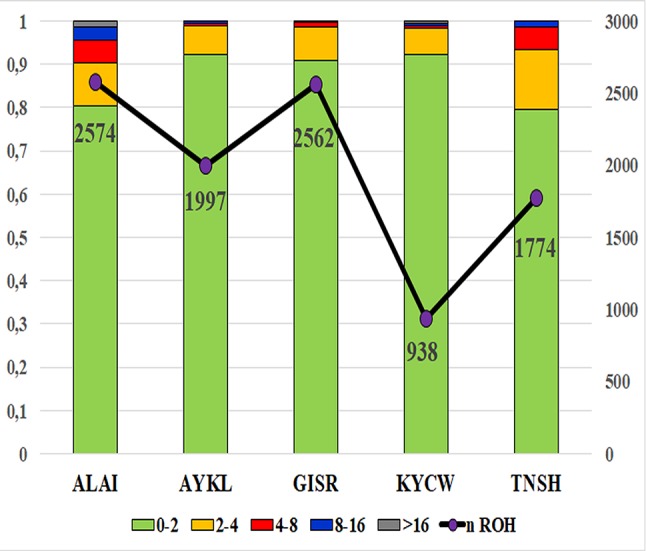
Total number of detected ROH and distribution of ROH classes among the studied Kyrgyz sheep breeds. X-axis – studied Kyrgyz sheep breeds: ALAI, Alai; AYKL, Aykol; GISR, Gissar; KYCW, Kyrgyz coarse wool; TNSH, Tien-Shan; Y-axis – distribution of ROH classes of different length; the total ROH counts in each breed are shown graphically by purple circles adjoined by digital values corresponding to the ROH numbers; the distribution ROH classes of different length is shown by a bar dendrogram: green color corresponds to ROH with a length of 0–2 Mb, orange to 2–4 Mb, red to 4–8 Mb, gray to 8–16 Mb, blue to more than 16 Mb.
Figure 2
Figure 2
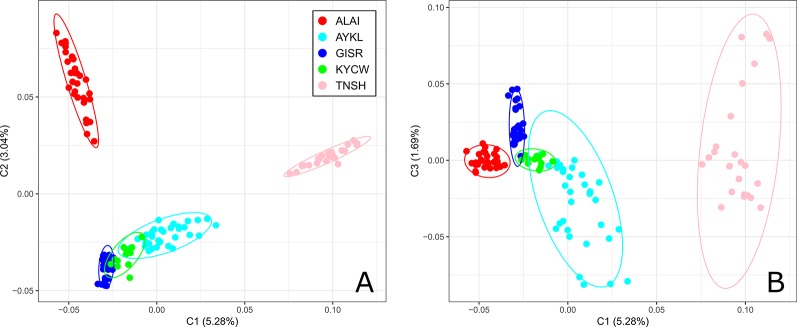
Multi-dimensional scaling analysis of the Kyrgyz sheep breeds. The analysis was performed for the first two components (C1 and C2) (A) and for the first and third component (C1 and C3) (B). The color indications for the breeds are as follows: Alai = red, Aykol = turquoise, Gissar = blue, Kyrgyz coarse wool = green, Tien-Shan = pink. Breeds: ALAI, Alai; AYKL, Aykol; GISR, Gissar; KYCW, Kyrgyz coarse wool; TNSH, Tien-Shan.
Figure 3
Figure 3
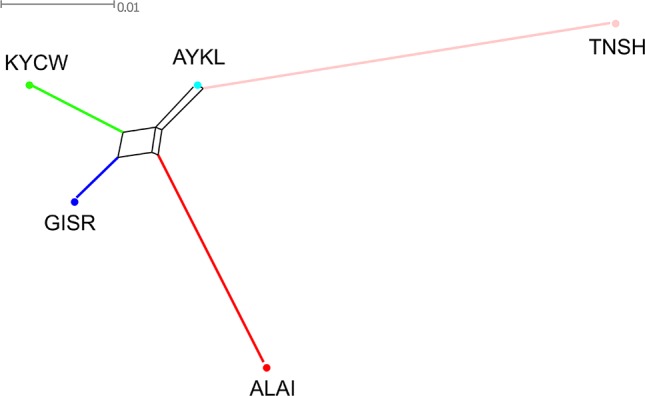
Neighbor network constructed from pairwise FST values for five Kyrgyz sheep breeds. The color indications for the breeds are as follows: Alai = red, Aykol = turquoise, Gissar = blue, Kyrgyz coarse wool = green, Tien-Shan = pink. Breeds: ALAI, Alai; AYKL, Aykol; GISR, Gissar; KYCW, Kyrgyz coarse wool; TNSH, Tien-Shan.
Figure 4
Figure 4
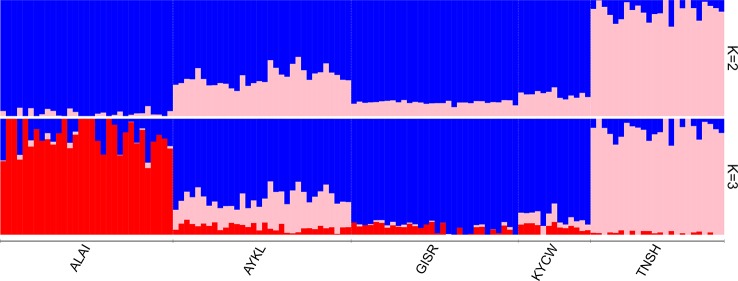
Clustering of individual animals for the Kyrgyz dataset using genome-wide SNP data. Results are shown for modelled ancestral populations K = 2–3. K = 3 was suggested as the most likely number of clusters. Breeds: ALAI, Alai; AYKL, Aykol; GISR, Gissar; KYCW, Kyrgyz coarse wool; TNSH, Tien-Shan.
Figure 5
Figure 5
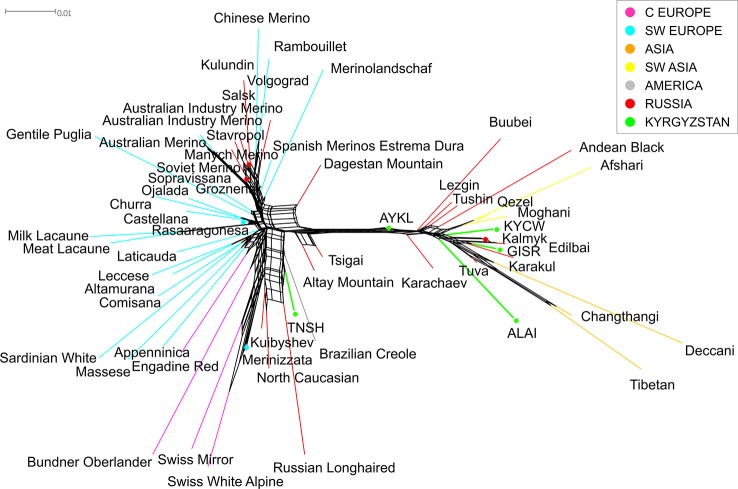
Neighbor network based on the matrix of pairwise FST values constructed for the combined dataset of SNP genotypes of the Kyrgyz, Russian and worldwide sheep breeds. The branches corresponding to the Kyrgyz breeds are indicated in green color. The colors of the branches of the worldwide breeds correspond to their ancestral geographic origin and are identical to the colors in Supplementary Table 1: pale pink for Central Europe, cyan for Southwestern Europe, orange for Asia, yellow for Southwestern Asia, gray for the Americas and red for Russia. For a description of the sheep breeds, [see Table 2 and Supplementary Table 1].
Figure 6
Figure 6
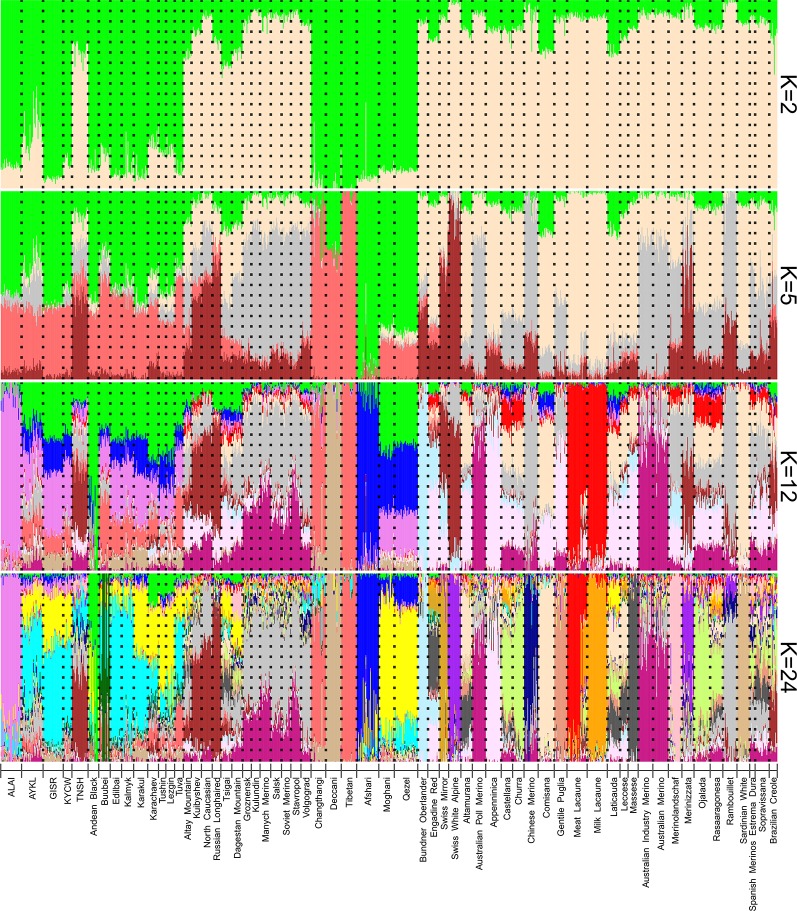
Clustering of the Kyrgyz sheep breeds in the context of the dataset of worldwide and Russian sheep breeds using genome-wide SNP data. Results are shown for modelled ancestral populations K = 2, 5, 12, and 24. K = 24 was suggested as the most likely number of clusters. For a description of the sheep breeds, [see Table 2 and Supplementary Table 1].
Figure 7
Figure 7
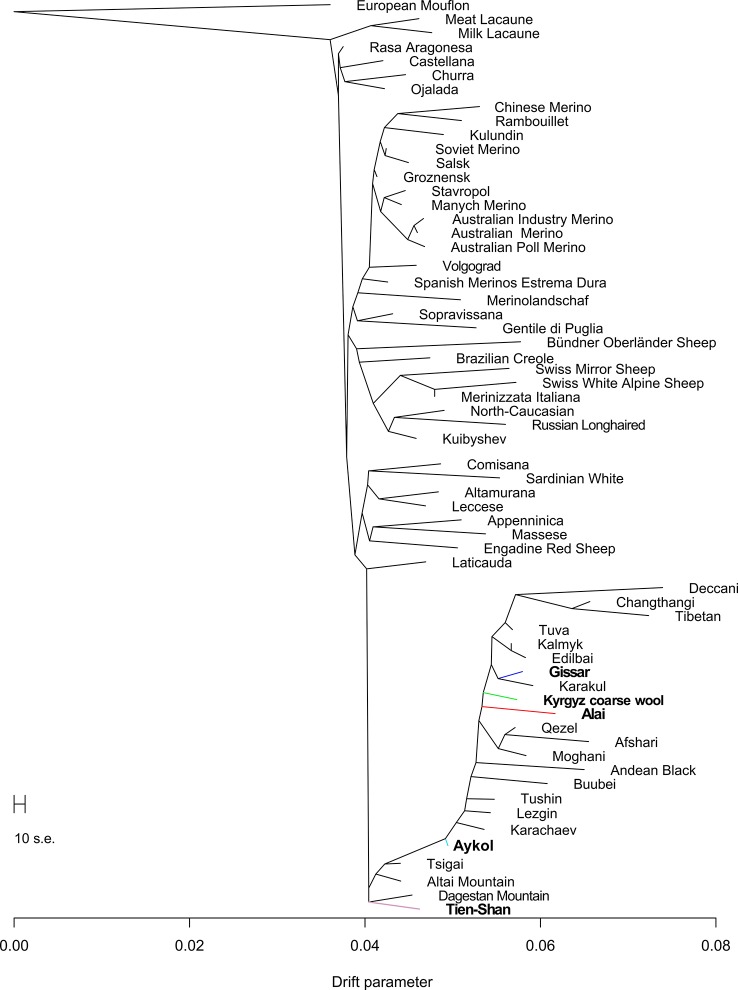
Phylogenetic network inferred by Treemix plot of the relationships between the Kyrgyz breeds and worldwide sheep populations with no migration events. The names of the Kyrgyz breeds are shown in bold. The color indications for tree branches of the Kyrgyz sheep breeds are as follows: Alai = red, Aykol = turquoise, Gissar = blue, Kyrgyz coarse wool = green, Tien-Shan = pink.
Figure 8
Figure 8
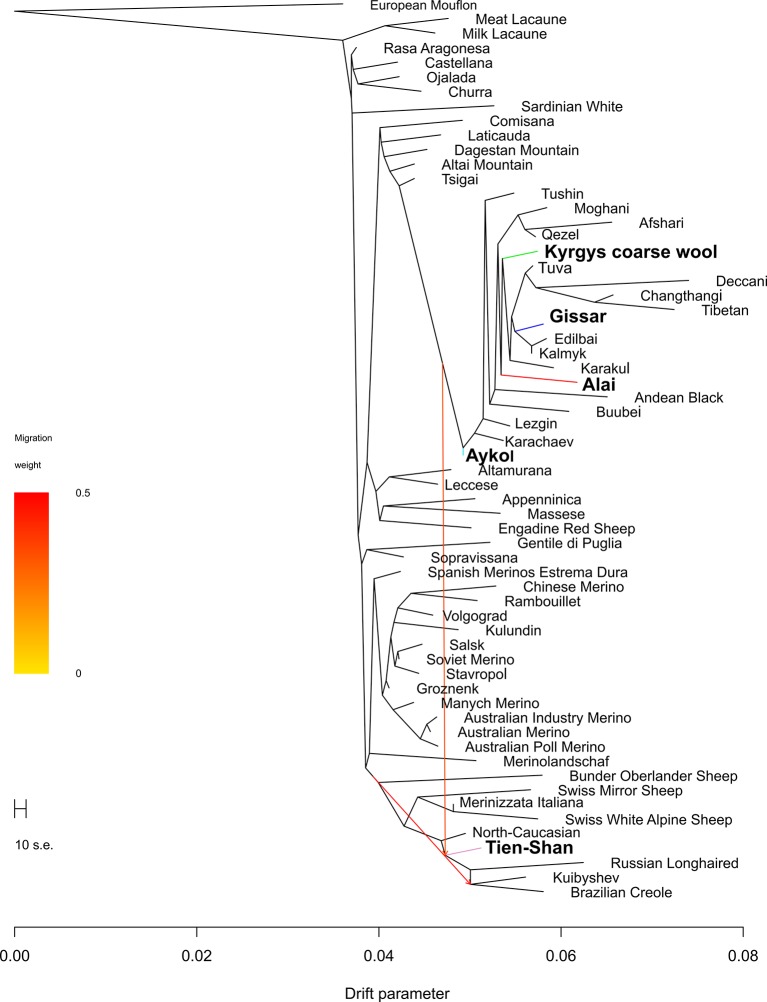
Phylogenetic network inferred by Treemix plot of the relationships between the Kyrgyz breeds and worldwide sheep populations with two migration events. The names of the Kyrgyz breeds are shown in bold. The color indications for tree branches of the Kyrgyz sheep breeds are as follows: Alai = red, Aykol = turquoise, Gissar = blue, Kyrgyz coarse wool = green, Tien-Shan = pink.

References

    1. Abdrisaev E. (2017). Silk Road Today: Kyrgyzstan on the ancient Silk Road. kabar.kg. Available at: http://kabar.kg/eng/news/silk-road-today-kyrgyzstan-on-the-ancient-silk-... (Accessed March 09, 2019).
    1. Ajibekov A. S., Almeyev I. A. (2008). “Small Ruminant Breeds of Kyrgyzstan,” in Characterization of Small Ruminant Breeds in Central Asia and the Caucasus. Eds. Iñiguez L., Mueller J. (Aleppo, Syria: International Center for Agricultural Research in the Dry Areas (ICARDA)), 117–166.
    1. Alexander D. H., Novembre J., Lange K. (2009). Fast model-based estimation of ancestry in unrelated individuals. Genome Res. 19, 1655–1664. 10.1101/gr.094052.109 - DOI - PMC - PubMed
    1. Al-Mamun H. A., Clark S. A., Kwan P., Gondro C. (2015). Genome-wide linkage disequilibrium and genetic diversity in five populations of Australian domestic sheep. Genet. Sel. Evol. 47, 90. 10.1186/s12711-015-0169-6 - DOI - PMC - PubMed
    1. Barbato M., Orozco-terWengel P., Tapio M., Bruford M. W. (2015). SNeP: a tool to estimate trends in recent effective population size trajectories using genome-wide SNP data. Front. Genet. 26, 109. 10.3389/fgene.2015.00109 - DOI - PMC - PubMed

LinkOut - more resources