Review
. 2019 Oct 26:17:1318-1325.
doi: 10.1016/j.csbj.2019.09.006. eCollection 2019.

Chemogenetic interactions in human cancer cells

Affiliations
Review

Chemogenetic interactions in human cancer cells

Medina Colic et al. Comput Struct Biotechnol J. .

Abstract

Chemogenetic profiling enables the identification of genes that enhance or suppress the phenotypic effect of chemical compounds. Using this approach in cancer therapies could improve our ability to predict the response of specific tumor genotypes to chemotherapeutic agents, thus accelerating the development of personalized drug therapy. In the not so distant past, this strategy was only applied in model organisms because there was no feasible technology to thoroughly exploit desired genetic mutations and their impact on drug efficacy in human cells. Today, with the advent of CRISPR gene-editing technology and its application to pooled library screens in mammalian cells, chemogenetic screens are performed directly in human cell lines with high sensitivity and specificity. Chemogenetic profiling provides insights into drug mechanism-of-action, genetic vulnerabilities, and resistance mechanisms, all of which will help to accurately deliver the right drug to the right target in the right patient while minimizing side effects.

Keywords: CRISPR; Chemogenetic screens; Drug-gene interactions.


Figures

Fig. 1
Fig. 1
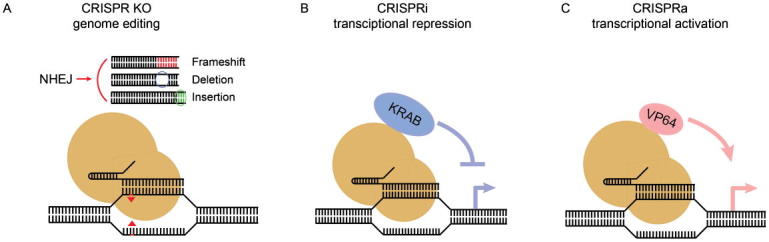
CRISPR technologies to perturb gene functions in mammalian cells for pooled genetic screens. CRISPR loss-of-function technologies include A) CRISPR knockout (KO) and B) CRISPR interference (CRISPRi). A) Cas9-mediated DNA cleavage is directed to the coding region of a gene by a single guide RNA (sgRNA) and it results in error-prone repair by nonhomologous end joining pathways (NHEJ), and as a consequence of that gene function is disrupted (when indels and especially frame shifts are introduced). B) Catalytically dead Cas9 (dCas9) is fused to a transcriptional repressor domain (e.g. KRAB) and as that is recruited to the transcription start site (TSS) of a gene specified by an sgRNA, to repress its transcription. CRISPR gain-off-function technology is C) CRISPR activation (CRISRPa). C) dCas9 is fused with transcriptional activation domain(s) (e.g. VP64) and recruited to a given gene’s TSS, to activate its transcription.
Fig. 2
Fig. 2
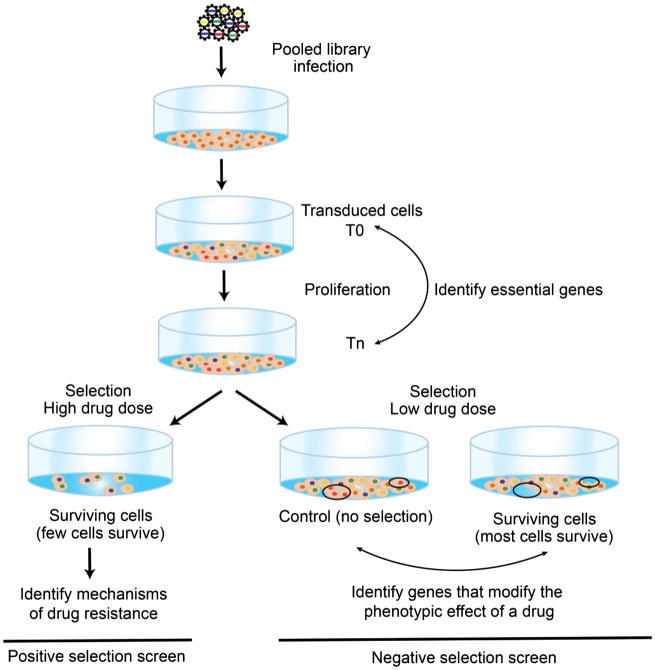
Experimental design for a whole genome CRISPR screen. In a pooled library CRISPR screen, cells are transduced with a pooled CRISPR library. Successfully transduced cells are sampled (T0) and grown for several doublings. At Tn cells are sampled again. Genomic DNA is extracted from T0 and Tn cells, PCR-amplified and sequenced using NGS. To identify essential genes (i.e. genes whose knock-out results in a fitness defect) abundance of each sgRNA at Tn is compared to abundance of each sgRNA at T0. Genome-wide CRISPR screens can be divided into two classes, positive and negative selection. In a positive screen, the goal is to identify those cells that survive post-selection (e.g. drug treatment). The selective pressure must be strong enough that most of the cells die, removing their sgRNAs from the population, and only a small fraction survives. After the surviving cells are collected, their plasmids are PCR-amplified and sequenced using NGS to identify their target gene. In a negative screen, the goal is to identify those cells that do not survive the selection mechanism. Two sets of cells are infected, one set is subject to selection (e.g. drug treatment) while the other set serves as a non-selected (i.e. non-treated) control. These two populations are then sequenced using NGS to determined which sgRNAs have been depleted by selection.
Fig. 3
Fig. 3
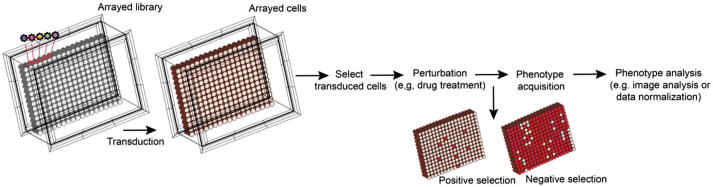
Arrayed library CRISPR screen. Arrayed libraries are generated in multi-well plates, where each well contains constructs preparation targeting an individual gene or genomic locus. Arrayed libraries are delivered to populations of cells grown in an arrayed format as well, preventing an individual cell from being transduced with multiple sgRNAs with different targets. There may be selection steps and treatments involved, but this can vary depending on the screen. Phenotypes are identified rather than necessarily being selected for (allowing for reverse genetic screening), since the sgRNA responsible for each phenotype is known based on well location in the original annotated library. The final outcome is a ranked phenotypic measure for each sgRNA delivered in the screen.

References

    1. Buolamwini J. Novel anticancer drug discovery. Curr Opin Chem Biol. 1999;10 - PubMed
    1. Jost M., Weissman J.S. CRISPR approaches to small molecule target identification. ACS Chem Biol. 2018;13:366–375. - PMC - PubMed
    1. Rine J., Hansen W., Hardeman E., Davis R.W. Targeted selection of recombinant clones through gene dosage effects. Proc Natl Acad Sci. 1983;80:6750–6754. - PMC - PubMed
    1. Hartwell L.H. Integrating genetic approaches into the discovery of anticancer drugs. Science. 1997;278:1064–1068. - PubMed
    1. Botstein D., Chervitz S.A., Cherry J.M. Yeast as a model organism. Science. 2011;4 - PMC - PubMed

LinkOut - more resources