Harnessing DNA Double-Strand Break Repair for Cancer Treatment
- PMID: 31921645
- PMCID: PMC6921965
- DOI: 10.3389/fonc.2019.01388
Harnessing DNA Double-Strand Break Repair for Cancer Treatment
Abstract
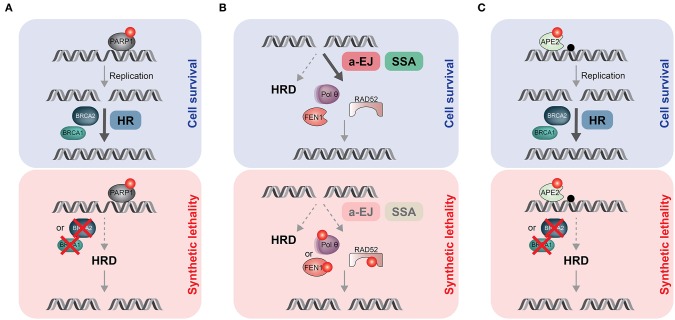
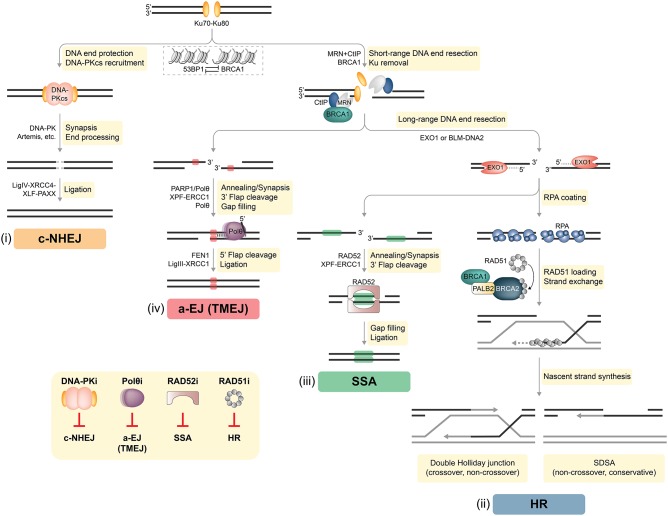
DNA double-strand breaks (DSBs) are highly deleterious, with a single unrepaired DSB being sufficient to trigger cell death. Compared to healthy cells, cancer cells have a higher DSB burden due to oncogene-induced replication stress and acquired defects in DNA damage response (DDR) mechanisms. Consequently, hyperproliferating cancer cells rely on efficient DSB repair for their survival. Moreover, augmented DSB repair capacity is a major cause of radio- and chemoresistance and, ultimately, cancer recurrence. Although inherited DDR defects can predispose individuals to develop certain cancers, the very same vulnerability may be therapeutically exploited to preferentially kill tumor cells. A paradigm for DNA repair targeted therapy has emerged in cancers that exhibit mutations in BRCA1 or BRCA2 tumor suppressor genes, conferring a strong defect in homologous recombination, a major and error-free DSB repair pathway. Clinical validation of such approaches, commonly described as synthetic lethality (SL), has been provided by the regulatory approval of poly(ADP-ribose) polymerase 1 inhibitors (PARPi) as monotherapy for BRCA1/2-mutated breast and ovarian tumors. In this review, we will describe the different DSB repair mechanisms and discuss how their specific features could be exploited for cancer therapy. A major emphasis is put on advances in combinatorial treatment modalities and SL approaches arising from DSB repair pathway interdependencies.
Keywords: BRCA; DNA polymerase theta; DSB repair; PARP inhibition (PARPi); alternative end joining (a-EJ); cancer therapy; homologous recombination (HR); synthetic lethality.
Copyright © 2019 Trenner and Sartori.
Figures
Similar articles
-
Polθ: emerging synthetic lethal partner in homologous recombination-deficient tumors.Cancer Gene Ther. 2024 Nov;31(11):1619-1631. doi: 10.1038/s41417-024-00815-2. Epub 2024 Aug 9. Cancer Gene Ther. 2024. PMID: 39122831 Free PMC article. Review.
-
Role of BRCA Mutations in Cancer Treatment with Poly(ADP-ribose) Polymerase (PARP) Inhibitors.Cancers (Basel). 2018 Dec 4;10(12):487. doi: 10.3390/cancers10120487. Cancers (Basel). 2018. PMID: 30518089 Free PMC article. Review.
-
CTCF facilitates DNA double-strand break repair by enhancing homologous recombination repair.Sci Adv. 2017 May 24;3(5):e1601898. doi: 10.1126/sciadv.1601898. eCollection 2017 May. Sci Adv. 2017. PMID: 28560323 Free PMC article.
-
PARP Inhibitor Resistance: A Tug-of-War in BRCA-Mutated Cells.Trends Cell Biol. 2019 Oct;29(10):820-834. doi: 10.1016/j.tcb.2019.07.008. Epub 2019 Aug 14. Trends Cell Biol. 2019. PMID: 31421928 Review.
-
New Targeted Agents in Gynecologic Cancers: Synthetic Lethality, Homologous Recombination Deficiency, and PARP Inhibitors.Curr Treat Options Oncol. 2016 Mar;17(3):12. doi: 10.1007/s11864-015-0378-9. Curr Treat Options Oncol. 2016. PMID: 26931795 Free PMC article. Review.
Cited by
-
Phase I study of peposertib and avelumab with or without palliative radiotherapy in patients with advanced solid tumors.ESMO Open. 2024 Feb;9(2):102217. doi: 10.1016/j.esmoop.2023.102217. Epub 2024 Feb 5. ESMO Open. 2024. PMID: 38320431 Free PMC article. Clinical Trial.
-
Novel Insights into Redox-Based Mechanisms for Auranofin-Induced Rapid Cancer Cell Death.Cancers (Basel). 2022 Oct 5;14(19):4864. doi: 10.3390/cancers14194864. Cancers (Basel). 2022. PMID: 36230784 Free PMC article.
-
RAD51AP1 and RAD54L Can Underpin Two Distinct RAD51-Dependent Routes of DNA Damage Repair via Homologous Recombination.Front Cell Dev Biol. 2022 May 16;10:866601. doi: 10.3389/fcell.2022.866601. eCollection 2022. Front Cell Dev Biol. 2022. PMID: 35652094 Free PMC article.
-
Comparative Study of the γH2AX Foci Forming in Human Lung Fibroblasts Incubated in Media Containing Tritium-Labeled Thymidine or Amino Acids.Bull Exp Biol Med. 2021 Dec;172(2):245-249. doi: 10.1007/s10517-021-05370-6. Epub 2021 Dec 2. Bull Exp Biol Med. 2021. PMID: 34853973
-
Molecular mechanisms and cellular functions of cGAS-STING signalling.Nat Rev Mol Cell Biol. 2020 Sep;21(9):501-521. doi: 10.1038/s41580-020-0244-x. Epub 2020 May 18. Nat Rev Mol Cell Biol. 2020. PMID: 32424334 Review.
References
Publication types
LinkOut - more resources
Full Text Sources
Other Literature Sources
Miscellaneous