. 2019 Dec 17:7:428.
doi: 10.3389/fbioe.2019.00428. eCollection 2019.

Numerical Investigation of Intra-abdominal Pressure Effects on Spinal Loads and Load-Sharing in Forward Flexion

Affiliations

Numerical Investigation of Intra-abdominal Pressure Effects on Spinal Loads and Load-Sharing in Forward Flexion

Tao Liu et al. Front Bioeng Biotechnol. .

Abstract

The intra-abdominal pressure (IAP), which generates extensor torque and unloads the spine, is often neglected in most of the numerical studies that use musculoskeletal (MSK) or finite element (FE) spine models. Hence, the spinal loads predicted by these models may not be realistic. In this work, we quantified the effects of IAP variation in forward flexion on spinal loads and load-sharing using a novel computational tool that combines a MSK model of the trunk with a FE model of the ligamentous lumbosacral spine. The MSK model predicted the trunk muscle and reaction forces at the T12-L1 junction, with or without the IAP, which served as input in the FE model to investigate the effects of IAP on spinal loads and load-sharing. The findings confirm the unloading role of the IAP, especially at large flexion angles. Inclusion of the IAP reduced global muscle forces and disc loads, as well as the intradiscal pressure (IDP). The reduction in disc loads was compensated for by an increase in ligament forces. The IDP, as well as the strain of the annular fibers were more sensitive to the IAP at the upper levels of the spine. Including the IAP also increased the ligaments' load-sharing which reduced the role of the disc in resisting internal forces. These results are valuable for more accurate spinal computational studies, particularly toward clinical applications as well as the design of disc implants.

Keywords: finite element model; intra-abdominal pressure; load sharing; musculoskeletal model; spinal load.


Figures

Figure 1
Figure 1
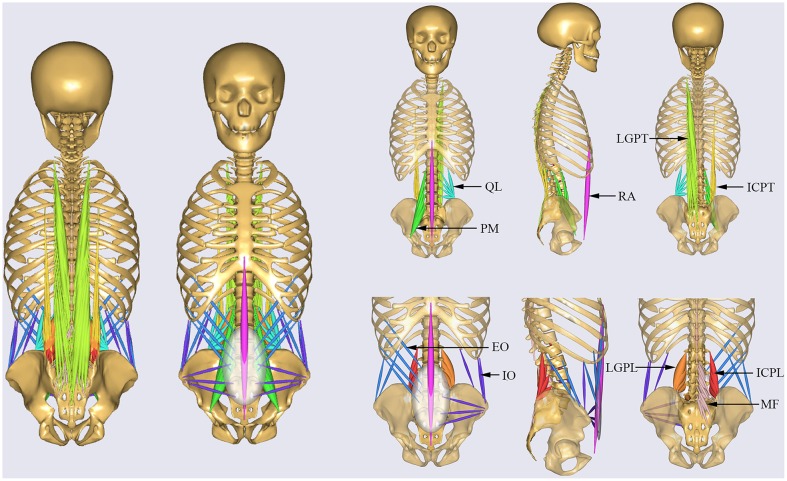
Musculature of the MSK model. Global muscles: RA, rectus abdominis; IO, internal oblique; EO, external oblique; ICPT, iliocostalis lumborum pars thoracic; LGPT, longisimus thoracis pars thoracic. Local muscles: ICPL, iliocostalis lumborum pars lumborum; LGPL, longisimus thoracis pars lumborum; PM, psoas major; MF, multifidus; QL, quadratus lumborum.
Figure 2
Figure 2
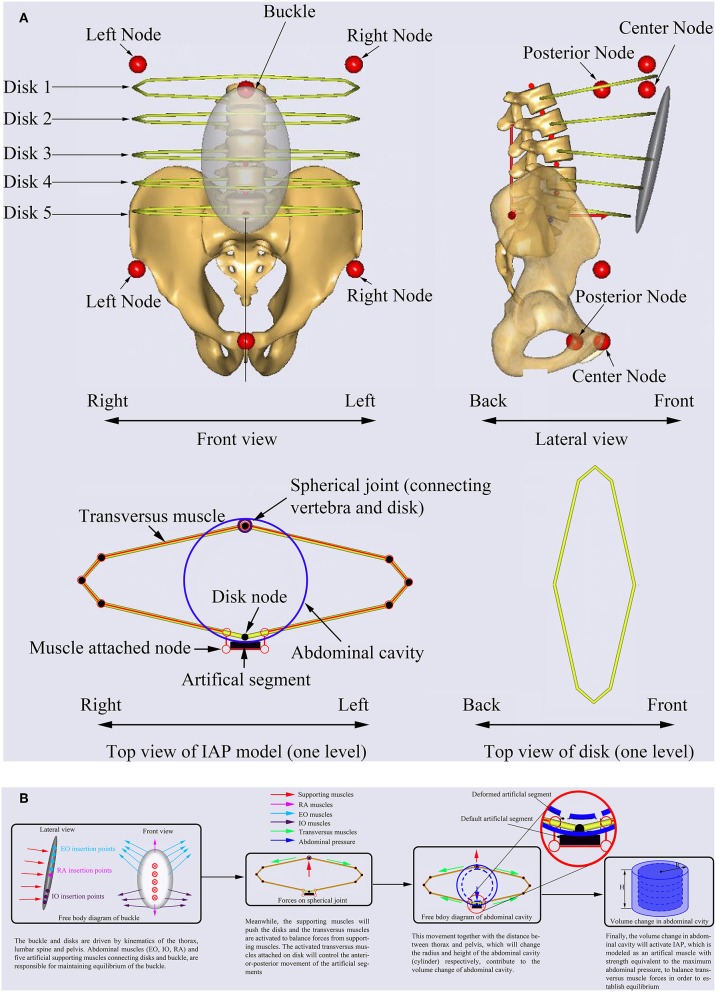
Description of the IAP modeling (A) and mechanism of IAP generation (B) in AnyBody.
Figure 3
Figure 3
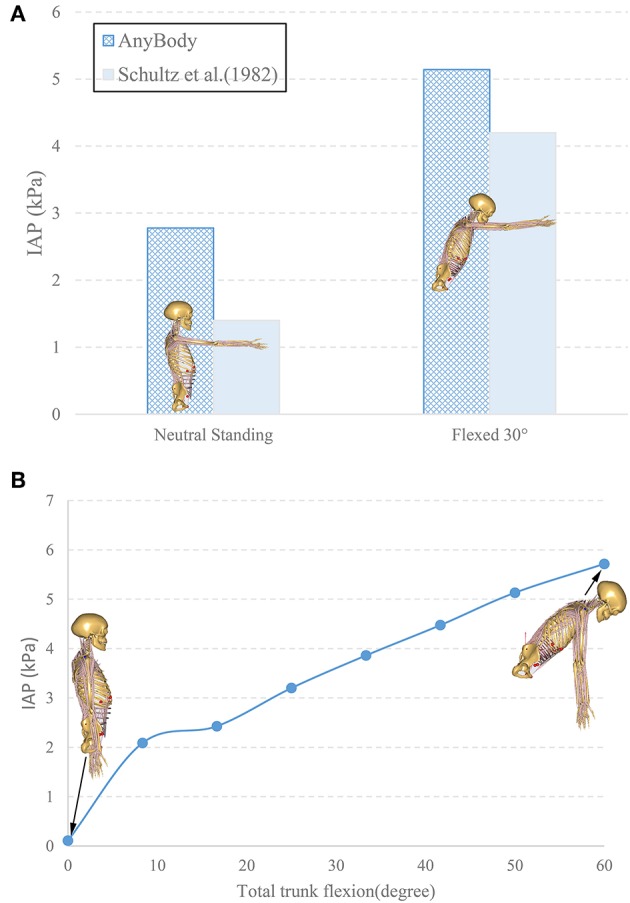
Comparison of the predicted IAP with in vivo experimental data (Schultz et al., 1982) (A). The change of IAP in the MSK model from neutral standing to 60° forward flexion (B).
Figure 4
Figure 4
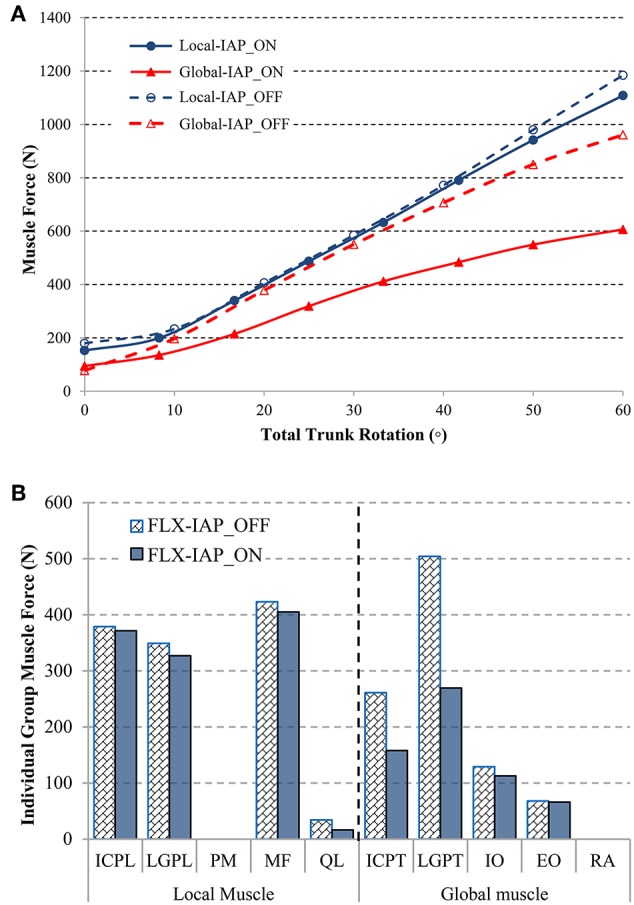
Comparison of the predicted global and local muscle forces under activation (IAP_ON) or deactivation (IAP_OFF) of the IAP during forward flexion (A). Local and global muscle forces at 60° forward flexion for both activated IAP (IAP_ON) and deactivated IAP (IAP_OFF) models (B).
Figure 5
Figure 5
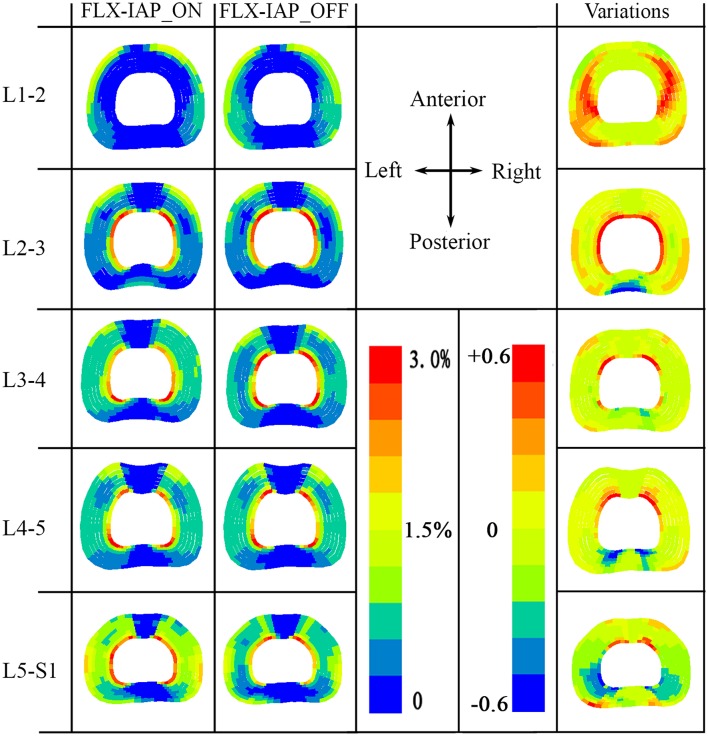
Annular fibers strain at all levels (L1-S1) predicted by the FE model at 60° forward flexion with both IAP settings. Variations were calculated with respect to the case with IAP activated (FLX-IAP_ON).
Figure 6
Figure 6
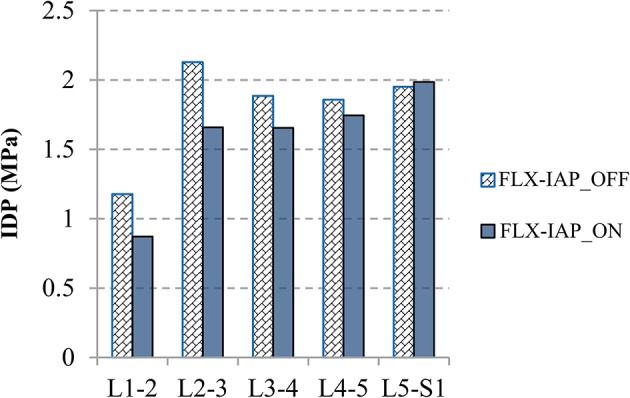
IDP values at all spinal levels predicted at 60° forward flexion angle for both IAP settings.
Figure 7
Figure 7
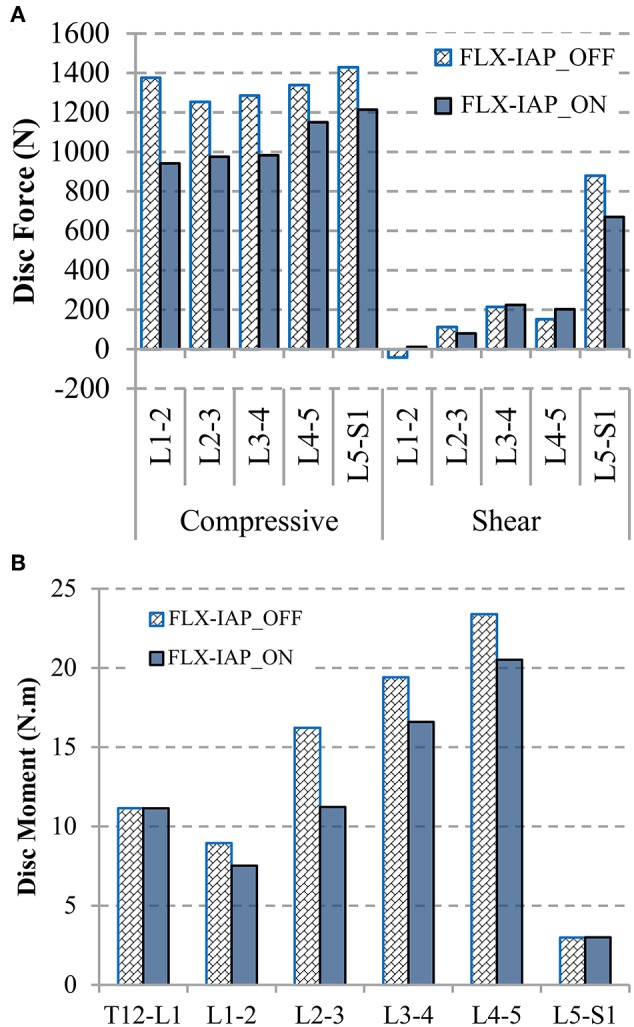
Disc compressive and shear forces (+ve in anterior direction) (A) and disc moments (+ve in flexion) (B) at 60° forward flexion predicted by the FE model.
Figure 8
Figure 8
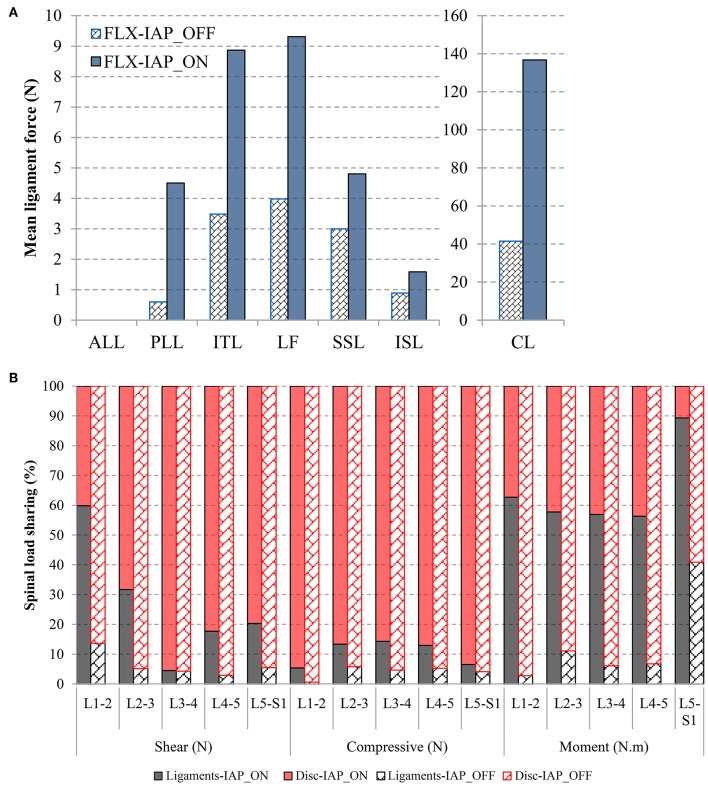
Effects of IAP on ligament force (A) and load-sharing of the passive structures (discs and ligaments) (B) evaluated at 60° forward flexion. The facet joints have no contribution to load-sharing.

References

    1. Andersson G. B. J., Örtengren R., Nachemson A. (1976). Quantitative studies of back loads in lifting. Spine 1:178 10.1097/00007632-197609000-00009 - DOI
    1. Arjmand N., Shirazi-Adl A. (2005). Biomechanics of changes in lumbar posture in static lifting. Spine 30, 2637–2648. 10.1097/01.brs.0000187907.02910.4f - DOI - PubMed
    1. Arjmand N., Shirazi-Adl A. (2006a). Role of intra-abdominal pressure in the unloading and stabilization of the human spine during static lifting tasks. Eur. Spine J. 15, 1265–1275. 10.1007/s00586-005-0012-9 - DOI - PMC - PubMed
    1. Arjmand N., Shirazi-Adl A. (2006b). Model and in vivo studies on human trunk load partitioning and stability in isometric forward flexions. J. Biomech. 39, 510–521. 10.1016/j.jbiomech.2004.11.030 - DOI - PubMed
    1. Arshad R., Zander T., Bashkuev M., Schmidt H. (2017). Influence of spinal disc translational stiffness on the lumbar spinal loads, ligament forces and trunk muscle forces during upper body inclination. Med. Eng. Phys. 46, 54–62. 10.1016/j.medengphy.2017.05.006 - DOI - PubMed