


Presumed Nonalcoholic Fatty Liver Disease Among Medicare Beneficiaries With HIV, 2006-2016
- PMID: 31921938
- PMCID: PMC6945300
- DOI: 10.1093/ofid/ofz509
Presumed Nonalcoholic Fatty Liver Disease Among Medicare Beneficiaries With HIV, 2006-2016
Abstract
Background: Newer treatments for HIV and hepatitis C virus (HCV) have decreased mortality in HIV/HCV patients. Nonalcoholic fatty liver disease (NAFLD) has increased globally; therefore, the prevalence and mortality of NAFLD among HIV (+) patients was assessed.
Methods: Using Medicare denominator, inpatient, and outpatient files (random 5% sample per year), serial cross-sectional analysis (2006 to 2016) was performed. Joinpoint trend analysis evaluated prevalence and mortality with average annual percent change (AAPC). HIV (+) patients and liver diseases (LDs) were identified using International Classification of Diseases 9/10 codes. NAFLD was presumed using diagnosis codes or codes for metabolic dysfunction and obesity in absence of other LDs. Liver-related HIV (+) indicated HIV (+) patients with LDs.
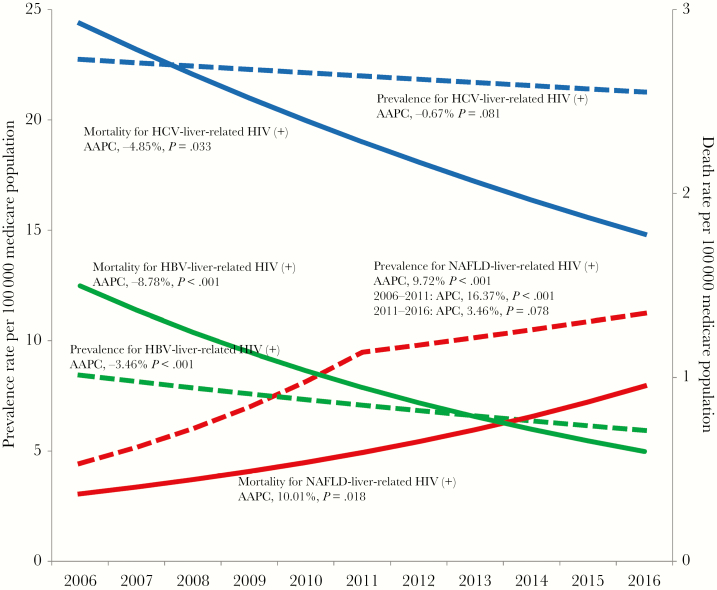
Results: Among 28 675 887 Medicare beneficiaries, 47 062 were HIV (+) (mean [SD] age, 51.4 [11.3] years); 11 920 had liver diseases (6923 HCV, 2019 hepatitis B virus [HBV], 2472 presumed NAFLD, 278 alcoholic liver disease [ALD], and 1653 other LDs); 2882 HIV (+) patients died; 1260 had LDs. The prevalence and mortality for non-liver-related HIV (+) decreased (AAPC, -1.1% and -9.1%). Liver-related HIV (+) increased (AAPC, 1.7%; P = .007); mortality leveled off. Prevalence and mortality worsened for presumed NAFLD (AAPC, 9.7% and 10.0%) and improved for HBV and HCV (HBV: AAPC, -3.5% and -8.8%; HCV: AAPC, -0.7% and -4.9%). After adjustments, HCV (odds ratio [OR], 2.00; 95% confidence interval [CI], 1.24-172), HBV (OR, 2.40; 95% CI, 2.09-2.77), ALD (OR, 5.70; 95% CI, 4.34-7.48), and presumed NAFLD (OR, 1.46; 95% CI, 1.24-1.72) increased 1-year mortality.
Conclusions: Among HIV (+) subjects, viral hepatitis remains the leading LD for increased 1-year mortality, but the prevalence and mortality with presumed NAFLD are increasing.
Keywords: HBV; HCV; liver disease; mortality; trends.
© The Author(s) 2020. Published by Oxford University Press on behalf of Infectious Diseases Society of America. All rights reserved. For permissions, please e-mail: journals.permissions@oup.com.
Figures


References
-
- Centers for Disease Control and Prevention. HIV at a glance. 2018. Available at: https://www.cdc.gov/hiv/statistics/overview/ataglance.html. Accessed 1 October 2019.
-
- Centers for Disease Control and Prevention. Monitoring selected national HIV prevention and care objectives by using HIV surveillance data—United States and 6 dependent areas—2013. HIV Surveillance Supplemental Report 2015; 20(No. 2). 2015. Available at: http://www.cdc.gov/hiv/library/reports/surveillance. Accessed 1 October 2019.
-
- Centers for Disease Control and Prevention. HIV prevention in the United States. New opportunities. New expectations. Available at: https://www.cdc.gov/hiv/pdf/policies/cdc-hiv-prevention-bluebook.pdf. Accessed 10 January 2019.
-
- Kang W, Tong H-I, Sun Y, et al. Hepatitis C virus infection in patients with HIV-1: epidemiology, natural history and management. Expert Rev Gastroenterol Hepatol 2014; 8:247–66. - PubMed
LinkOut - more resources
Full Text Sources
Research Materials
