. 2019 Sep 19;5(1):66-80.
doi: 10.1016/j.ekir.2019.09.009. eCollection 2020 Jan.

Predicting and Defining Steroid Resistance in Pediatric Nephrotic Syndrome Using Plasma Proteomics

Collaborators, Affiliations

Predicting and Defining Steroid Resistance in Pediatric Nephrotic Syndrome Using Plasma Proteomics

Shipra Agrawal et al. Kidney Int Rep. .

Abstract

Introduction: Nephrotic syndrome (NS) is a characterized by massive proteinuria, edema, hypoalbuminemia, and dyslipidemia. Glucocorticoids (GCs), the primary therapy for >60 years, are ineffective in approximately 50% of adults and approximately 20% of children. Unfortunately, there are no validated biomarkers able to predict steroid-resistant NS (SRNS) or to define the pathways regulating SRNS.

Methods: We performed proteomic analyses on paired pediatric NS patient plasma samples obtained both at disease presentation before glucocorticoid initiation and after approximately 7 weeks of GC therapy to identify candidate biomarkers able to either predict steroid resistance before treatment or define critical molecular pathways/targets regulating steroid resistance.

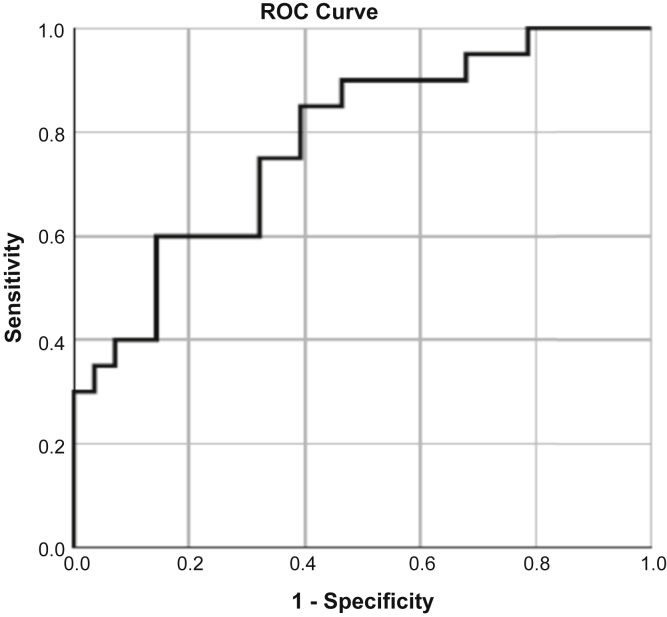
Results: Proteomic analyses of 15 paired NS patient samples identified 215 prevalent proteins, including 13 candidate biomarkers that predicted SRNS before GC treatment, and 66 candidate biomarkers that mechanistically differentiated steroid-sensitive NS (SSNS) from SRNS. Ingenuity Pathway Analyses and protein networking pathways approaches further identified proteins and pathways associated with SRNS. Validation using 37 NS patient samples (24 SSNS/13 SRNS) confirmed vitamin D binding protein (VDB) and APOL1 as strong predictive candidate biomarkers for SRNS, and VDB, hemopexin (HPX), adiponectin (ADIPOQ), sex hormone-binding globulin (SHBG), and APOL1 as strong candidate biomarkers to mechanistically distinguish SRNS from SSNS. Logistic regression analysis identified a candidate biomarker panel (VDB, ADIPOQ, and matrix metalloproteinase 2 [MMP-2]) with significant ability to predict SRNS at disease presentation (P = 0.003; area under the receiver operating characteristic curve = 0.78).

Conclusion: Plasma proteomic analyses and immunoblotting of serial samples in childhood NS identified a candidate biomarker panel able to predict SRNS at disease presentation, as well as candidate molecular targets/pathways associated with clinical steroid resistance.

Keywords: biomarkers; nephrotic syndrome; proteomics; steroid resistance.


Figures

Figure 1
Figure 1
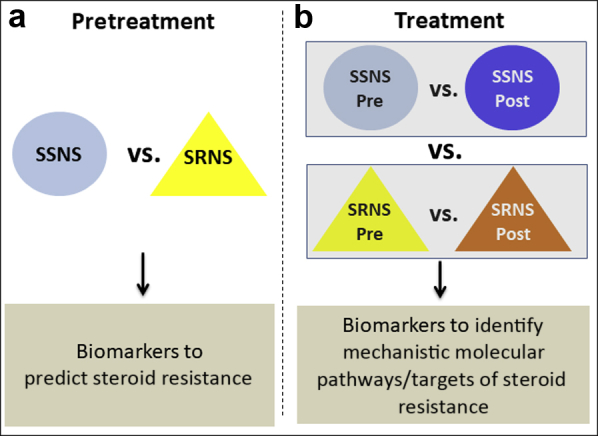
Study hypothesis and design. The present studies were designed to test the hypothesis that proteomic analyses with subsequent validation in paired plasma samples from children with steroid-sensitive nephrotic syndrome (SSNS) and steroid-resistant nephrotic syndrome (SRNS) can be used to identify biomarkers able to (a) predict clinical steroid resistance, and (b) mechanistically define specific molecular pathways or targets associated with clinical steroid resistance.
Figure 2
Figure 2
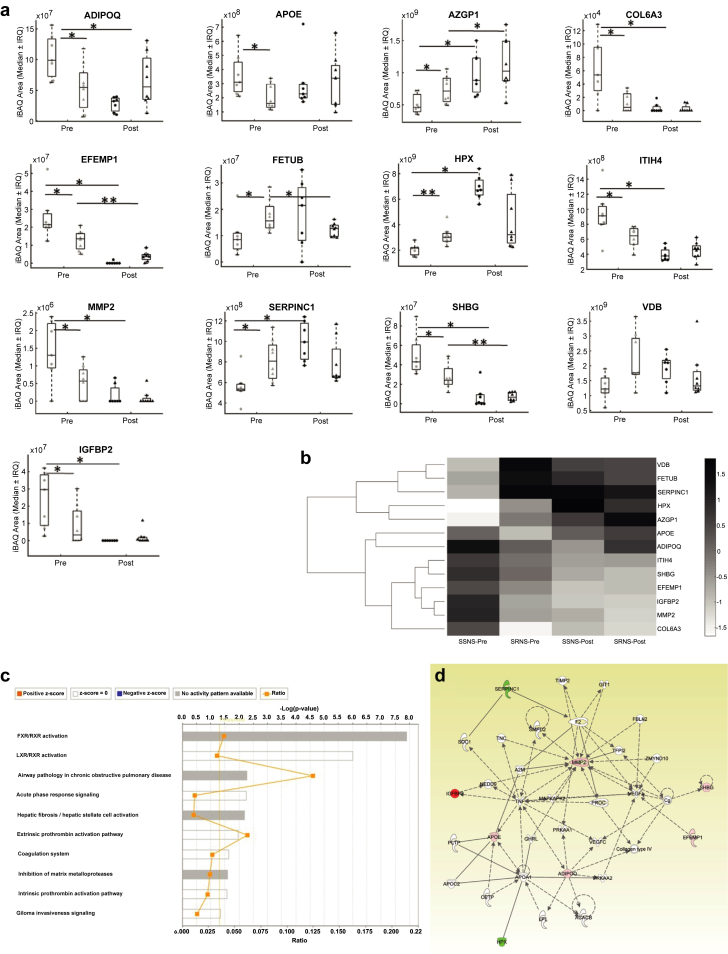
Candidate biomarkers able to predict steroid resistance and their informatics analysis to examine emergent properties. (a) Median intensity-based absolute quantification (iBAQ) areas (middle hash), interquartile range (IQR); boxed area and whisker for maximum and minimum values for candidate biomarkers able to predict steroid resistance were plotted for pre- and post-treatment samples for children with steroid-sensitive nephrotic syndrome (SSNS) and steroid-resistant nephrotic syndrome (SRNS) (SSNS Pre, light circle; SSNS Post, dark circle; SRNS Pre, light triangle; SRNS Post, dark triangle). All the pretreatment samples were significantly different between the SSNS versus SRNS groups (Table 2). Post-treatment time point comparator is added for illustration purposes (Table 3). *P < 0.05; **P < 0.01. (b) Candidate proteins (n = 13) significantly differentiating pre-steroid exposure patient samples were analyzed by hierarchical clustering. Protein abundance (iBAQ scores) were normalized and scaled by the clustergram function in MatLab (MathWorks, Natick, MA). Values are expressed as a fractional value around the median. Gene names and fold-changes (SSNS to SRNS) for significantly regulated pretreatment plasma proteins were submitted for (c) canonical molecular pathways analysis and (d) network analysis by Ingenuity Pathways Analysis (IPA) to consider implications of abundance difference trends within the proteomic dataset. (c) The top 10 canonical molecular pathways illustrated show significant enrichment, including 2 highly enriched pathways (Farnesoid X receptor FXR/retinoid X receptor [RXR] activation and liver X receptor [LXR]/RXR activation). Ratio data demonstrate the fraction of the submitted gene names to the gene names contained within the canonical pathways. (d) The top canonical network included 2 downregulated (SSNS < SRNS) and 6 upregulated (SSNS > SRNS) proteins, of which 3 upregulated proteins (matrix metalloproteinase 2 [MMP-2], APOE, and adiponectin [ADIPOQ]) occupied network node space. Tumor necrosis factor (TNF) is a central node within this network and inference based on its known regulation of ADIPOQ, APOE, IFGBP2, and MMP-2 expression (Activation Z-score 0.152; overlap P < 0.0001). ADIPOQ, adiponectin; HPX, hemopexin; SHBG, sex hormone–binding globulin; VDB, vitamin D binding protein. (c,d) Copyright © 2000–2017 Qiagen. The authors acknowledge that the networks and functional analyses were generated through the use of IPA (https://www.qiagenbioinformatics.com/products/ingenuity-pathway-analysis/).
Figure 3
Figure 3
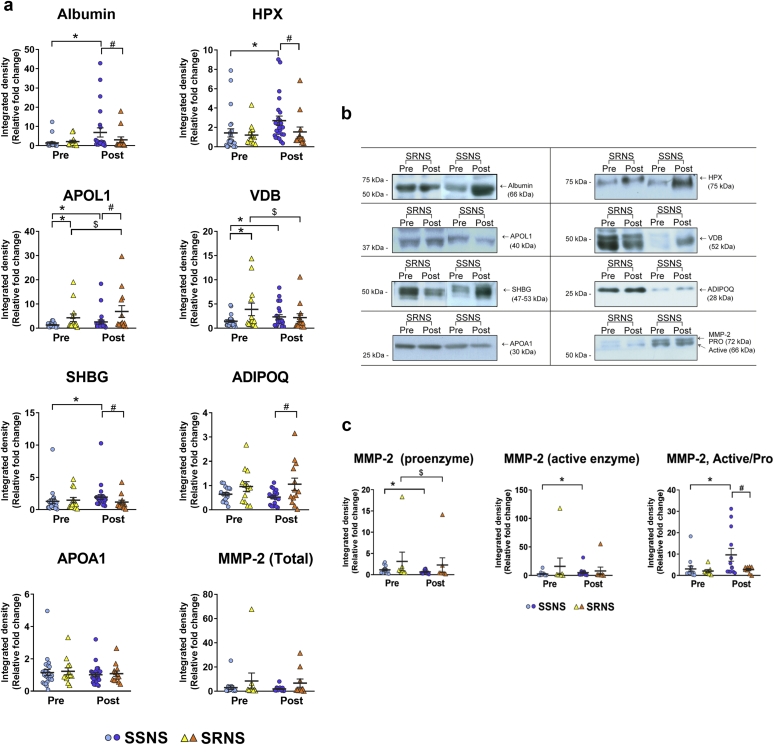
Biomarker validation studies of selected candidate biomarkers to predict or define steroid resistance in childhood nephrotic syndrome. (a) Validation graphs and (b) representative blots are shown from the analyses of 37 patients (n = 74 samples) comprising 24 steroid-sensitive nephrotic syndrome (SSNS) and 13 steroid-resistant nephrotic syndrome (SRNS) patients by immunoblotting with specified antibodies for the validation of selected predictive and defining biomarkers outlined in Tables 2 and 3. A control sample was run on every gel, and test patient samples were normalized to control by densitometry. (c) Western blot semiquantitative comparisons of the candidate biomarker matrix metalloproteinase 2 (MMP-2). MMP-2 immunoblotting of 54 patient samples (16 SSNS and 10 SRNS patients) showed 2 bands, representing the active (lower band, 64 kDa) and proenzyme (upper band, 72 kDa) forms of the enzyme. These were individually semiquantitated by densitometry and the active versus proenzyme ratios measured. Statistical significance was determined by unpaired or paired t tests using the GraphPad Prism software version 6.00 (LaJolla, CA) for Windows. P values were considered significant at P < 0.05 (*P < 0.05 vs. SSNS pretreatment; #P < 0.05 vs. SSNS post-treatment; $P < 0.05 vs. SRNS pretreatment). ADIPOQ, adiponectin; HPX, hemopexin; SHBG, sex hormone–binding globulin; VDB, vitamin D binding protein.
Figure 4
Figure 4
Receiver operating characteristic (ROC) curve. Logistic regression analysis of confirmatory immunoblot studies identified vitamin D binding protein (VDB), adiponectin (ADIPOQ), and matrix metalloproteinase 2 (MMP-2) as a minimal, significant set of plasma proteins predicting steroid response. An ROC analysis for these 3 proteins to classify steroid response in patients with NS (n = 37 paired samples) returned an area under the curve of 0.78.

Comment in

References

    1. Nourbakhsh N., Mak R.H. Steroid-resistant nephrotic syndrome:past and current perspectives. Pediatr Health Med Ther. 2017;8:29–37. - PMC - PubMed
    1. Canetta P.A., Radhakrishnan J. The evidence-based approach to adult-onset idiopathic nephrotic syndrome. Front Pediatr. 2015;3:78. - PMC - PubMed
    1. Beck L.H., Jr., Bonegio R.G., Lambeau G. M-type phospholipase A2 receptor as target antigen in idiopathic membranous nephropathy. N Engl J Med. 2009;361:11–21. - PMC - PubMed
    1. Tomas N.M., Beck L.H., Jr., Meyer-Schwesinger C. Thrombospondin type-1 domain-containing 7A in idiopathic membranous nephropathy. N Engl J Med. 2014;371:2277–2287. - PMC - PubMed
    1. Wheelock K.M., Cai J., Looker H.C. Plasma bradykinin and early diabetic nephropathy lesions in type 1 diabetes mellitus. PLoS One. 2017;12 - PMC - PubMed