


doi: 10.1016/j.ekir.2019.09.004.
eCollection 2020 Jan.
Collagen IV Gene Mutations in Adults With Bilateral Renal Cysts and CKD
Affiliations
- PMID: 31922066
- PMCID: PMC6943786
- DOI: 10.1016/j.ekir.2019.09.004
Item in Clipboard
Collagen IV Gene Mutations in Adults With Bilateral Renal Cysts and CKD
Kidney Int Rep.
.
No abstract available
Figures
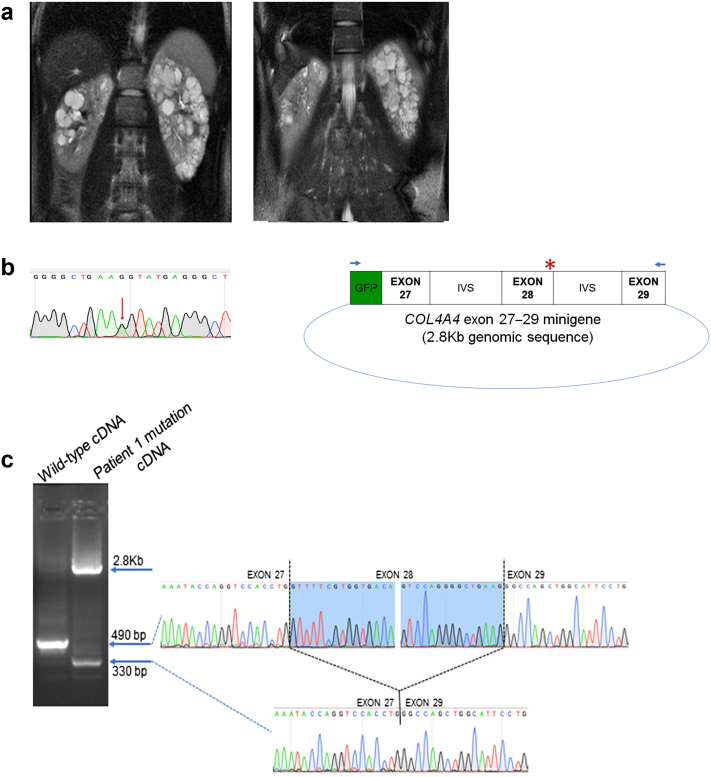
(a) Magnetic resonance image of the abdomen from patient 1 showing both kidneys with several small to moderate cysts. Imaging at enrollment into the CRISP study (left image) and at 4-year follow-up into the CRISP study (right image) is shown. (b) (Left) Sanger sequence tracing showing the heterozygous substitution variant (red arrow) COL4A4: exon28: c. G2383A in patient 1. (Right) Minigene plasmid containing green fluroescent protein (GFP) contiguous with the 2.8-Kb COL4A4 genomic sequence that includes exons 27–29 and the intervening intronic sequences (IVSs). The red asterisk denotes the position of the COL4A4 variant in patient 1. Blue arrows indicate the primer locations used for reverse-transcription polymerase chain reaction that selectively amplify the minigene sequence and avoid amplification of the native COL4A4 transcript. (c) (Left) Reverse-transcription polymerase chain reaction products from the wild-type splice form (490-base pair [bp]) and from the mutation (2.8-Kb unspliced product and 330-bp product resulting from complete skipping of exon 28). (Right) Sanger sequencing of the wild-type and 330-bp mutated cDNA showing that exon 27 is spliced directly to exon 29 as result of the mutation.
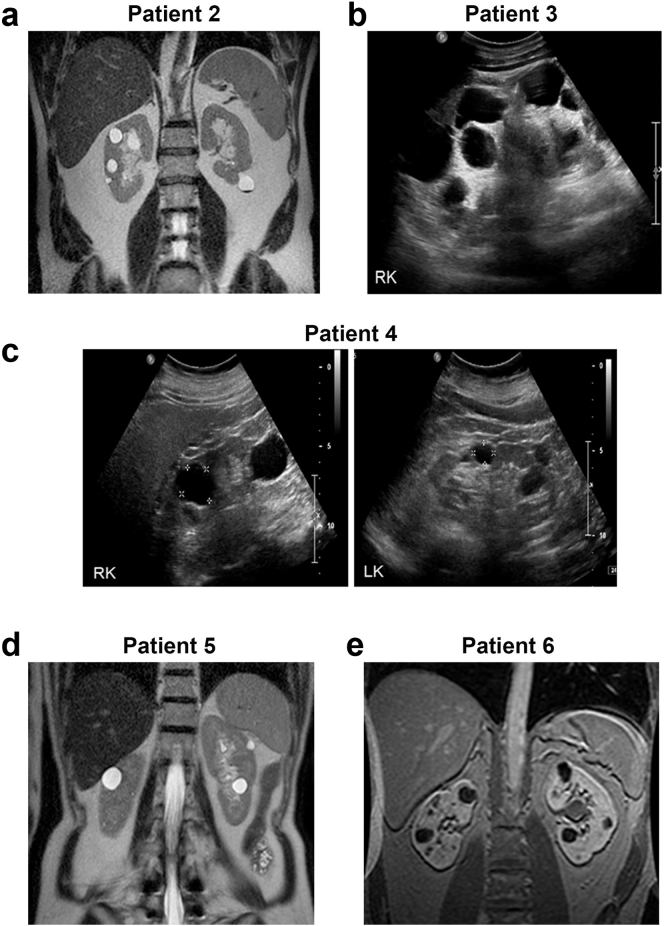
Kidney imaging (magnetic resonance [MR] imaging/ultrasound) for patients 2 to 6 with bilateral kidney cysts and type IV collagen gene variants. Images are labeled by patient number as in Table 1. (a) Patient 2: MR imaging showing both of the kidneys with few bilateral well-formed cysts. (b) Patient 3: ultrasound imaging of the right kidney (RK) showing multiple cysts. Left cystic kidney not shown. (c) Patient 4: ultrasound imaging of the RK and left kidney (LK) showing multiple cysts. (d) Patient 5: MR imaging showing both of the kidneys with few bilateral well-formed cysts. (e) Patient 6: MR imaging showing both of the kidneys with bilateral well-formed cysts.
References
-
- Plaisier E., Gribouval O., Alamowitch S. COL4A1 mutations and hereditary angiopathy, nephropathy, aneurysms, and muscle cramps. N Engl J Med. 2007;357:2687–2695. - PubMed
-
- Pierides A., Voskarides K., Athanasiou Y. Clinico-pathological correlations in 127 patients in 11 large pedigrees, segregating one of three heterozygous mutations in the COL4A3/ COL4A4 genes associated with familial haematuria and significant late progression to proteinuria and chronic kidney disease from focal segmental glomerulosclerosis. Nephrol Dial Transplant. 2009;24:2721–2729. - PubMed
Grants and funding
LinkOut - more resources
Full Text Sources
