


Indicators Associated With Job Morale Among Physicians and Dentists in Low-Income and Middle-Income Countries: A Systematic Review and Meta-analysis
- PMID: 31922555
- PMCID: PMC6991249
- DOI: 10.1001/jamanetworkopen.2019.13202
Indicators Associated With Job Morale Among Physicians and Dentists in Low-Income and Middle-Income Countries: A Systematic Review and Meta-analysis
Abstract
Importance: Improving health care in low- and middle-income countries (LMICs) requires a workforce with positive job morale. However, the level of job morale in this population remains unclear.
Objective: To analyze studies measuring the job morale of physicians and dentists working in LMICs, using levels of job burnout, job satisfaction, and job motivation as indicators of job morale.
Data sources: A comprehensive search of Scopus, PubMed, PsycINFO, EMBASE, Web of Science, and the Cochrane Library, from database inception to October 30, 2018, and gray literature was performed.
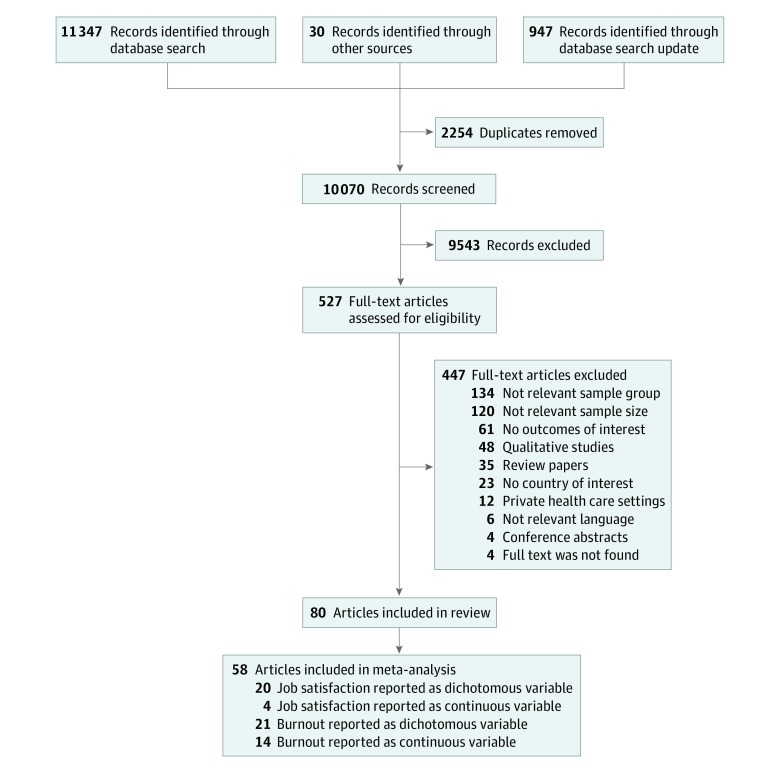
Study selection: Studies were eligible if at least 50% of the sample were qualified physicians and/or dentists working in public health care settings in LMICs. Three indicators of job morale in this population were used: job burnout, job satisfaction, and job motivation. Of 12 324 records reviewed, 79 studies were included in the systematic review and 59 were eligible for the meta-analysis.
Data extraction and synthesis: Data were extracted independently by several investigators in accordance with the Meta-analyses of Observational Studies in Epidemiology (MOOSE) reporting guidelines. Random-effects meta-analyses, planned subgroup analyses, and metaregression were performed. The Quality Assessment Tool for Observational Cohort and Cross-Sectional Studies was used to assess bias.
Main outcomes and measures: Levels of job burnout, job satisfaction, and job motivation as indicators of job morale.
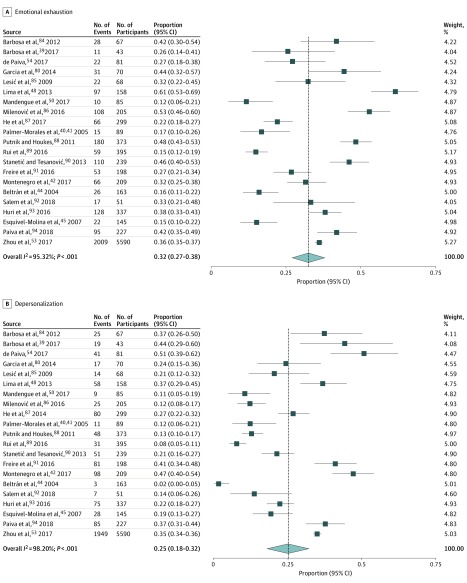
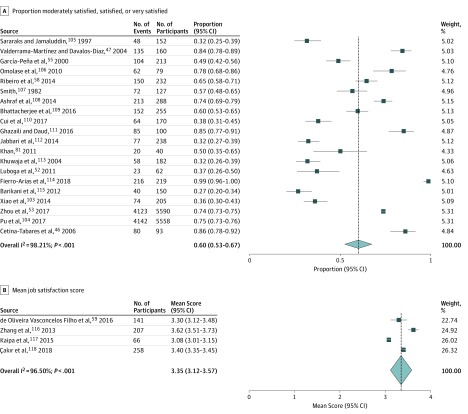
Results: Overall, 12 324 records were identified. Of them, 80 records, representing 79 studies and involving 45 714 participants across 37 LMICs, met the inclusion criteria for the review; however, only 3 were from low-income countries. In 21 studies with 9092 participants working mainly in middle-income countries, 32% (95% CI, 27%-38%; I2 = 95.32%; P < .001) reported job burnout, and in 20 studies with 14 113 participants, 60% (95% CI, 53%-67%; I2 = 98.21%; P < .001) were satisfied with their job overall. Sufficient data were not available for a meta-analysis of job motivation.
Conclusions and relevance: The findings suggest that, among physicians and dentists working mainly in middle-income countries, more than half reported having positive job morale. Positive job morale among physicians and dentists may help with recruitment and retention and thus support programs for improving health care in LMICs.
Conflict of interest statement
Figures
Comment in
-
Limitations of Meta-analyses of Studies With High Heterogeneity.JAMA Netw Open. 2020 Jan 3;3(1):e1919325. doi: 10.1001/jamanetworkopen.2019.19325. JAMA Netw Open. 2020. PMID: 31922554 No abstract available.
References
-
- Guba EG. Morale and satisfaction: a study in past-future time perspective. Adm Sci Q. 1958;3(2):195-209. doi: 10.2307/2391017 - DOI
-
- Motowidlo SJ, Borman WC. Relationships between military morale, motivation, satisfaction, and unit effectiveness. J Appl Psychol. 1978;63(1):47-52. doi: 10.1037/0021-9010.63.1.47 - DOI
-
- Stewart JH, Spence R. A new look at factors related to college faculty morale. Educ Res Q. 1997;20(3):29-40.
Publication types
MeSH terms
LinkOut - more resources
Full Text Sources
Miscellaneous
