Trends in the Adoption of Robotic Surgery for Common Surgical Procedures
- PMID: 31922557
- PMCID: PMC6991252
- DOI: 10.1001/jamanetworkopen.2019.18911
Trends in the Adoption of Robotic Surgery for Common Surgical Procedures
Abstract
Importance: Increasing use of robotic surgery for common surgical procedures with limited evidence and unclear clinical benefit is raising concern. Analyses of population-based trends in practice and how hospitals' acquisition of robotic surgical technologies is associated with their use are limited.
Objective: To characterize trends in the use of robotic surgery for common surgical procedures.
Design, setting, and participants: This cohort study used clinical registry data from Michigan from January 1, 2012, through June 30, 2018. Trends were characterized in the use of robotic surgery for common procedures for which traditional laparoscopic minimally invasive surgery was already considered a safe and effective approach for most surgeons when clinically feasible. A multigroup interrupted time series analysis was performed to determine how procedural approaches (open, laparoscopic, and robotic) change after hospitals launch a robotic surgery program. Data were analyzed from March 1 through April 19, 2019.
Exposures: Initiation of robotic surgery.
Main outcomes and measures: Procedure approach (ie, robotic, open, or laparoscopic).
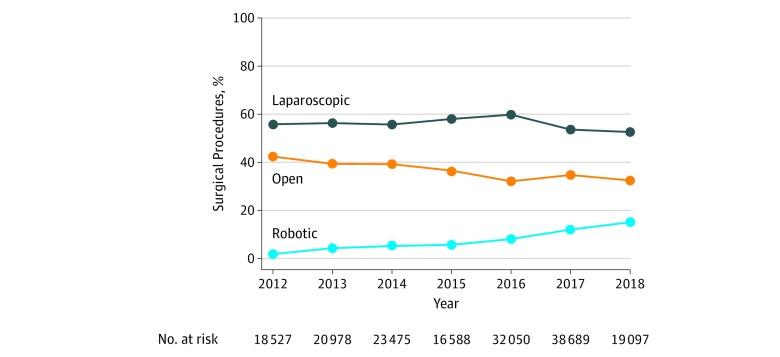
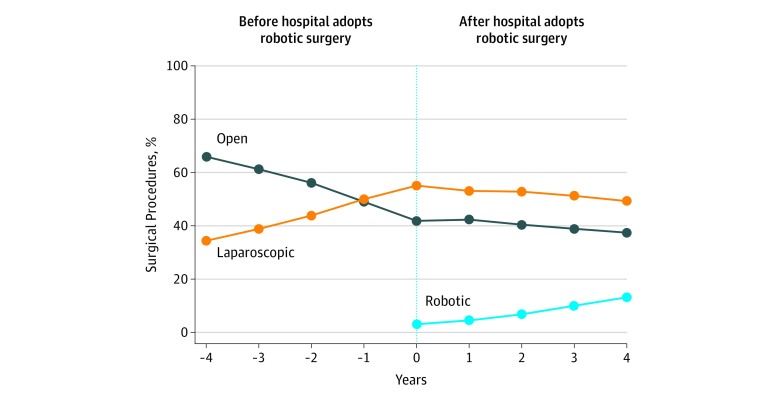
Results: The study cohort included 169 404 patients (mean [SD] age, 55.4 [16.9] years; 90 595 women [53.5%]) at 73 hospitals. The use of robotic surgery increased from 1.8% in 2012 to 15.1% in 2018 (8.4-fold increase; slope, 2.1% per year; 95% CI, 1.9%-2.3%). For certain procedures, the magnitude of the increase was greater; for example, for inguinal hernia repair, the use of robotic surgery increased from 0.7% to 28.8% (41.1-fold change; slope, 5.4% per year; 95% CI, 5.1%-5.7%). The use of robotic surgery increased 8.8% in the first 4 years after hospitals began performing robotic surgery (2.8% per year; 95% CI, 2.7%-2.9%). This trend was associated with a decrease in laparoscopic surgery from 53.2% to 51.3% (difference, -1.9%; 95% CI, -2.2% to -1.6%). Before adopting robotic surgery, hospitals' use of laparoscopic surgery increased 1.3% per year. After adopting robotic surgery, the use of laparoscopic surgery declined 0.3% (difference in trends, -1.6%; 95% CI, -1.7% to -1.5%).
Conclusions and relevance: These results suggest that robotic surgery has continued to diffuse across a broad range of common surgical procedures. Hospitals that launched robotic surgery programs had a broad and immediate increase in the use of robotic surgery, which was associated with a decrease in traditional laparoscopic minimally invasive surgery.
Conflict of interest statement
Figures
References
-
- US Food and Drug Administration. Caution when using robotically-assisted surgical devices in women's health including mastectomy and other cancer-related surgeries: FDA safety communication [press release]. https://www.fda.gov/medical-devices/safety-communications/caution-when-u.... Published February 28, 2019. Accessed April 25, 2019.
Publication types
MeSH terms
Grants and funding
LinkOut - more resources
Full Text Sources
Miscellaneous