


Economics and mental health: the current scenario
- PMID: 31922693
- PMCID: PMC6953559
- DOI: 10.1002/wps.20692
Economics and mental health: the current scenario
Abstract
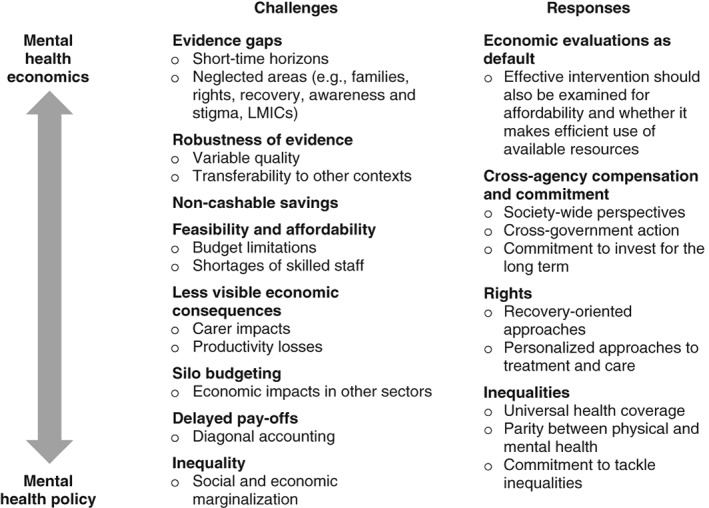
Economics and mental health are intertwined. Apart from the accumulating evidence of the huge economic impacts of mental ill-health, and the growing recognition of the effects that economic circumstances can exert on mental health, governments and other budget-holders are putting increasing emphasis on economic data to support their decisions. Here we consider how economic evaluation (including cost-effectiveness analysis, cost-utility analysis and related techniques) can contribute evidence to inform the development of mental health policy strategies, and to identify some consequences at the treatment or care level that are of relevance to service providers and funding bodies. We provide an update and reflection on economic evidence relating to mental health using a lifespan perspective, analyzing costs and outcomes to shed light on a range of pressing issues. The past 30 years have witnessed a rapid growth in mental health economics, but major knowledge gaps remain. Across the lifespan, clearer evidence exists in the areas of perinatal depression identification-plus-treatment; risk-reduction of mental health problems in childhood and adolescence; scaling up treatment, particularly psychotherapy, for depression; community-based early intervention and employment support for psychosis; and cognitive stimulation and multicomponent carer interventions for dementia. From this discussion, we pull out the main challenges that are faced when trying to take evidence from research and translating it into policy or practice recommendations, and from there to actual implementation in terms of better treatment and care.
Keywords: Economic evaluation; cost-benefit; cost-effectiveness; cost-utility; dementia; depression; mental health policy; psychosis; return on investment.
© 2020 World Psychiatric Association.
Figures
References
-
- Knapp M. Economic evaluation and mental health: sparse past… fertile future? J Ment Health Policy Econ 1999;2:163‐7. - PubMed
-
- Drummond MF, Sculpher MJ, Claxton K et al. Methods for the economic evaluation of health care programmes, 4th ed Oxford: Oxford Medical Publications, 2015.
-
- Knapp M, Iemmi V. Mental health In: Scheffler RM. (ed). World scientific handbook of global health economics and public policy, Vol. 2 Singapore: World Scientific, 2016:1‐41.
-
- Bloom DE, Cafiero ET, Jané‐Llopis E et al. The global economic burden of noncommunicable diseases. Geneva: World Economic Forum, 2011.
LinkOut - more resources
Full Text Sources
Medical
Miscellaneous
